When I first saw Visicalc—the first digital spreadsheet— on an Apple II, the first PC at Morgan Stanley, it didn’t look like the start of a revolution. It looked like a faster way to do the math we were already doing by hand. But within a few years, that simple program had reshaped finance and accounting. The spreadsheet didn’t replace people—it amplified them. It erased bottlenecks between ideas and action.
That memory is hard to shake as I listen to the latest wave of predictions about AI replacing white-collar jobs. The tone feels familiar—urgent, confident, and a little apocalyptic, a little bit like this clip says from the podcast Moonshots from last week. “So bottom line here is that this effort by OpenAI could eliminate between a quarter and half of the junior headcount across Wall Street within two years.” —Moonshots Podcast, October 27, 2025
For two centuries, every major technology has triggered the same alarm: this will destroy jobs. The loom, the tractor, the assembly line, the spreadsheet, the internet—all of them replaced tasks once done by people. Yet in every case, employment recovered, living standards rose, and few today question whether those advances should have been stopped.
But this time, it may really be different.
Until now, technology has mostly amplified human ability—it’s helped us think faster, move heavier loads, or communicate farther. But AI reaches into something new: it can replace decision-making and even physical motion. Think about professional drivers. There are over 5.6 million of them in the United States alone, moving the physical economy every day. If autonomous systems eventually remove the need for those drivers, that’s not just a white-collar disruption—it’s a redefinition of work itself.
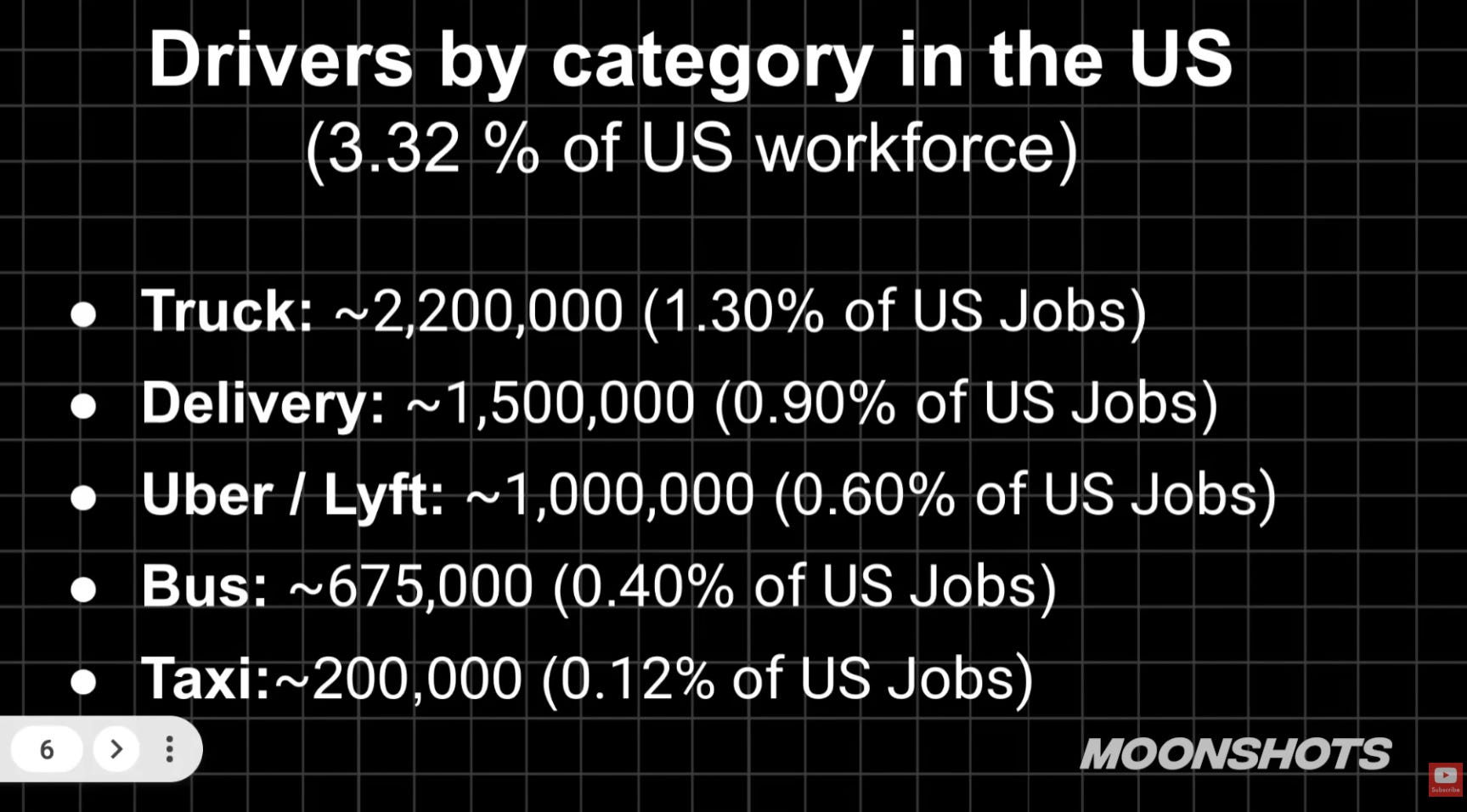
When we lost telephone operators a century ago, about two hundred thousand jobs vanished, but new industries absorbed the shock. Replacing millions of drivers would be a test of whether AI is simply another wave of progress—or something more fundamental.
Simply assuming “it always works out” isn’t analysis—it’s nostalgia. The right question isn’t whether AI will replace some jobs (it will), but what characteristics AI—or any technology—would need to have to cause a lasting decline in both employment by organizations and living standards for a large share of society.
If those conditions aren’t met, history probably rhymes again. If they are, we’ve identified the mechanisms that could finally make technological unemployment real.
Measuring employment
Employment here means being on someone’s payroll: receiving a wage or salary from a structured organization that coordinates people and capital.
An organization is any persistent structure—company, agency, school, hospital, nonprofit—whose purpose is to achieve outcomes more efficiently than individuals acting alone by using hierarchy, specialization, and shared capital.
That distinction matters because a world with fewer payroll jobs isn’t automatically a world with less work or meaning. What truly matters is whether ordinary families can sustain—and hopefully improve—their quality of life.
When technology waves go wrong
Historically, the damage from new technology comes from speed and mismatch, not permanence. Two forces drive the pain:
Coordination shock—automation happens faster than people and institutions can adapt.
Bottleneck relocation—the new system creates a choke point (skills, capital, trust) that limits who benefits.
Those are temporary. To get persistent declines in employment and living standards, a technology has to do more: it must outcompete organizations at coordinating human effort and make human contribution less complementary to capital over time.
The six characteristics AI would need to shrink both employment and prosperity
1. End-to-end autonomy
Past automation handled isolated tasks. AI would have to perform entire functions—strategy, design, execution, iteration—without human supervision. When a model can be “hired” as a department rather than a tool, organizations start replacing payroll with compute.
2. Cross-domain generalization
Automation becomes truly job-displacing when systems can move fluidly across contexts—operations today, marketing tomorrow, compliance next week. That’s what makes humans valuable; if AI matches it, the salaried generalist disappears.
3. Institutional trust and liability
Organizations exist partly to absorb risk and coordinate trust. For AI to displace them, its outputs must be auditable, insurable, and legally recognized. When regulators, accountants, and insurers accept AI-only workflows, entire human layers vanish.
4. Social and persuasive competence
The last moat for people has been empathy and persuasion: teaching, managing, selling, caring. If AI becomes “good enough” at social nuance and motivation, organizations can automate much of the headcount tied to the human preference for human contact.
5. Near-zero coordination costs
Economist Ronald Coase1 taught us in 1937 that firms exist because hiring/coordination costs are high. If AI drives those costs near zero—auto-forming, contracting, and dissolving micro-teams on demand—then long-lived hierarchies shrink, replaced by fluid, capital-plus-AI networks. Payrolls fall even if output rises.
AI agents that find each other, negotiate, and execute contracts instantly could make formal organizations seem slow and expensive.
But communication between AIs is not progress unless it transmits meaning between humans. Value arises when understanding moves through people—when someone learns, decides, builds, or enjoys. Without that loop, it’s just computation. For example, picture two AIs flawlessly negotiating a contract no person requested. The system hums, but nothing changes for humanity. Coordination has replaced comprehension; efficiency has replaced intent.
6. Capital capture without benefiting humans broadly
Employment and prosperity decline only if the productivity gains accrue mainly to model owners, data owners, and compute owners—while adding people no longer raises value. That’s when labor’s share of income falls alongside payrolls.
Early warning indicators
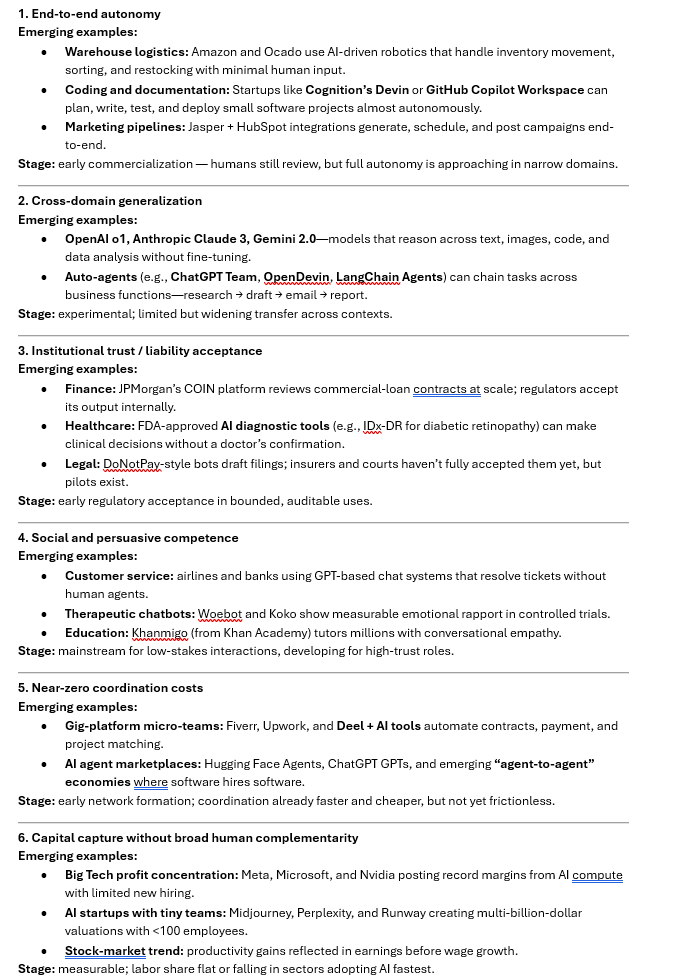
How would we know this is happening? Well, there are examples in today’s economy for every one of these 6 characteristics.2 But for them to matter at scale, we need to watch for:
Departments replaced wholesale by AI agents, not “AI copilots per person.”
Sales or service parity where customers prefer AI interfaces for complex, emotional tasks.
Flattened org charts as middle management evaporates.
Falling labor share of GDP alongside stagnant median consumption.
Regulatory acceptance of AI-only processes in finance, healthcare, and law.
Collapsing training pipelines because entry-level ladders disappear.
Exploding “agent spend” as firms pay for software labor rather than human labor.
These indicators form a framework for assessing whether AI is beginning to erode employment.
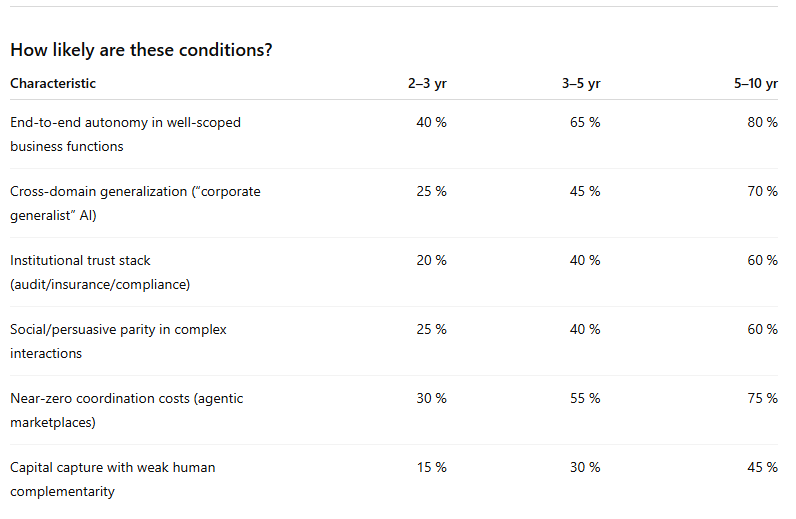
Over the coming years, these probability estimates suggest that AI is likely to shrink organizational headcount—especially in middle layers—but a broad decline in living standards is not inevitable. Prosperity erodes only if ownership and opportunity fail to broaden as efficiency rises.
Are we measuring the right thing?
The public still treats “employment” as the headline indicator of economic health, especially in terms of AI progress. That made sense when the firm was the only efficient way to coordinate production. If AI collapses coordination costs, employment by organizations may fall even as work, output, and opportunity rise.
“The world is emerging into an economy of entrepreneurs—and that future is much better.” —Moonshots Podcast, 2025
Better measures of prosperity include:
Median consumption (quality-adjusted), not just wages.
Time wealth: discretionary hours, commute reduction, caregiving load.
Access: wait times for healthcare, education, and housing.
Autonomy: how easily one person can launch a project that reaches thousands.
Resilience: savings and safety nets that buffer income volatility.
If people can use AI to pursue interests that create value—teaching, designing, local manufacturing, analysis, art—and those pursuits translate into income and fulfillment, then a fall in “organizational employment” might mark not decline but liberation.
What society can do to tilt the odds toward prosperity
Broaden ownership of complements. Let more people access AI-driven profits through equity, royalties, and data-dividend models.
Create on-ramps, not credentials. Replace degree barriers with mastery-based certification so people can enter new AI supply chains quickly.
Measure what matters. Traditional measurements like employment and GDP should be evaluated for their meaningfulness- maybe track consumption, access, and time wealth to see real human outcomes.
The bottom line
Fear that “this time is different” is as old as progress itself. It’s usually wrong because human imagination keeps finding new complements to capital.
But if AI becomes end-to-end, cross-domain, institutionally trusted, socially competent, and nearly frictionless at coordination—while channeling most gains to capital owners—then yes, organizational employment could fall and living standards could stagnate.
Our task shouldn’t be to chant “it’ll be fine” or “we’re doomed.” It’s to watch the right indicators and make sure as many people as possible have a way to own and use the new leverage.
“I think that this is the best time to be an entrepreneur... Because AI is a force multiplier for every application you want to build, every business process you want to automate, every customer interaction you want to redefine.” - Satya Nadella, CEO of Microsoft
The real story of AI and jobs isn’t what disappears—it’s what expands when human imagination guides the systems it creates.
Thank you very much to our sponsors:
Truflation: Truflation: BUY Truflation products/services and save 10% using code BOBDEW10. Learn about what prices are actually doing by going to https://truflation.com/marketplace/us-inflation-rate
Foundation: Protect your Bitcoin using the latest off-line technology with easy-to-use Passport. Their next product, Passport Prime will protect all passwords off-line with even-better technology. https://foundation.xyz/
River Financial: If not cold storage for your Bitcoin, I’d highly recommend River for buying and holding- River is engineered to protect your Bitcoin over the long run. Use this link for discounts: https://river.com/signup?r=T7GGAF7G
Economist Ronald Coase argued in The Nature of the Firm (1937), companies exist because markets are costly to use—finding partners, negotiating contracts, enforcing agreements. Those “transaction costs” explain why it’s often cheaper to coordinate work inside a firm than through the open market.
Here are the examples provided by Chat GPT of what exists in today’s economy in each of these six categories: