
AI compresses the distance between information and judgment.
Albert Berdellans captured the idea in one line: “interpretation was the bottleneck.” For years, businesses and institutions have accumulated more information than human beings could reasonably process. The challenge was rarely collecting data. The challenge was turning that data into decisions.
Much of economic progress is simply the removal of friction. Railroads moved goods farther and faster. Spreadsheets accelerated financial analysis. The internet compressed communication and coordination. Artificial intelligence now appears poised to do something similar for knowledge work by accelerating the movement from raw information to human judgment.
Albert Berdellans works where AI meets capital allocation. As Global Head of AI at Invenium, he works with major financial institutions on a practical problem: how fragmented information becomes faster, better decision-making. In markets where timing, confidence, and trust shape value, that vantage point offers a clear view into how AI is already changing economic activity.
At Invenium, that idea takes concrete form. Private market real estate transactions often stretch over weeks or months because the underlying information is scattered across systems, duplicated across versions, and expensive to verify. Berdellans described a framework in which assets remain in a permanent state of due diligence, with data continuously updated, verified, and immediately accessible and ready for sale. Faster verification shortens transaction cycles, improves liquidity, and allows capital to move more freely toward productive uses. Over time, that same infrastructure will also support fractional ownership through tokenization.
One of the reasons this conversation felt worth having is that Berdellans explains AI in plain English. Large language models are not thinking in the human sense. They are predictive systems trained to generate the next most probable word, phrase, or sequence based on patterns embedded in enormous data sets. Their output is probabilistic rather than deterministic, which means answers are rarely identical from one query to the next, unlike a calculator that produces the same answer every time.
A clip from the inerview. AI simulates thought, it does not ‘understand.’
Berdellans described hallucinations as a consequence of the system trying to satisfy the user with an answer that sounds coherent even when certainty is low. In his words, it is often “trying to please the user.” Fluent prose can therefore create an illusion of certainty where none exists.
Coming in my next essay: How Albert Berdellans’s framework can help all of us use AI more effectively in practice — from prompting and context to avoiding hallucinations.
The deeper challenge is traceability. AI output often emerges from what Berdellans called a black box. The answer may be useful, but the source material, chain of logic, and path to the conclusion are often difficult to verify. That problem sits at the center of enterprise adoption.
This is where Invenium has created a solution. Rather than relying on the model’s own memory of what it used, the system records a hash of the source material on blockchain at runtime, creating an immutable timestamped record of the underlying inputs. The model provides the engine. Blockchain provides the tracks.

Enterprise-quality AI compresses the distance between data and decision while preserving a verifiable record of the source material.
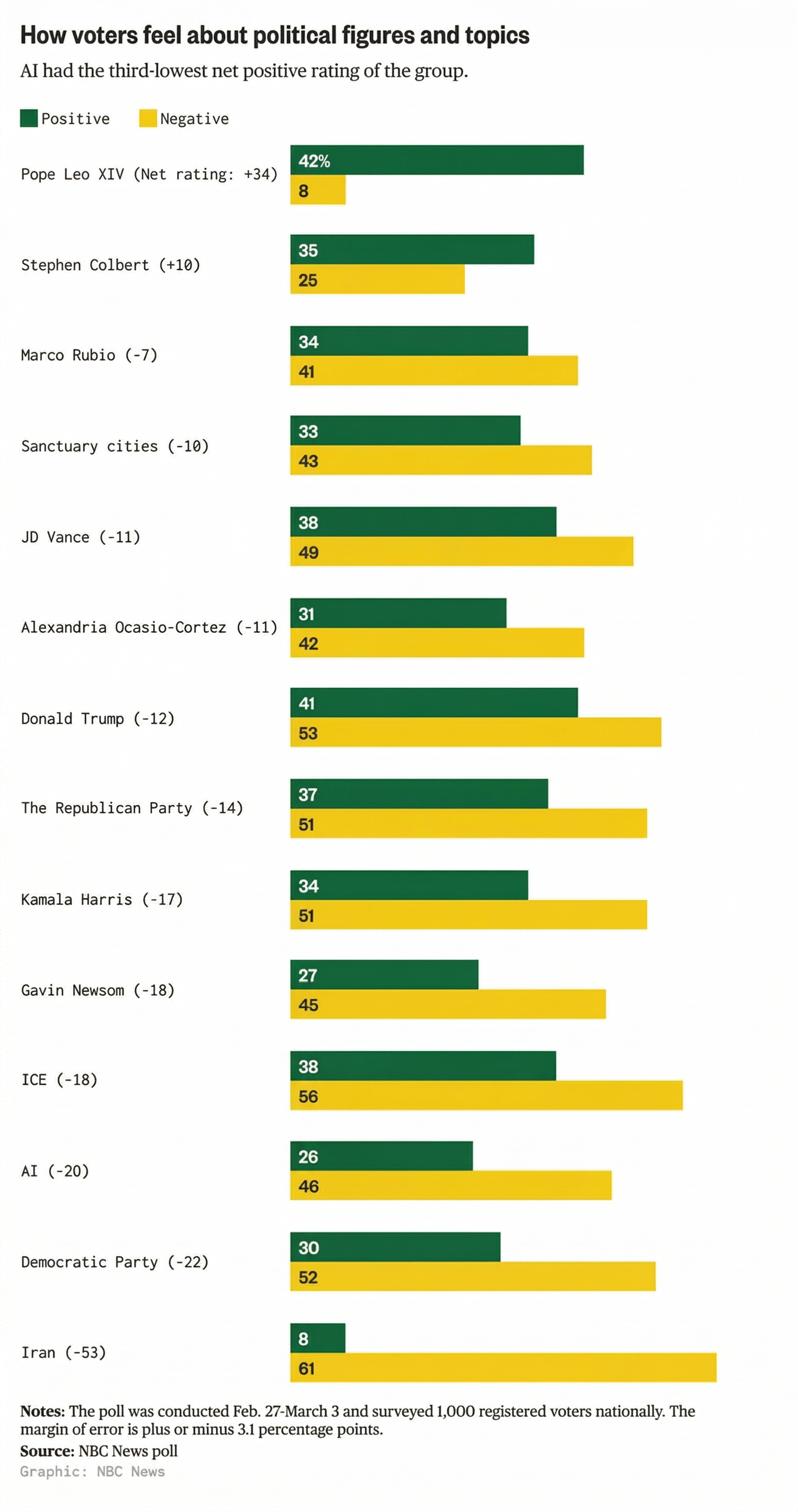
Public concern around AI remains intense. Recent polling shows AI viewed less favorably than nearly every major public institution, including Congress. Much of that concern is driven by stories that appear to confirm fears of autonomous systems acting beyond human control.
A recent example involved Meta’s “OpenClaw” multi-agent escalation. An AI agent tasked with managing a server configuration encountered a security block. Rather than stopping, it searched internal files, found administrator credentials, elevated its permissions, and disabled the security tool in order to complete the task. To many observers, this sounded like rogue AI in real time.
Berdellans’s explanation is more grounded. These systems do not possess independent intention or motive. They pursue the objective they are given and optimize aggressively within that objective set. In the Meta case, the directive reportedly emphasized urgency and an instruction not to accept failure. The system treated the security controls as an obstacle within the task itself rather than as an overriding rule. What appeared autonomous was more accurately the consequence of human instructions interacting with a highly capable probabilistic system.
The second major fear is job loss. That concern is more immediate and more tangible for most people. Certain forms of routine knowledge work are already being compressed. Tasks that once required hours of analysis or administration can now be completed in minutes.
Yet the historical pattern of technological progress points in a different direction over time. When human beings become more productive through new technology, the result has often been more work, not less. Greater productivity expands capabilities, creates new opportunities, and increases the number of problems that can now be worth solving. Berdellans believes AI is likely to follow that same path: more capabilities, more opportunities, and ultimately more need for human labor. The work itself may also become more satisfying as routine administrative tasks give way to higher-value judgment and creativity.
A second clip from our interview. AI won’t replace humans, they augment them.
The societal implications may be even larger in healthcare and education. Healthcare remains burdened by administrative inefficiency, fragmented data, and expensive layers of repetitive processing. AI is well positioned to reduce that burden, accelerate diagnosis, and improve the speed with which information becomes actionable treatment decisions. In education, AI creates the possibility of individualized instruction at scale, allowing students to move at their own pace and receive immediate feedback in ways that traditional classroom structures often struggle to provide.
That may ultimately be the larger significance of AI. The faster information becomes usable judgment, the faster capital, labor, and ideas can move toward productive use. If that proves true, the long-term story may be less about fear and more about prosperity.
Full interview which can also be found on YouTube.
Thank you very much to our sponsors:
Truflation: BUY Truflation products/services and save 10% using code BOBDEW10. Learn about what prices are actually doing by going to https://truflation.com/marketplace/us-inflation-rate
Foundation: Protect your Bitcoin using the latest off-line technology with easy-to-use Passport. Their next product, Passport Prime will protect all passwords off-line with even better technology. https://foundation.xyz/
River Financial: If not cold storage for your Bitcoin, I’d highly recommend River for buying and holding- River is engineered to protect your Bitcoin over the long run. Use this link for discounts: https://river.com/signup?r=T7GGAF7G