
When Intelligence Stops Being the Advantage
Artificial intelligence is no longer a laboratory curiosity. It is moving through the professional class with measurable speed. Lawyers, radiologists, accountants, analysts, roles once insulated by education and credential, are now exposed to automation at the level of cognition itself.
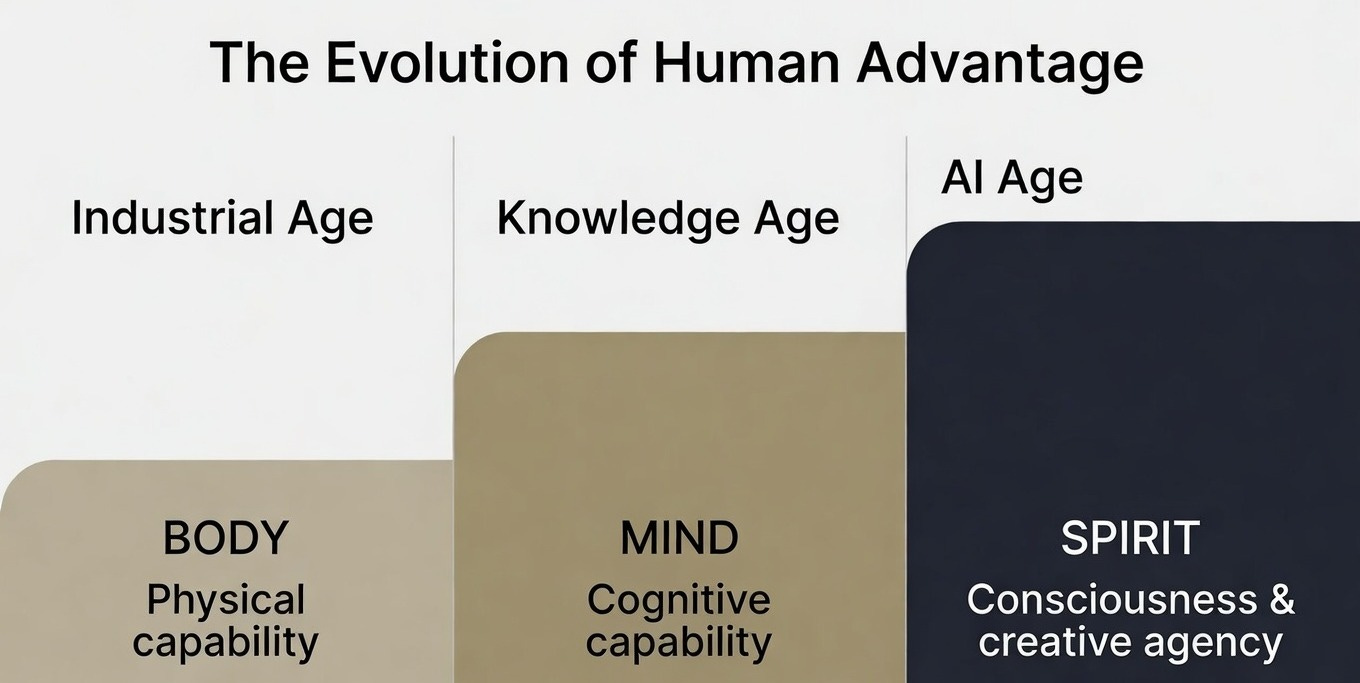
Previous technological revolutions replaced muscle. This one replaces cognition. The industrial age automated physical labor. The knowledge age rewarded those who could process information faster and better than their peers. AI erodes that advantage. If machines can outthink us and soon outproduce us, the question becomes unavoidable. What remains distinctly human?
Naeem Zamindar accepts the premise of acceleration. He does not dismiss the disruption. He leans into it.
The Frontier Beyond the Mind
His inversion is simple. For two centuries, prosperity strengthened the body and then the mind. The next frontier is neither. It is spirit.
He uses the word spirit to describe consciousness itself. Presence. A felt expansion beyond the isolated self, rather than doctrine or ritual offered as protection against code. When people experience joy, he says, they feel larger than their circumstances. When they are anxious, they contract. The shift from contraction to expansion is, in his framework, the core human capacity that has been underdeveloped.
He links this expansion to belonging. The longest running happiness research in America points to community as the central variable in human flourishing. Belonging changes behavior. People take responsibility for what they feel connected to. Spirit, in this sense, is not belief. It is alignment and coherence. It is the loss of rigid separation between self and other.
The claim is forward-looking. Modern technology is often blamed for eroding spirituality. Naeem sees the opposite possibility. If machines assume more of the cognitive load, human beings are pushed toward the layer that cannot be automated. The automation of intellect becomes the catalyst for the development of consciousness.
Clip from full interview:
Training the Invisible Muscle
He describes spirit as a muscle. Physical strength once determined survival and status. Cognitive strength determined success in the knowledge economy. Now a different muscle becomes trainable. Presence can be cultivated. Flow states can be induced and stabilized. Belief systems can be examined and revised. The metaphor is developmental. Muscles grow through repetition and feedback.
His confidence in this process comes from biography, not abstraction. He grew up in Pakistan, a sick child struggling with severe asthma. He later entered Silicon Valley as a venture capitalist during the internet boom. When the dot-com bubble burst, anxiety followed. A doctor offered Prozac. He declined. Instead he encountered breathwork and meditation through the Art of Living Foundation. He describes an experience of expansion, a quieting of the mental noise that had dominated him.
He distinguishes between pain and suffering. Pain is real. Suffering is the story layered on top of it. Stress, in his view, is a mind oscillating between regret and anticipation. Happiness appears in the present tense. This is not an argument against ambition. It is an argument that the nervous system can be trained to remain stable amid uncertainty.
AI as Coach Instead of Competitor
That personal arc shapes how he sees AI. Most people use AI as a tool to produce faster. Draft the memo. Analyze the data. Generate the image. He wants to use AI to develop the user.
He speaks in operational terms. An AI system can assess where an individual stands psychologically and emotionally. It can identify limiting beliefs and patterns. It can recommend practices. It can build accountability and measurement into the process. His phrase is “heal, awaken, enable.” Heal the baggage. Awaken the awareness. Enable the growth.
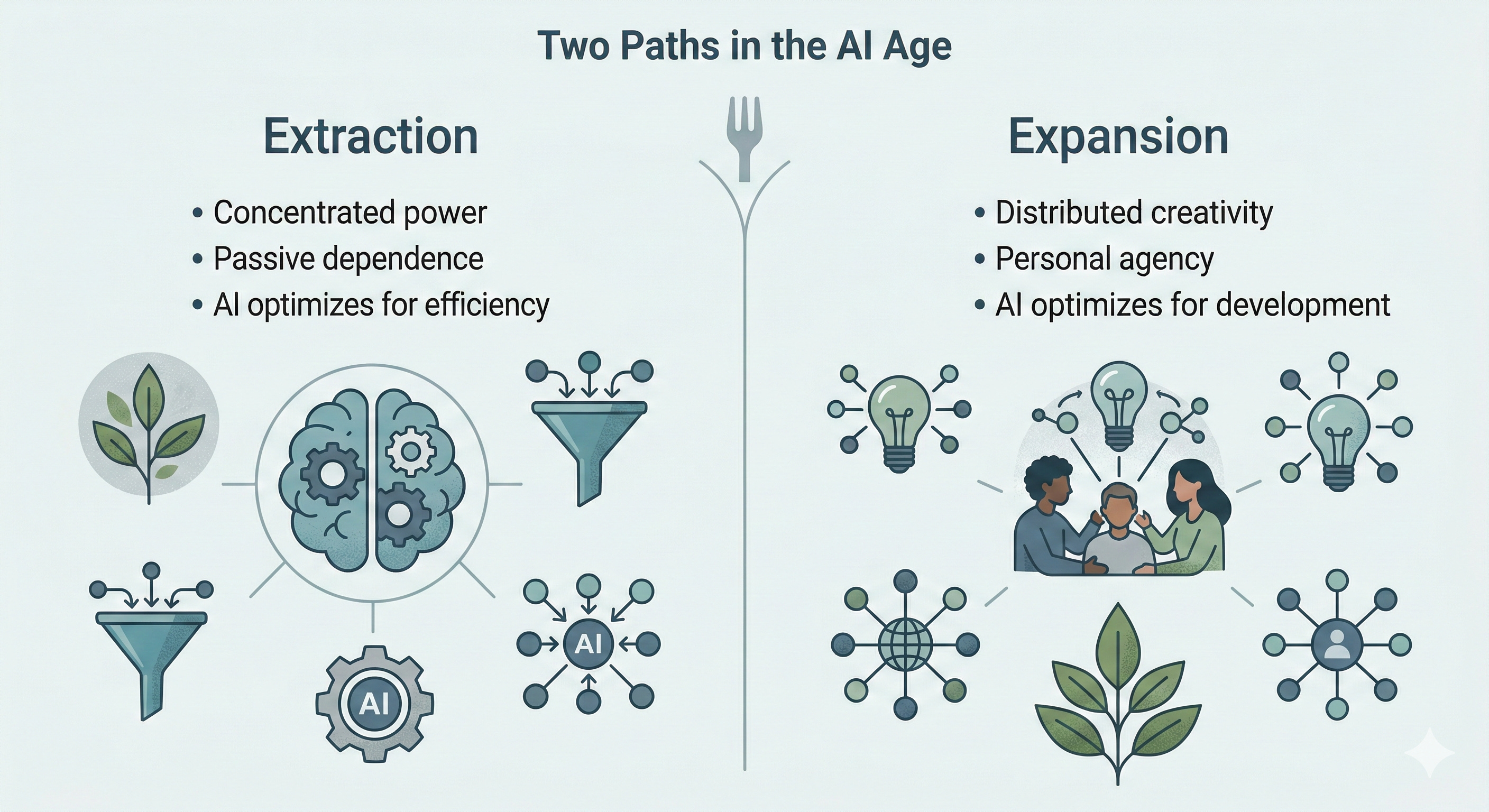
The distinction is subtle but sharp. AI can hack attention for extraction, as social platforms have done. Or it can help individuals hack their own operating systems for expansion. The same intelligence that optimizes advertising could optimize human development.
The natural objection surfaces quickly. How do you measure spirit? Counting church attendance will not suffice. Naeem does not dismiss measurement. He believes belonging, responsibility, coherence, and subjective well-being can be quantified with far greater precision than blunt institutional proxies. AI systems already detect patterns in mood, behavior, and engagement. He sees no reason that similar tools cannot track growth in inner stability and connection.
He extends this architecture into education and healthcare. In education, standardized instruction flattens differences. AI can identify where a student’s understanding fractured and repair it at the root. It can adapt to learning modalities rather than forcing conformity. In healthcare, symptom management dominates. A system oriented toward root causes would integrate mental, emotional, and behavioral inputs alongside biological data. The aim is not dependency but empowerment.
These examples make his thesis tangible. They are not futuristic fantasies. They are extensions of tools already in development.
Abundance or Extraction
He is building an entity around this framework. It functions like a startup. There is talk of an MVP (Minimally Viable Product), of early adopters, of selecting an initial market segment. He speaks of investors and collaborators. Yet he also frames it as open source and community-governed, an attempt to prevent concentration of power in the very infrastructure designed to counter it.
The ambition is not a meditation app. It is a platform for human development in an AI age. As artificial general intelligence matures, he wants the system to evolve alongside it. The long-term vision is infrastructure that supports body, mind, heart, and spirit as an integrated whole.
Timing is central to his optimism. He argues that change arrives through inspiration or desperation. He expects both. The middle class, particularly white-collar professionals, will face sustained pressure as AI improves. That pressure could produce passivity and resentment. It could also produce inquiry. When traditional markers of status weaken, individuals look for new anchors.
He describes two futures without melodrama. One is extraction. A small set of actors controls the tools, and the majority adapts passively. Abundance of output coexists with scarcity of agency. The other path is expansion. Material abundance becomes the floor rather than the prize. Individuals cultivate creativity and coherence as differentiators that machines cannot absorb.
His optimism rests on a view of human nature. He believes people have already experienced moments of expansion, of connection, of improbable achievement. He is betting that those experiences are not anomalies. If intelligence becomes abundant, he assumes consciousness will follow.
Whether that bet proves correct remains open. The machines will advance regardless. The question is not whether AI reshapes the economy. It will. The question is whether human beings respond by shrinking or by growing.
In Naeem’s telling, the age of AI is not the end of the human story. It is the forcing function that reveals what was neglected. Body was trained. Mind was trained. Spirit, he argues, has been waiting.
Full Interview with Naeem Zamindar
Thank you very much to our sponsors:
Truflation: BUY Truflation products/services and save 10% using code BOBDEW10. Learn about what prices are actually doing by going to https://truflation.com/marketplace/us-inflation-rate
Foundation: Protect your Bitcoin using the latest off-line technology with easy-to-use Passport. Their next product, Passport Prime will protect all passwords off-line with even-better technology. https://foundation.xyz/
River Financial: If not cold storage for your Bitcoin, I’d highly recommend River for buying and holding- River is engineered to protect your Bitcoin over the long run. Use this link for discounts: https://river.com/signup?r=T7GGAF7G