
Exploring Prosperity examines the forces that make life better and the obstacles that hold us back. Through essays and conversations with people working on consequential problems, I explore how technology, markets, money, and human ingenuity shape our future. Evidence, not cheerleading.
“Unfortunately, No.”
AI is already prompting dramatic predictions about job losses, economic disruption, and the need for government intervention. But do we have the information necessary to distinguish genuine problems from speculation?
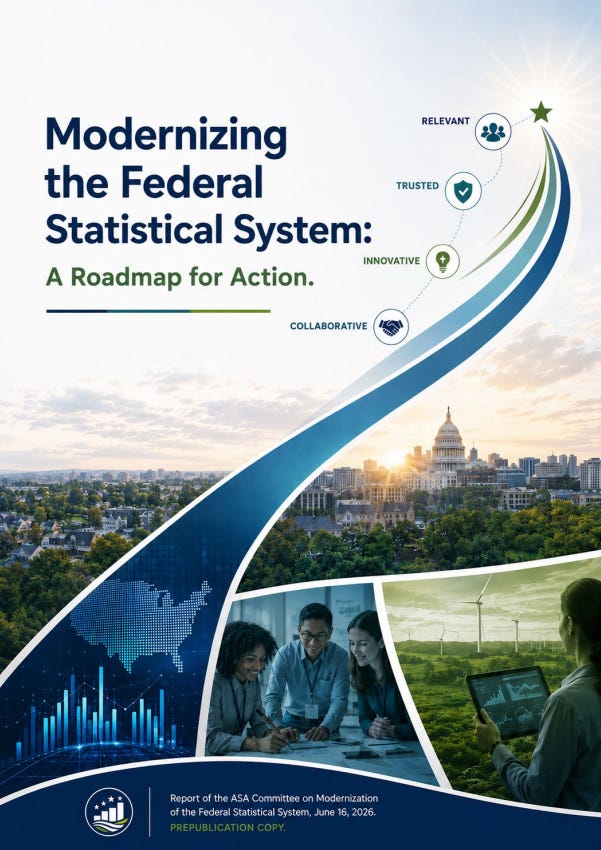
I recently put that question to Erica Groshen, former Commissioner of the Bureau of Labor Statistics (BLS), who helped lead a major new report on modernizing the federal statistical system.
“Unfortunately, no,” she replied.
Groshen offered a striking illustration of the uncertainty. Researchers she is working with counted 1,010 studies posted from January 1 through October 5, 2026, examining AI’s effects on the labor market. Their conclusions vary widely. We have an extraordinary volume of research but still lack the underlying data needed to determine what’s actually happening to workers.
Our government produces thousands of economic statistics that influence financial markets, business decisions, and public policy. We treat these numbers as authoritative, often without considering what they measure, how accurately they measure it, or what they leave out. And the system that produces them was largely designed for an earlier economy, one that new technologies are now reshaping.
What happens when policymakers respond to problems they cannot yet measure accurately?
The Numbers We Trust
Every month, investors and policymakers await the latest Consumer Price Index from the BLS. A surprise of a few tenths of a percentage point can move financial markets as investors reassess Federal Reserve policy and other implications.
Yet the CPI is an estimate, constructed from sampled prices and statistical adjustments. It doesn’t observe every price Americans pay, and, as Groshen pointed out, no individual actually experiences that inflation rate.
Private alternatives offer different pictures. Truflation tracks price changes across tens of millions of SKUs, sometimes producing readings substantially different from the government’s. Yet markets still hang on the CPI. When different methods produce different results, how much confidence should we place in any single headline? And inflation is only the beginning.
A Statistical System Built for Another Era
The American Statistical Association’s new modernization report identifies problems that have been building for decades. The federal statistical system was a remarkable achievement of the twentieth century, but its methods have struggled to keep pace with changes in technology and the economy.
Much of the system relies on surveys. As Groshen explained, government statisticians helped pioneer modern survey methodology, allowing researchers to collect representative information and estimate its reliability. But survey response rates have been declining for decades, making the data more expensive to collect and potentially less reliable.
Groshen called it a “slow-moving train wreck.” She emphasized that the headline economic indicators remain relatively robust. The greater problems emerge when researchers try to understand particular occupations, industries, or communities. Those details are precisely what we need to assess the effects of AI.
The system is also fragmented. Unlike many advanced countries, the United States has no single national statistical agency. Instead, 13 principal agencies and more than 100 other statistical units operate across the federal government, often with outdated technology and legal restrictions on sharing information.
One example: the BLS and Census Bureau maintain separate databases covering American employers, but the records don’t fully agree. The Bureau of Economic Analysis, which produces GDP estimates, must work around those discrepancies when combining their information.
Never have we had so much economic data, much of it generated digitally and largely beyond the statistical agencies’ reach. Yet as the economy changes, we may understand less and less about what’s actually happening. But improving the accuracy of our existing statistics is only part of the challenge. We also need to consider whether those statistics tell us what we most want to know about economic progress.
When Progress Looks Like Decline
Consider a company that uses AI to rethink its business strategy. Its analytical power helps management identify better opportunities, avoid costly mistakes, and make more productive use of capital. The company may need fewer consultants and employees to achieve better results. Employment in those occupations could decline even as the company’s productive capacity increases.
When I raised the possibility that AI might create economic value our statistics fail to capture, Groshen pushed back. “Well, it’ll show up,” she said. If AI improves productivity, GDP will rise.
She’s right that greater measured output will eventually appear in GDP. But what happens before those gains materialize? A company may eliminate positions today while the benefits of its new strategy take time to become apparent. The immediate job losses are measurable. The value of better decisions, avoided mistakes, and future opportunities is much harder to observe.
Or consider a successful employee who leaves a well-paid job to start a business. Their reported income falls, perhaps dramatically. They spend months or years developing a product before earning meaningful revenue. They believe the opportunity offers greater rewards than remaining employed, though success is far from guaranteed.
Our statistics can capture the decline in current income and much of the investment made along the way. What they cannot readily tell us is whether the decline reflects economic distress or a deliberate investment in a potentially more prosperous future.
Multiply these decisions across millions of businesses and individuals. Some will fail, but others will produce innovations and productivity gains that drive long-term growth. The eventual results will largely appear in our economic statistics. But policymakers must make decisions before those results are known.
If they interpret every short-term decline in measured activity as evidence of economic deterioration, they risk discouraging the very adjustments that create future prosperity.
The Opportunity to See More Clearly
There is an encouraging irony here. AI is making the economy harder to measure while simultaneously giving us better tools to measure it.
Groshen’s report identifies opportunities to use AI for data cleaning, integration, and detecting anomalies. Administrative records, electronic transactions, and other digital information could supplement traditional surveys, potentially providing more timely and detailed pictures of economic activity at lower cost.
Groshen proposed a practical starting point: improve the wage records employers already submit for unemployment insurance. Adding information about workers’ occupations, hours, and locations would allow researchers to follow employment changes in much greater detail. Combine those records with information about which companies adopt AI, and we could begin measuring its actual effects on wages, employment, and particular occupations rather than relying so heavily on predictions.
The obstacles are not merely technological. Agencies face legal restrictions on sharing data, outdated infrastructure, and legitimate concerns about privacy and public trust. As the report emphasizes, AI should augment human statistical expertise, not replace it.
AI is changing what we need to measure, how quickly we need to measure it, and what it costs to do so. Modernizing our statistical system would help us distinguish genuine economic problems from the sometimes uncomfortable adjustments that accompany progress.
What Else Aren’t We Seeing?
My conversation with Erica Groshen opens a broader question I intend to keep exploring at Exploring Prosperity: What do our economic statistics reveal, what do they miss, and how might we measure prosperity more accurately?
The danger isn’t simply that our statistics might fail to capture economic progress. It’s that we might mistake progress for a problem and adopt policies that prevent it.
Read the new report HERE.
Thank you very much to our sponsors:
Foundation: When it comes to protecting your Bitcoin, you shouldn’t have to simply trust the company that made your hardware wallet.
Foundation believes in verifiability over reputation. Its firmware and apps are open source, its builds are reproducible, and both Passport Core and Passport Prime have undergone independent hardware security audits. The point isn’t simply that Foundation says its products are secure. It’s that you can verify that for yourself.
Foundation is also expanding what users can control:
Passport Prime goes beyond Bitcoin. It can manage passwords and two-factor authentication codes, serve as a FIDO2 security key, and provide encrypted storage—all on a device you own and control. Foundation also plans to enable app sideloading, opening Prime to applications from independent developers.
Users can now add their own entropy. The latest Envoy and KeyOS releases allow users to introduce their own randomness when creating a seed, reducing reliance on the device itself to generate it.
Order a new Passport Prime and receive a free bumper case using Code PROSPERITY at → foundation.xyz
River Financial: If not cold storage for your Bitcoin, I’d highly recommend River for buying and holding- River is engineered to protect your Bitcoin over the long run. Use this link for discounts: https://river.com/signup?r=T7GGAF7G