
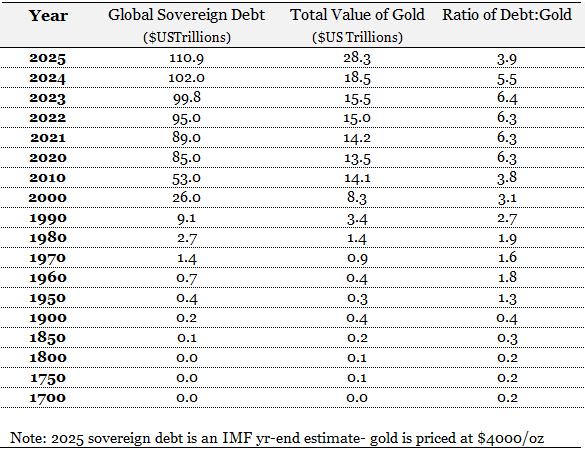
For the last two years, I have tracked a ratio that captures the very essence of our current financial predicament: Global Sovereign Debt divided by the Total Value of Above-Ground Gold. In a sound financial world, the ratio should be stable, governed by hard constraints. In reality, it has moved in almost one direction—up—since the gold anchor was removed. Unlike the Debt-to-GDP ratio, which compares a debt stock accumulated over history to an annual economic flow that can be inflated away, this ratio pits global debt against the only asset that cannot be printed, making it a truer barometer of long-term solvency.
The reason for the climb from below 1 to a peak of 6.4 2023 is simple: governments now borrow without genuine constraint because they can create the money to service that debt. The updated table shows that the ratio has reversed over the last 18 months, pulling back from its all-time high. The improvement, however, occurred for the wrong reason. This tension defines the structure of the modern monetary system.
The Historical Discipline of Hard Money
To understand what is happening today, you must first appreciate the discipline of the past. Until the late 1800s, lending was grounded in a simple physical reality. Government borrowers could not borrow more money than any lender had in gold, which simultaneously meant lenders could only lend the gold they physically possessed or had explicit claim on. This placed a hard-money cap on the global debt complex. Historical analysis suggests the ratio of sovereign debt to above-ground gold value stayed tightly constrained, typically between 0.2 and 0.4. The data for early periods is imperfect and derived from multiple historical sources, but the pattern is robust: gold imposed an upper bound on the debt complex because it could not be printed.
While in times of emergency like wars, governments did find lenders motivated to accommodate beyond the value of gold—an exception the academic literature shows was almost exclusive to wartime before the 1800s—the fundamental discipline of hard money always self-corrected. As Saifedean Ammous details in The Gold Standard, this is the world that WWI and the subsequent embrace of fiat ultimately broke.
The Recent Shift in the Ratio
The recent improvement in the ratio from 6.4 in 2023 to 3.9 today is the defining surprise. The ratio fell not because the numerator shrank, but because the value of gold rose sharply. This is not a story of renewed fiscal discipline by sovereign nations. It is a story of capital flowing out of trust-based assets and into the ultimate trust-minimised reserve asset acceptable to major central banks. The ratio is improving not because the government side of the ledger got sound, but because the metallic side of the ledger is violently reflecting reality.
The Geopolitical Driver
The surge in gold price is a profound geopolitical and institutional shift, sparked by central bank demand. This record-breaking accumulation is a clear, institutional reaction to the US-led freezing of Russia’s foreign exchange reserves in 2022. That single act was a geopolitical turning point, revealing that even sovereign holdings of fiat currency reserves (like US Treasuries) carry counterparty risk. Gold held in physical custody does not.
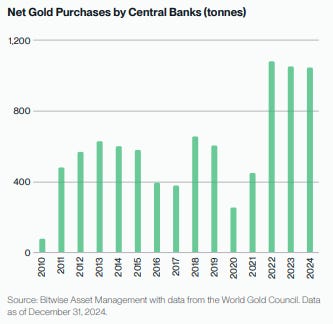
For countries seeking to diversify away from reserve assets that can be sanctioned, seized, or rendered inaccessible, gold has re-emerged as the most practical alternative. (Saifedean Ammous argues in The Bitcoin Standard that Bitcoin will ultimately become the world’s dominant reserve asset, precisely because it carries the same trust-minimized properties as gold but with absolute scarcity and no storage risk.)
Academic Backing
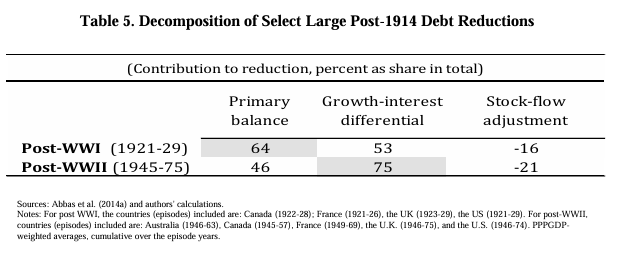
The historical pattern is consistent with the findings of Public Debt Through the Ages1, an academic study that distinguishes sharply between pre-1914 and post-WWII debt resolutions. Before World War I, governments reduced large debt burdens primarily through decades of primary surpluses—sustained fiscal effort rather than inflation. The study notes that “governments inheriting heavy debts ran primary surpluses for long periods in order to reduce those burdens to sustainable levels.”
In stark contrast, the post-WWII debt consolidation (a drop from 140 percent to roughly 30 percent of GDP) was achieved primarily through inflation and interest-rate suppression. The paper notes that this currency debasement accounted for approximately 75 percent of the total reduction. After this reduction to roughly 30 percent of GDP, advanced economies underwent a multi-decade borrowing surge that has returned debt ratios to roughly 120 percent today.
Next Up
My conversation with Saifedean Ammous about The Gold Standard was a deep dive into an imagined past. This short piece is the starting point for a larger series that will explore Ammous’s theories on how a hard money system impacts society at large, reaching far beyond the economy. We will explore how sound money could re-engineer foundational aspects of civilization, including the state of technology, energy production, health care, education, and politics, and what this paradigm shift suggests for current problems like income inequality, geopolitical instability, unsustainable levels of defense spending, social justice, and the erosion of trust in democratic institutions.
Thank you very much to our sponsors:
Truflation: Truflation: BUY Truflation products/services and save 10% using code BOBDEW10. Learn about what prices are actually doing by going to https://truflation.com/marketplace/us-inflation-rate
Foundation: Protect your Bitcoin using the latest off-line technology with easy-to-use Passport. Their next product, Passport Prime will protect all passwords off-line with even-better technology. https://foundation.xyz/
River Financial: If not cold storage for your Bitcoin, I’d highly recommend River for buying and holding- River is engineered to protect your Bitcoin over the long run. Use this link for discounts: https://river.com/signup?r=T7GGAF7G