
The Current Divergence and Its Implications
In February 2025, a significant divergence emerged between the Consumer Price Index (CPI) and the Truflation index (TRUUX), sparking renewed interest in how we measure inflation in the United States. While the CPI showed inflation remaining stubbornly above 3%, TRUUX indicated a sharp decline to just above 2%.
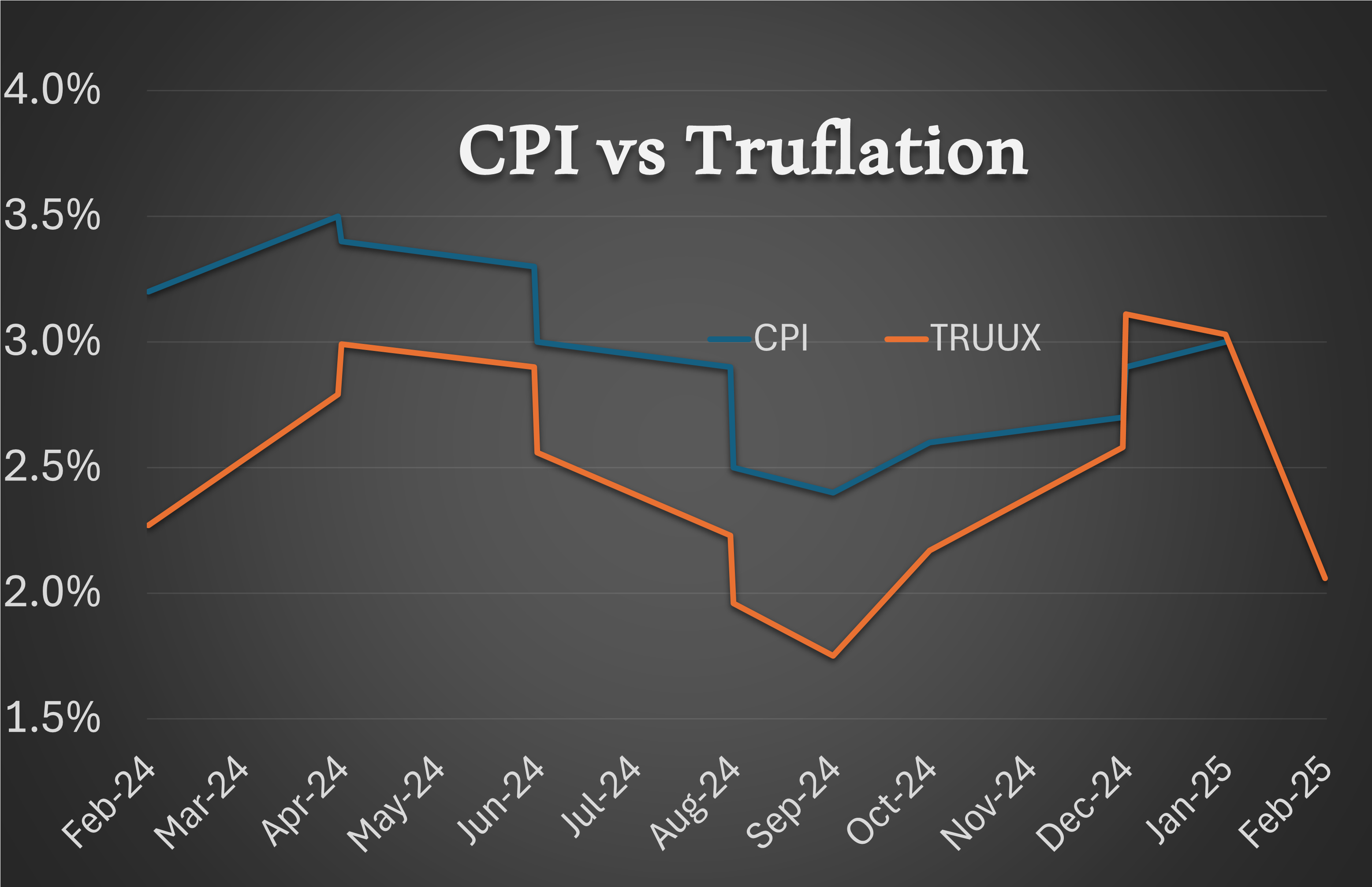
This disparity raises important questions about how we track inflation and what it means for economic forecasting.
Sponsor note: We are proud to be sponsored by Truflation and this article and the interview explain why. The inflation rate is one of the most important economic statistics in the US economy, and it is notorious for being difficult to measure. Truflation leverages technology and disclosure to provide customers with a customized and precise view of the annual price changes of virtually any service or product. Learn more at https://truflation.com/.
According to Stefan Rust, CEO of Truflation, their company has developed models that can predict CPI movements approximately 45 days in advance by replicating the BLS's calculation methodology. However, their flagship index, TRUUX, serves a different purpose – it measures actual annual price changes across a census-based basket of goods in the US economy, tracking over 30 million prices that are mostly updated daily. While Rust predicts inflation will stabilize around 3% in the longer term, he pairs this forecast with an optimistic outlook for economic growth, suggesting real GDP growth could accelerate to 5-7% if AI reaches its true potential and if capital allocation becomes increasingly driven by the private sector, leading to more higher levels of productivity.
Thank you to our sponsor Foundation.xyz, the maker of Passport, the #1-rated Bitcoin hardware wallet made in the USA. In April they will release Passport Prime, their revolutionary new security platform device that secures all passwords, not just Bitcoin. Learn more at https://foundation.xyz/.
Efficiency Through Technology
The contrast in operational efficiency between Truflation and the BLS is striking. The BLS employs over 2,100 people to produce the CPI at an annual cost of approximately $1 billion. Truflation, meanwhile, accomplishes its comprehensive price tracking with just around 20 employees, demonstrating how modern technology can dramatically improve efficiency in economic measurement. Their census-based approach spans 12 categories, compared to the BLS's six categories, providing a more granular view of price movements.
This efficiency disparity is particularly evident in data collection methods. While the BLS relies heavily on surveys and manual data collection, often with significant time lags and multiple layers of human processing that can introduce errors, Truflation's automated systems capture actual market prices in real-time. This is especially apparent in the housing sector, where the CPI relies on subjective surveys asking homeowners what they think their properties would rent for, while Truflation captures actual market prices.
Transparency and Evolution
The BLS's methodology has drawn criticism for its lack of transparency, particularly regarding its annual January adjustments. These modifications to calculation methods are only revealed after the fact, in February, making it difficult for markets to anticipate or understand changes in reported inflation rates. This opacity stands in sharp contrast to Truflation's approach, which emphasizes real-time data and transparent methodology.
International markets have begun to take notice of these differences. Argentina, facing its own challenges with inflation measurement, has partnered with Truflation to enhance their data collection and analysis capabilities. This collaboration highlights a growing recognition that traditional inflation measurements may need to evolve to meet the needs of modern economies. As technology continues to advance and markets demand greater transparency, the emergence of more efficient, data-driven solutions like Truflation suggests a fundamental shift in how we measure and understand economic indicators.