
The milestone of Bitcoin reaching $100,000 represents more than just a price point—it validates Bitcoin's role as the first technology to successfully separate money from government control. While this price likely reflects some anticipation of future demand, the underlying structural imbalance between Bitcoin's fixed supply and accelerating adoption suggests a persistent long-term tailwind, despite its characteristic volatility. This achievement carries profound implications for both global finance and individual freedom.
Here is my latest episode on my YouTube Channel Exploring Prosperity.
Supply and Demand: A Compelling Imbalance
The fundamental supply-demand dynamics of Bitcoin reveal its scarcity value:
Only 450 new Bitcoin are mined daily, worth $45 million at $100,000 per coin
Daily trading volume reaches $76 billion, with $38 billion in buying demand
This creates a 844:1 ratio of daily demand versus new supply
62.9% of Bitcoin has remained in the same wallets for over a year
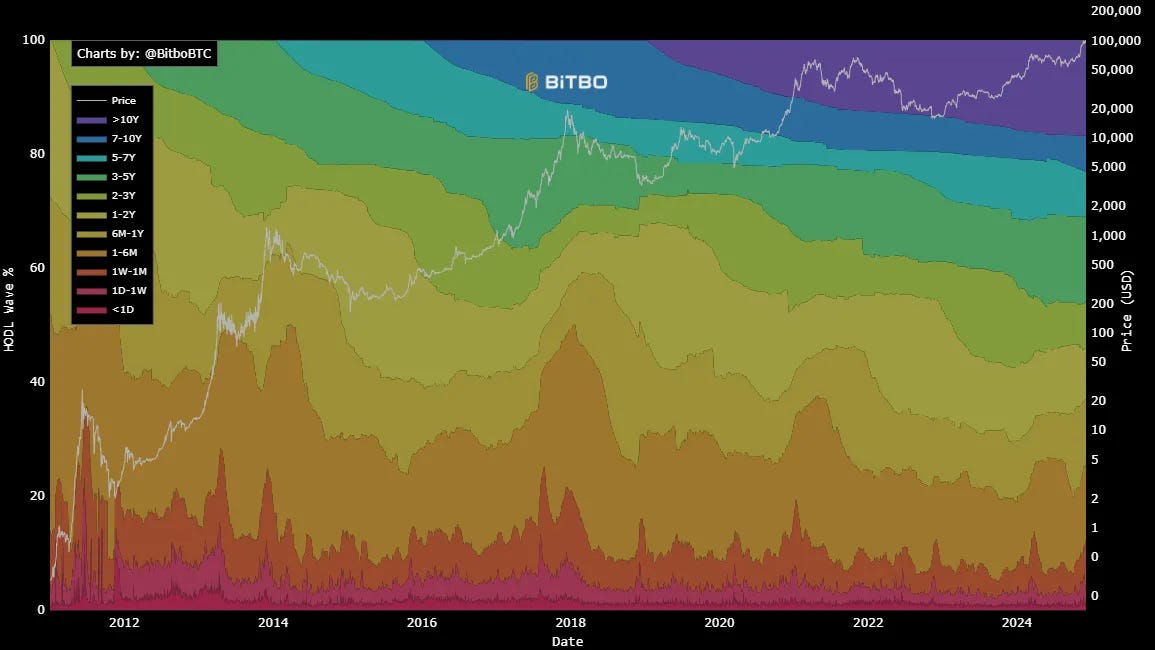
This is a “HODL Wave Chart” by BiTBO which shows ownership of Bitcoin that has not moved by cohort of time. The red (<1 day) and orange (1 day to 1 week) sections at the bottom are % of Bitcoin that has traded most recently (see chart for details) while the purple, blue and green sections, which you can see are the largest, have not traded for longer periods of time. You can see that from 2020 until now, the long term holders have grown as a percent of total Bitcoin owned. Many perceive this as a rising conviction by holders of Bitcoin in the long term value of Bitcoin.
Thank you to our sponsor Truflation. Learn more at Truflation.com.
Institutional Adoption Creates Urgency
The market is witnessing unprecedented institutional adoption, with each major buyer increasing the likelihood of additional participants:
Over 1,100 institutions now own Bitcoin through ETFs
11 states in the US are reported to be proposing Strategic Bitcoin Reserves
Corporations are adding Bitcoin to their balance sheets, with some companies following MicroStrategy's path of becoming dedicated Bitcoin treasury vehicles.
Traditional financial institutions are reversing their previous hesitancy to engage with Bitcoin given a changing regulatory approach in the US
Political Validation and Government Adoption
Recent election results have decisively demonstrated bipartisan, widespread and growing political support for cryptocurrency, with the election resulting in a pro-crypto President, 20 pro-crypto Senators won races vs only 12 anti-crypto, and 278 House representatives pro vs 122 anti-crypto, a large majority. The President's platform includes support for Americans' right to self-custody Bitcoin and the establishment of a Strategic Bitcoin Reserve (SBR). This political shift isn't limited to the United States—two additional nation-states are preparing to announce their own SBR plans, creating a race among governments to secure their positions before major state-level buying begins.
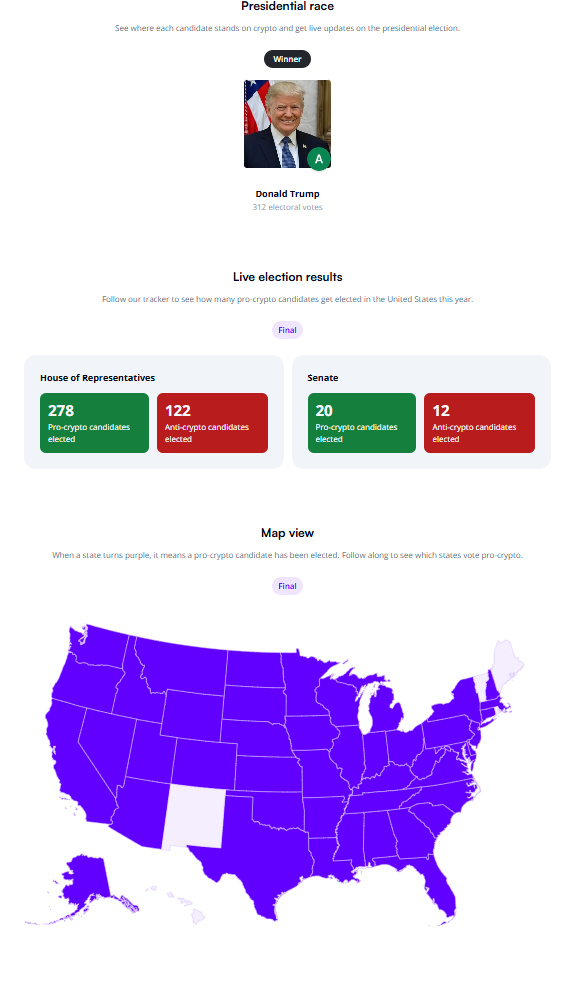
Source: https://www.standwithcrypto.org/races
The Global Debt Challenge
Since 1971, when the gold standard ended, fiat currencies have enabled unprecedented leverage in the global financial system.
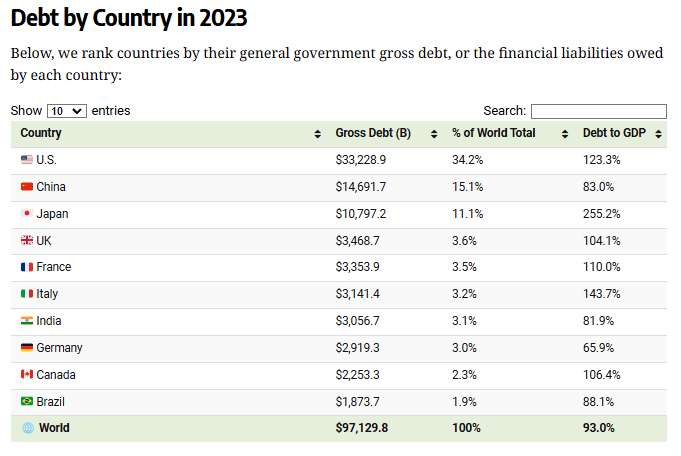
Source: https://www.visualcapitalist.com/97-trillion-of-global-debt-in-2023/
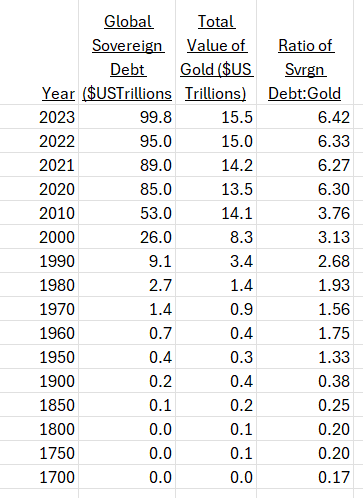
Its stark to see how the ratio of sovereign debt to the total value of gold has skyrocketed since currencies left the gold standard. These levels of sovereign debt are commonly believed to be beyond the scope of governments to repay. The US and others have additional unfunded liabilities that exceed even the debt levels outstanding.
Rising Bitcoin: The Solution to the US Debt Crisis?
Bitcoin presents a revolutionary approach to managing sovereign debt through two distinct channels. First, Senator Lummis proposes the U.S. Treasury add Bitcoin to its reserves, where appreciation could help offset the $36T national debt. While the President could initiate this through executive order, lasting implementation requires congressional approval. Second, though not currently under consideration, the Federal Reserve could theoretically add Bitcoin to its balance sheet, enhancing U.S. monetary policy flexibility. Both strategies would benefit from first-mover advantage: as more governments adopt Bitcoin reserves, early adopters gain most as demand overwhelms Bitcoin's fixed supply.
Bitcoin's Core Value Proposition
Bitcoin's fundamental value stems from primary use cases:
1. Asset Protection: Bitcoin offers a hedge against inflation and currency devaluation because it is decentralized and outside of the control of anyone or anything that would issue more Bitcoin in response to rising demand for it. While this might seem less crucial for US dollar users because of the relative stability of the $US, it's vital for much of the world's population where high inflation and devaluations are a fact of life.
2. Financial Freedom: In regions facing financial repression, Bitcoin provides a crucial medium of exchange, particularly for targeted groups like women in Afghanistan who face institutional barriers.
3. Energy Efficiency: Bitcoin mining transforms energy market dynamics through its unique flexibility to be turned on or off instantly without operational impact. This enables two powerful use cases: At oil wells, miners convert otherwise flared gas (stranded too far from pipelines) directly into Bitcoin and cash, eliminating waste. In grid applications, miners provide crucial stability by absorbing excess power and shutting down during peak demand. One African power plant demonstrates this perfectly - originally generating excess power that raised costs for the local community, Bitcoin mining converted surplus electricity into local currency, ultimately lowering electricity prices for residents.
Understanding Bitcoin's Network Effects
A common misconception is that Bitcoin's rise "drains" money from the fiat system. This is false. When $38 billion of Bitcoin trades daily, 99.99% of that money flows between buyers and sellers, with only 0.01% going to miners. Bitcoin's power comes from network effects: as more individuals, institutions, corporations, and governments adopt it, its utility as a monetary system grows stronger, creating a self-reinforcing cycle of adoption and value appreciation. This network effect, not any drain on fiat money, drives Bitcoin's growing importance in the global financial system.
Looking Forward
The $100,000 milestone serves as a catalyst for broader understanding and adoption. As more individuals, institutions, and governments recognize Bitcoin's value proposition, the supply-demand imbalance will likely intensify. The emergence of Strategic Bitcoin Reserves among nations creates a new paradigm in global monetary policy, potentially reshaping how governments approach fiscal responsibility and monetary sovereignty.
This price point isn't just a number—it's a validation of Bitcoin's potential to address the global debt challenge by offering a credible alternative to traditional monetary systems. The race to accumulate Bitcoin between nations, institutions, corporations, and individuals marks the beginning of a new era in global finance, where Bitcoin serves as both a solution to our debt crisis and a foundation for a more transparent and accountable monetary future.