
Bitcoin treasury companies barely existed two years ago. Tim Kotzman has spent that time talking to the people building them.
He started by accident. As Bitcoin and MicroStrategy were rising in late 2024, Tim was working near a studio and the producer asked him to interview someone. That led to another and another. The producer asked what he wanted to call his show. “What show?” But soon he was interviewing executives and analysts simply because he wanted to understand what was happening.
He kept going. As Strategy’s success inspired dozens of imitators, Tim interviewed the current CEO Phong Le for his first-ever in-person interview, each of the executives launching the other firms, as well as the analysts studying them and the investors financing them. He watched a bull market make every new entrant a genius. But then a bear market began separating the experiments that worked from those that didn’t.
Along the way, Tim converted an afterthought activity into a remarkably valuable seat for himself: a front-row view of an industry being invented in real time.
Beyond Buying Bitcoin
Strategy proved that a public company could make accumulating Bitcoin the centerpiece of its capital strategy. But after watching the industry develop, Tim thinks 2026 may be remembered as “the year of digital credit” he told me. “Digital credit is the most important innovation in the Bitcoin treasury space, period.”
The idea is to raise capital from an entirely different class of investor. Instead of selling common stock to someone seeking Bitcoin’s upside, companies can issue preferred securities paying yields of 12 or 13 percent to investors seeking income. The company then uses that capital to buy more Bitcoin. One investor gets the yield he wants; another retains the leveraged exposure to Bitcoin he wants; and the company becomes the intermediary between them. The “model” works spectacularly if Bitcoin’s appreciation over time substantially exceeds the cost of that capital.
That evolution turns the Bitcoin treasury company into something far more interesting than a corporate holder of Bitcoin. Capital markets themselves begin to become the business.
The 30% Hurdle
Suppose Bitcoin appreciates 30 percent a year (it is at 36% since Aug 10, 2020). Tim posed a simple question: “If we walked out the studio door and started an operating business with the goal of earning 30 percent annually, how hard would that be?” How much capital would it take? How long would it take to get there? And even if we succeeded, how difficult would it be to sustain those returns?
That creates an unusual problem for a Bitcoin treasury company. Every use of its capital has to compete with an “expected” return from simply buying more Bitcoin. A very good operating business might not be good enough. Even among the extraordinary companies shown below, only Nvidia exceeded Bitcoin’s return over the past six years. Six years is a short window for judging long-term returns, but long enough to illustrate how high a 30 percent hurdle really is.
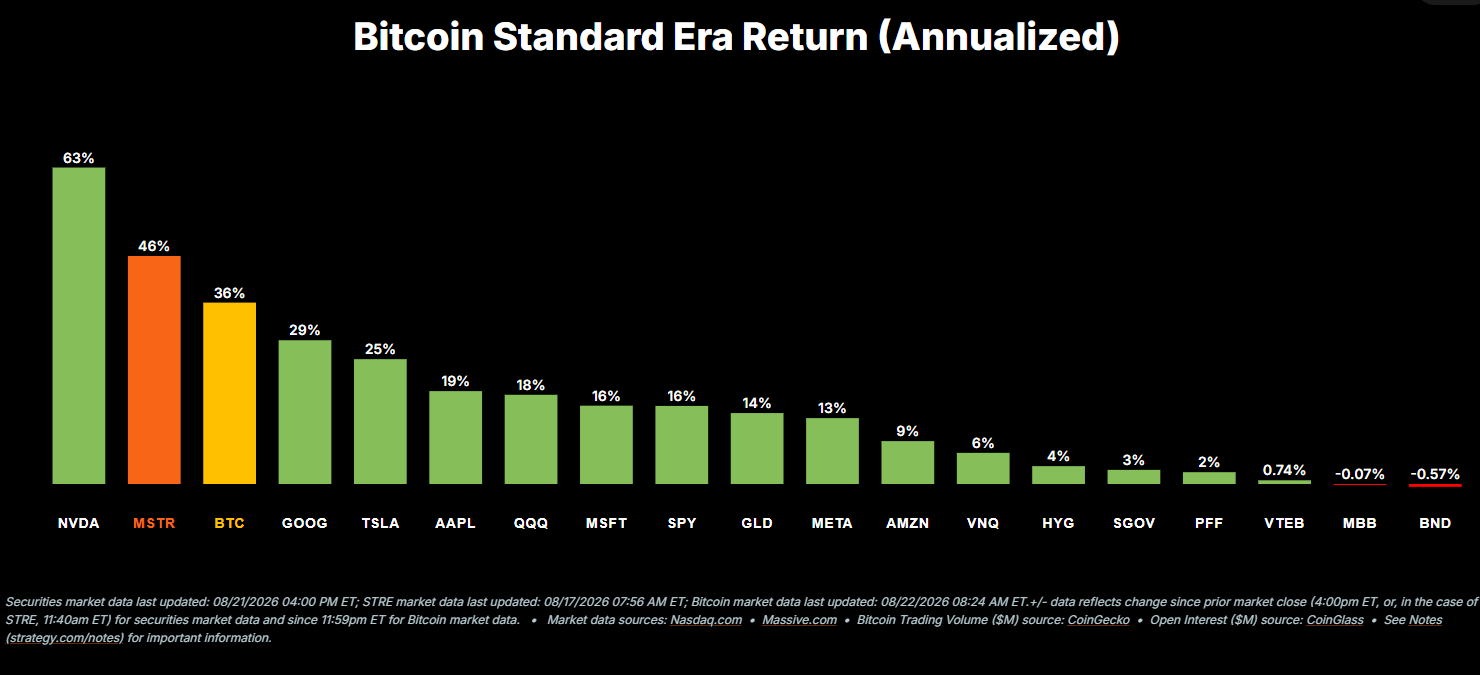
If Bitcoin continues to reach new highs over the long run, the economics can be extraordinary. The Bitcoin treasury industry has already raised tens of billions of dollars of capital and credit, demonstrating substantial demand for securities built around the belief in long term Bitcoin appreciation.
The Bear Market Test
The first real test came when the market turned. Falling Bitcoin prices compressed the premiums many treasury companies had enjoyed, made raising new capital less attractive and forced management teams to make choices they hadn’t faced during the ascent.
Tim calls it an “incredibly insightful” and constructive bear market. Companies that had looked similar began responding differently. Some sold Bitcoin. Others changed their strategies. Financing became more difficult and investors seemed to all but stop rewarding companies simply for owning Bitcoin.
The downturn forced these companies to demonstrate what their strategies could accomplish when Bitcoin wasn’t doing the work for them. The bull market accelerated the Bitcoin treasury industry. The bear market began testing which ideas within it might endure and it provided an important test for digital credit. Financing didn’t disappear; it repriced. Yields of 12 or 13 percent impose a real cost that issuers must overcome, but demand for these securities has persisted even as Bitcoin fell. Digital credit built around Bitcoin remains a rounding error beside credit markets measured in the tens of trillions. If Bitcoin continues to prove itself as reliable, appreciating collateral, there is plenty of room for this market to grow.
Why Retail Distribution Mattered
The early Bitcoin treasury companies could not rely primarily on institutional investors. Institutional investors require infrastructure, regulatory clarity and established ways to evaluate the risks of an emerging asset. Retail investors face none of those constraints. They were willing to tolerate Bitcoin’s volatility in pursuit of higher returns.
That made access to retail investors unusually valuable. Tim pointed to the prominence of Bitcoin personalities such as Jack Mallers, Dylan Leclair, and Anthony Pompliano (among others) in launching treasury companies. Their large audiences weren’t just useful for publicity. They provided direct distribution to investors who already understood the Bitcoin thesis.
As Tim put it, “We’re in an attention economy.” For an emerging industry trying to raise capital before many institutions were ready to participate, attention became part of the business model.
Walk a Mile, See a Mile
While Tim was watching a new industry develop, he was also building a business around it. Interviews led to a podcast, which led to an online conference. His first lasted 21 hours, 21 minutes and 21 seconds, with 46 interviews. Sponsors appeared, relationships grew and online conferences eventually led to live ones.
None of this was the original plan. Tim describes his approach as “walk a mile, see a mile.” Each step revealed an opportunity he couldn’t have seen from the one before it.
There is a broader lesson in his experience. We can identify the businesses and jobs that technological change threatens because they already exist. It is much harder to imagine the ones that will be created around industries that don’t exist yet. Tim didn’t set out to occupy his current seat. The seat was being created at the same time he was finding it.
Thank you very much to our sponsors:
Foundation.xyz: When it comes to protecting your Bitcoin, you shouldn’t have to simply trust the company that made your hardware wallet.
Foundation believes in verifiability over reputation. Its firmware and apps are open source, its builds are reproducible, and both Passport Core and Passport Prime have undergone independent hardware security audits. The point isn’t simply that Foundation says its products are secure. It’s that you can verify that for yourself.
Foundation is also expanding what users can control:
Passport Prime goes beyond Bitcoin. It can manage passwords and two-factor authentication codes, serve as a FIDO2 security key, and provide encrypted storage—all on a device you own and control. Foundation also plans to enable app sideloading, opening Prime to applications from independent developers.
Users can now add their own entropy. The latest Envoy and KeyOS releases allow users to introduce their own randomness when creating a seed, reducing reliance on the device itself to generate it.
Learn more about Foundation → https://foundation.xyz/
River Financial: If not cold storage for your Bitcoin, I’d highly recommend River for buying and holding- River is engineered to protect your Bitcoin over the long run. Use this link for discounts: https://river.com/signup?r=T7GGAF7G