
In this third essay of our series exploring the paradox of pessimism in an age of progress, we turn our attention to reasons for optimism about America's future prosperity. While there are several compelling factors that paint a positive picture, perhaps none is as transformative and far-reaching as the democratization of technology. This essay will explore how unprecedented access to powerful tools of creation and innovation is unleashing human potential on a global scale, effectively addressing the 'missing Einsteins' problem (mentioned by recent guest Professor Jared Rubin) and amplifying Adam Smith's concept of the invisible hand in ways never before possible.
The Modern Invisible Hand: Technology and Global Empowerment
Adam Smith's concept of the invisible hand posits that individual self-interest in a free market economy leads to economic prosperity. Today, technology has exponentially amplified this effect. The internet, personal computers, smartphones, and an array of software tools have put the power of creation and innovation into the hands of billions.
This technological revolution has redefined the meaning of "free market." No longer confined to physical spaces or limited by geographical boundaries, the marketplace of ideas and commerce now exists in a global, digital realm. An entrepreneur in rural America can collaborate with a designer in Europe and a manufacturer in Asia, all working together to bring a new product to market. A citizen journalist in a developing country can share critical information with the world, bypassing traditional gatekeepers.
The "Missing Einsteins" Phenomenon
The "missing Einsteins" concept refers to the lost potential of individuals who, due to socioeconomic factors, lack of access to education, or other barriers, never get the opportunity to contribute their talents to society. The democratization of technology is directly addressing this issue.
Today, a child with access to a smartphone and internet connection anywhere in the world can learn coding, explore advanced mathematics, or study any subject through free online courses and resources. Platforms like Khan Academy, Coursera, edX, and Saylor Academy have made world-class education accessible to anyone with an internet connection.
What's particularly encouraging is not just the broad availability of technology, but the extraordinary efforts made by many in the developed world to promote and extend that availability globally. Numerous organizations and initiatives are working to bridge the digital divide in developing nations. Global efforts like the UN ICT (Information and Communication Technology) Task Force and the World Summit on the Information Society (WSIS) are setting the stage for international cooperation. Organizations such as the One Laptop per Child Project and Computer Aid International are providing essential hardware to underserved communities, while initiatives like the International Institute for Communication and Development (IICD) focus on leveraging ICT for development. These are just a few examples among many dozens of organizations dedicated to this cause. Collectively, these efforts are creating pathways for talent in developing nations to participate in the global digital economy, unlocking potential that might have otherwise remained dormant due to lack of access or training.
Democratization of Creation and Innovation
The tools for creation and innovation are more accessible than ever before. Anyone with a computer can create digital art, produce music, write and publish books, or develop software. Social media platforms allow individuals to build audiences and movements around ideas or causes.
Platforms like Instagram and TikTok have revolutionized idea-sharing. With just a smartphone, individuals can now reach global audiences, bypassing the need for expensive infrastructure and distribution costs of traditional media and often with superior engagement. A significant portion of this content focuses on practical skills, from DIY projects to cooking demonstrations, spreading knowledge more effectively than ever before. This democratization of content creation empowers individuals to become educators and influencers, facilitating a rapid, global exchange of ideas and cultural practices.
This democratization extends beyond digital products. 3D printing technology allows inventors to prototype physical products from their homes. Crowdfunding platforms like Kickstarter enable them to raise capital and validate their ideas in the market. The barriers between having an idea and bringing it to fruition have never been lower.
Small Businesses and the New Entrepreneurial Landscape
The impact of this technological democratization is clearly reflected in small business statistics. According to the SBA's Small Business Profile, small businesses accounted for 43.5% of GDP as of 2023. While the COVID-19 pandemic posed significant challenges, with as many as 200,000 more small businesses closing in the first year of the pandemic compared to historical levels, it also spurred a wave of entrepreneurship. In 2021, 5.4 million new business applications were filed, a 53% increase from 2019 which has continued since.
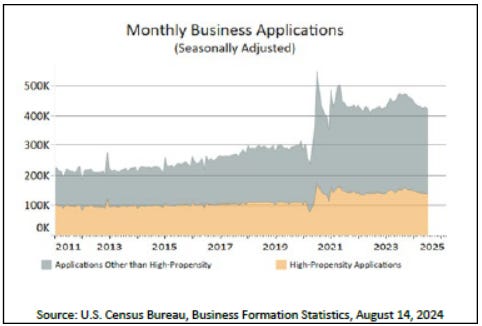
The resilience of small businesses is further evidenced by the fact that by Q3 2022, the number of small businesses had surpassed pre-pandemic levels. Moreover, as of July 2023, the number of self-employed Americans reached 9.3 million, the highest since 2008.
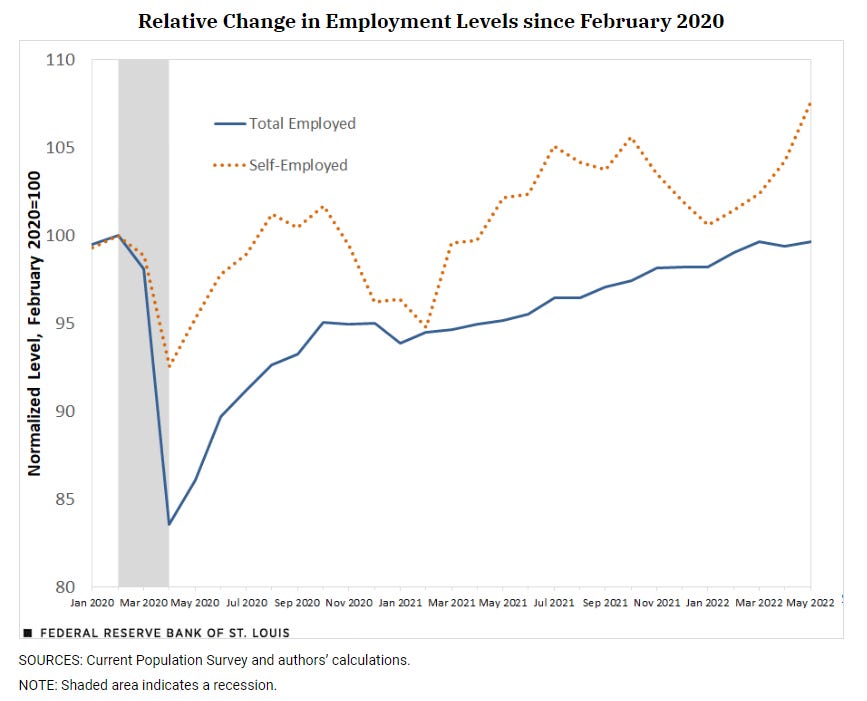
This data underscores how technology has not only lowered barriers to entry for new businesses but also enhanced their ability to adapt and thrive in challenging circumstances. The pandemic accelerated digital transformation across all sectors, with even the smallest businesses leveraging e-commerce, remote work tools, and digital marketing to survive and grow.
The Cumulative Effect: From Individual Actions to Global Progress
The true power of this technological democratization lies in its cumulative effect. Millions of individuals, empowered by technology, are each making small contributions that add up to significant global progress. This is Adam Smith's invisible hand at work on an unprecedented scale.
Open-source software development is a prime example of this phenomenon. Countless developers around the world contribute to projects that form the backbone of our digital infrastructure. Linux, which powers everything from smartphones to supercomputers, is the result of this collaborative effort.
Similarly, citizen science projects are harnessing the power of individuals to contribute to scientific research. Platforms like Zooniverse allow anyone to participate in real scientific research across a range of disciplines, from astronomy to zoology.
The acceleration of idea sharing and collaboration enabled by technology is also driving progress in addressing global challenges. Climate change solutions, medical breakthroughs, and innovative approaches to education are all benefiting from this global exchange of ideas and cooperation.
Challenges and Considerations
While the overall trend is overwhelmingly positive, it's important to acknowledge the challenges that come with this technological empowerment. The digital divide remains a significant issue, with many individuals still lacking access to the internet or the skills to fully utilize these tools. Privacy concerns and data security are ongoing challenges that require constant vigilance and innovative solutions.
Perhaps one of the most pressing challenges is the growing influence of social media platforms and the resulting attention from elected officials and regulators. These platforms have become so powerful in shaping public discourse that they are now targets for potential regulation. Concerns about content moderation, free speech, and the concentration of power in the hands of a few tech giants are at the forefront of public debate.
However, true to the spirit of innovation, solutions are emerging from the very technologies causing these concerns. Decentralized platforms like NOSTR (Notes and Other Stuff Transmitted by Relays) are being developed to ensure open access and user control over content and reach. These platforms aim to create a more resilient and censorship-resistant internet, where users have greater control over their data and online presence.
Blockchain technology and other decentralized systems are also being explored as ways to address issues of trust, transparency, and centralization in digital spaces. While these technologies are still in their early stages, they represent promising approaches to some of the challenges we face.
In this context, Bitcoin has emerged as a powerful tool for individual financial empowerment. As a decentralized digital currency, Bitcoin offers an alternative to government-controlled fiat currencies. It allows for peer-to-peer transactions without the need for intermediaries, giving individuals greater control over their financial assets. While Bitcoin and cryptocurrencies come with their own set of challenges and volatility, they represent a significant step towards financial democratization and individual economic sovereignty.
Conclusion
The democratization of technology represents a powerful reason for optimism about our future prosperity. By putting the tools of creation and innovation into the hands of billions, we are unleashing human potential on an unprecedented scale. The "missing Einsteins" of the past now have the opportunity to contribute their talents and ideas to the global marketplace.
While challenges exist, the very nature of this technological empowerment means that solutions to these challenges are likely to emerge from unexpected sources, driven by the collective intelligence and creativity of individuals around the world.
As we continue to explore other reasons for optimism in future essays, it's important to remember that this technological democratization underpins and amplifies many other positive trends. From advancements in renewable energy to breakthroughs in medical research, the collaborative and innovative spirit fostered by these technologies is driving progress across all sectors of society.
The digital renaissance we are experiencing is not just about new gadgets or faster internet speeds. It's about fundamentally reshaping how we solve problems, create value, and work together as a global community. As we look to the future, this unleashing of human potential gives us ample reason to be optimistic about our ability to address challenges and create a more prosperous world for all.
Looking Ahead
In the coming weeks, I will be interviewing a pioneer in the field of democratizing access to investment opportunities. This individual is at the forefront of increasing the availability of capital for small companies, further breaking down barriers in the financial sector. This conversation promises to provide additional insights into how technology is reshaping the landscape of entrepreneurship and investment.