
Last week, I argued that the real question about AI and jobs isn’t how many disappear, but whether AI begins to outcompete organizations at coordinating human effort—the moment when payrolls shrink but living standards rise as AI tools extend leverage to people instead of firms.
I’m returning to the topic because the headlines were loud again this week with “evidence” that AI is taking jobs. Charts are circulating that show job openings plunging while the S&P soars, as if the market were feeding on labor itself. It’s worth diving in again—not because those charts are wrong, but because they risk being misunderstood.
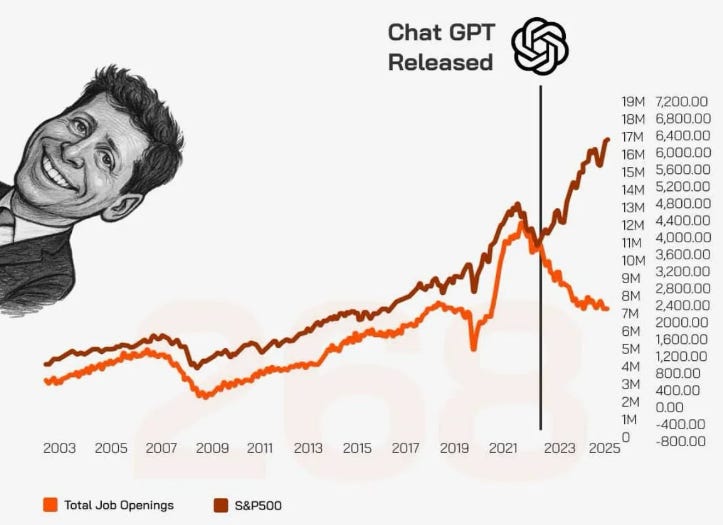
Source: Excellent essay on this by Derek Thompson this week.
This week delivered a trio of signals that the economics and politics of AI are starting to converge. The October Challenger report logged 153,000 layoffs, the highest October total since 2003, with AI now explicitly cited as a contributing factor. Hakeem Jeffries framed “affordability” as the Democrats’ new rallying cry—not just in New York City but nationally—after five Trump-leaning New Jersey counties flipped blue on that message. And at the state level, lawmakers from California to Colorado accelerated efforts to rein in AI before its benefits are even visible.
It’s all connected. The “K-shaped” economy—rising markets on one side, fading opportunity on the other—has become a political narrative. And AI, fairly or not, is emerging as its symbol.
The Misread Causality
Derek Thompson recently challenged the idea that the K-shaped chart—soaring stock prices alongside falling job openings—proves that AI is replacing workers. He pointed out that there are other possibilities: the Fed’s aggressive rate hikes were designed to cool hiring, and the JOLTS data peaked precisely when that tightening began. In other words, the slowdown in job openings may reflect monetary policy or a miriad of other factors, not machine learning exclusively.
He’s right about the economics. But politics runs on perception, not regression coefficients. When prosperity looks like an index and insecurity looks like your rent bill, correlation becomes causation in the public mind. Voters don’t separate Fed policy from technology trends—they see a booming market and shrinking opportunity and assume the two are linked.
The Political Feedback Loop
In my last essay, I wrote that regulation becomes the leading indicator when society starts treating AI as an organizational threat rather than a personal tool. We may already be there.
California and Colorado are racing ahead with ambitious AI legislation, while states such as Texas, Utah, and Tennessee are taking a lighter approach focused on disclosure and bias testing. Congress debated national preemption over the summer but declined to act, leaving the field open for state experimentation.
Source: a16z Podcast Monday, November 3, 2025. Guest David Sachs, White House AI and Crypto Czar - edited clip from 44:38.
Under U.S. precedent, states may regulate the use of AI within their borders, but the Dormant Commerce Clause prevents any one state from imposing model-wide or nationwide restrictions on AI training, deployment, or system design. That balance preserves local control but creates a maze for developers.
It’s worth distinguishing what’s happening. Guardrails manage risk; restrictions manage permission. Guardrails build trust by requiring transparency, accountability, and fairness. Restrictions create friction by forcing pre-approval or imposing liability before innovation can occur. The U.S. is now experimenting with both models at once.
Colorado’s new Artificial Intelligence Act illustrates the problem. It defines “high-risk systems” and “consequential decisions” so vaguely that companies may need separate compliance regimes for every state. Similar bills in California, Connecticut, and New York use different definitions and thresholds. California’s proposed SB 1047 (later vetoed) would have required safety testing and “kill switches” for large models, while AB 2013, signed in October, mandates disclosure when generative AI is used in content or services. Each law aims for safety but uses its own vocabulary and enforcement mechanism.
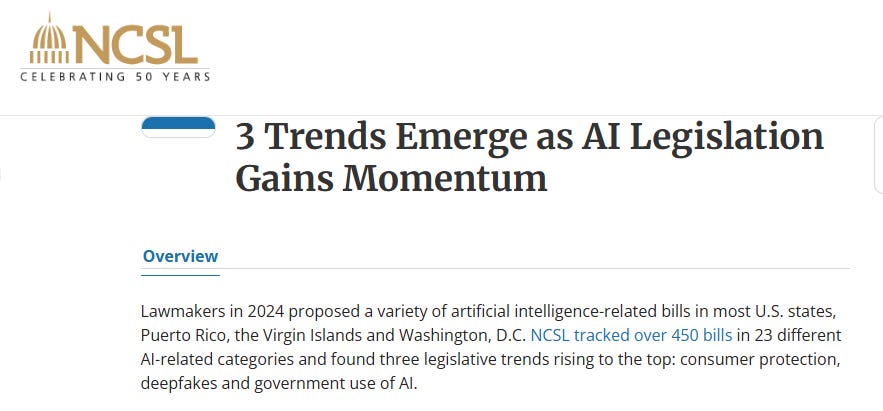
Source: For a state by state summary of the 450 bills, click here: https://www.ncsl.org/technology-and-communication/artificial-intelligence-2024-legislation
The result is regulatory entropy—a patchwork of good intentions that multiplies costs and deters startups. As industry critics have warned, such inconsistencies make scaling AI across states nearly impossible. And in the global race for capability, that matters. China’s AI strategy is national, coordinated, and singularly focused. Ours risks becoming localized, fragmented, and defensive. America’s edge has always been its openness to experimentation, but that strength can turn into friction if every state writes its own rulebook.
The Real K-Shaped Risk
A world with fewer payroll jobs isn’t automatically a world with less work or meaning. The problem arises when politics treats employment as the only legitimate form of contribution. Instead of accelerating new individual empowerment through AI tools, policymakers are leaning toward preserving traditional corporate jobs—the very structures AI could liberate.
Europe’s experience is instructive. Decades of layoff protections created stability but strangled innovation; almost no global technology leaders emerged under that model. The United States risks the same fate if it substitutes job preservation for opportunity creation.
The Irony of Progress
AI isn’t yet the cause of the K economy, but it could become its accelerant if politics turns defensive. The irony is that the more powerful AI becomes, the more tempting it is for governments to protect the old economy from it.
If policymakers focus on consistent guardrails rather than fear-driven restrictions, AI can amplify human capability rather than replace it. But if we regulate by anxiety—state by state, definition by definition—we’ll throttle the very productivity gains that could make life more affordable for the voters now demanding relief.
The challenge isn’t to slow AI down. It’s to make sure progress moves faster than the fear of it.
Thank you very much to our sponsors:
Truflation: Truflation: BUY Truflation products/services and save 10% using code BOBDEW10. Learn about what prices are actually doing by going to https://truflation.com/marketplace/us-inflation-rate
Foundation: Protect your Bitcoin using the latest off-line technology with easy-to-use Passport. Their next product, Passport Prime will protect all passwords off-line with even-better technology. https://foundation.xyz/
River Financial: If not cold storage for your Bitcoin, I’d highly recommend River for buying and holding- River is engineered to protect your Bitcoin over the long run. Use this link for discounts: https://river.com/signup?r=T7GGAF7G