
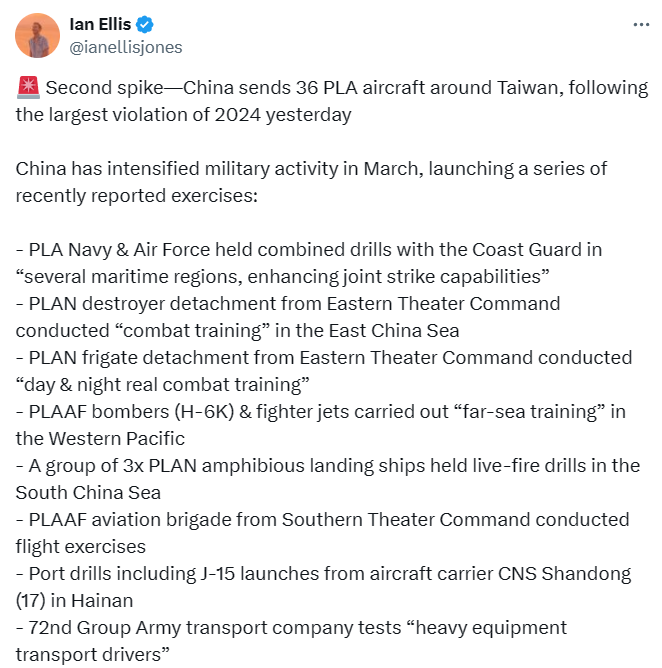
There are reports of an uptick in March of Chinese actions pressuring US interests. This posting on X by @ianellisjones lays it out:
This news prompts me to share this interview (HERE) with Steve Roach about his book published in late 2022 that gives a comprehensive analysis of US/China relations and concludes with a process that would defuse this growing tension.
Order Steve Roach's book HERE:
The continued prosperity of the US, the world, and China depend heavily on how well the US and China can appreciate the precariousness of their co-dependence and keep it alive, and there is no one better than Steve Roach to analyze this co-dependence as one of the most respected economists among investors in the US over the past four decades, and the first US economist to have prioritized China for the past two decades.
In our interview with Steve on May 23, 2023, he pointed out that US sentiment towards China is the worst in history, and that much of this enmity stems from false narratives that each country has for one-another. His extensive analysis and conclusions, as well as specific proposals for how the US and China could change what has become a Cold War into a more productive co-dependence are all laid out in a comprehensive book titled “Accidental Conflict: America, China, and the Clash of False Narratives”.
Relationship Deterioration: While we have seen two news items just this week (Back in May, 2023) about how the Biden Administration was trying, and sounding optimistic about reversing the deteriorating relationship with China, the latest series of actions belied a momentum gathering for further deterioration.
Biden's optimism was rebuffed shortly later, followed by news about the first cabinet-level meeting which was welcome, but too soon and too isolated to be material. Roach points out why events like these are insufficient given how much damage has been done.
By Steve Roach’s assessment, and he cites Henry Kissinger’s agreement, the US is now in a cold war with China, which poses a serious threat to global growth and global peace. Financial markets are vulnerable to any step function intensification of the conflict, and Steve points out this is the other side of the same coin as complacency.
It was the China balloon fiasco that marked the serious turning point, and since then, National Security Advisor Jake Sullivan stated that US national security takes priority over economic security, which was echoed one month later by Xi Jinping who repeated that primacy of national security. Both were firsts, and worrisome given that economic concerns contain mutually beneficial options, and security concerns do not.
Roach’s Assessment: Our interview discusses valuable, detailed historical context of the economic characteristics of both the US and China that laid the groundwork for what had been a very mutually-beneficial relationship. And that groundwork is critical to understanding how these false narratives of the US for China and of China for the US unfolded.
The headline for the US false narrative of China is how the US has fixated on unfair trading practices as the cause of the decline of American communities, companies, and families.
And for China, it is that the US is choking off its ability to grow- China’s growth is self-inflicted on a number of fronts that Steve discusses. See the preponderance of evidence that Roach provides to underscore each of the misconceptions.
Roach’s Remedy: The ability to improve our relationship comes down to i) growth- we both need to grow to escape our domestic problems, and so we need to find areas of trust, ii) drive home a series of specific growth initiatives that each country benefits from, and iii) there should be an institution created – a Secretariat- where a road range of specialists from each country can work together to create solutions to economic and diplomatic issues that is headquartered in a neutral country and Chinese and American counterparties share working space. The book is not only a comprehensive research product that organizes complexity into understandable segments but it also draws conclusions that offer some hope to a serious and growing challenge to the global and societal prosperity that we have enjoyed since WWII.