In my latest interview (HERE) on Exploring Prosperity, China expert and economist Stephen Roach provided critical insights into the complex dynamics of Sino-US relations, a cornerstone of global economic stability and a key factor in the first pillar of prosperity: 1) Governance, Rule of Law, and Security. This pillar, along with 2) Economic Competitiveness, 3) Human Capital Development, and 4) Living Standards and Social Fabric, forms what I consider to be the four major components of societal prosperity.
Thank you to my sponsor Truflation.
Roach's unique perspective, honed through his decades at Morgan Stanley (MS) as chief economist and decades since as top emissary to China as co-head of MS Asia and as Senior Fellow at Yale, offers a valuable lens through which to view the current state of US-China relations and its implications for global prosperity.
Find all of Roach’s work at www.stephenroachauthor.com.
Fresh back from a trip to China and Hong Kong, Roach shared unprecedented experiences that signaled a shift in his reception. For the first time in 24 years, he was barred from speaking at The China Development Forum, despite being the longest participating foreign delegate to this premiere event. More strikingly, his thesis outlined in his FT article in February, 2024 entitled "It pains me to say Hong Kong is over", drew sharp criticism from the Hong Kong government, marking a departure from his typically warm welcome.
Roach outlines three key reasons for Hong Kong's potentially bleak future:
The city's economic prospects are inextricably linked to China's fading economic strength.
Growing Sino-American conflicts are straining Hong Kong's position.
Hong Kong's shift towards a more authoritarian political posture threatens to stifle the capitalist culture that has historically driven its success.
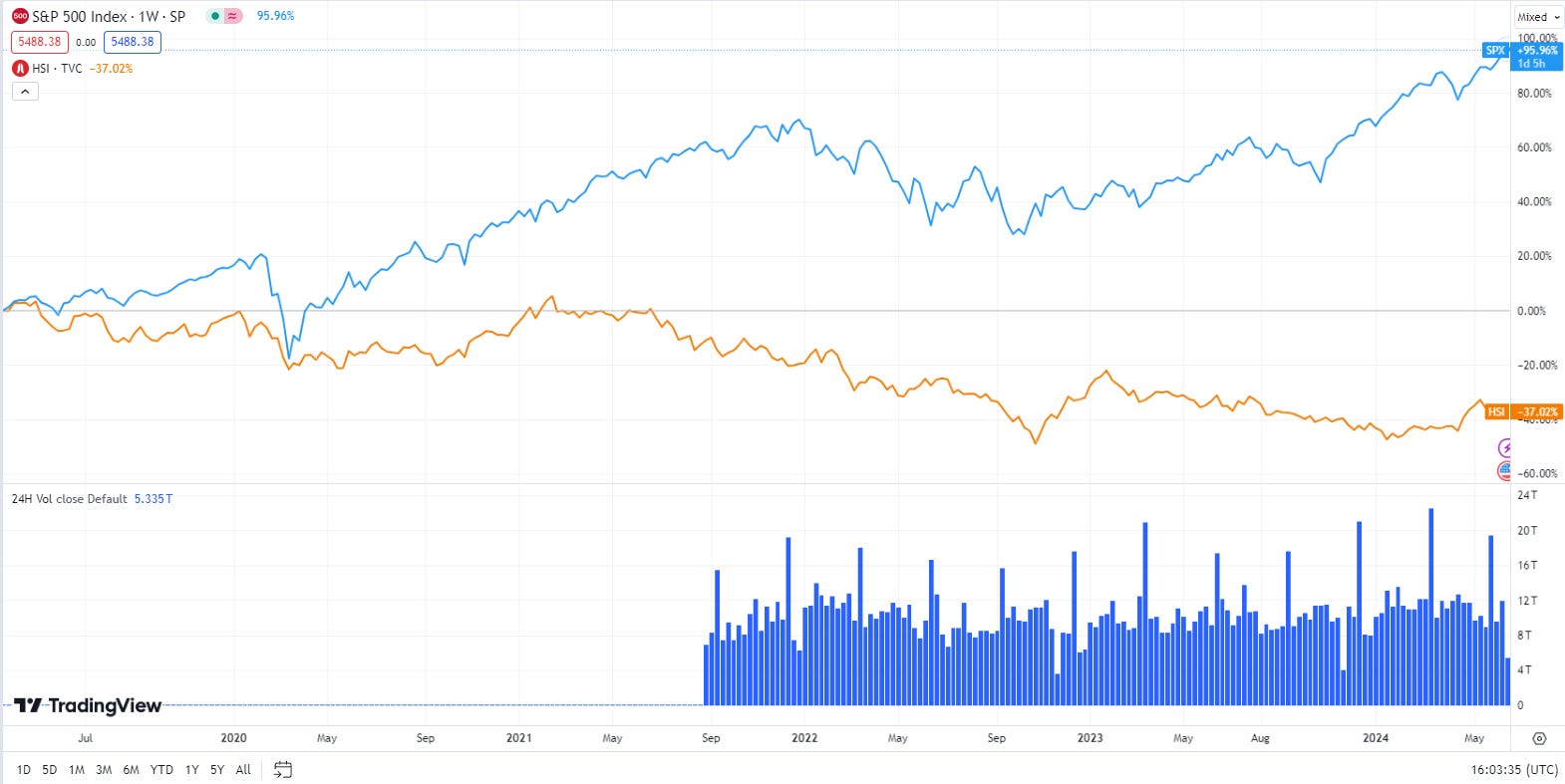
This outlook is reflected in the Hang Seng index, which has plummeted 39% since 3/15/19 at the start of Hong Kong riots, contrasting sharply with the S&P 500's rise of 96%. While some investors view this as a buying opportunity, banking on Hong Kong's historical resilience, Roach's analysis suggests a meaningful enough underlying economic recovery is unlikely.
The interview also touched on US policymakers’ reception of Roach's recent book, "Accidental Conflict: America, China and the Clash of False Narratives" which we discussed in detail in a previous interview (HERE). Despite critical acclaim from former senior policymakers, Roach's proposed multi-step process for improving US-China relations has been largely sidelined in favor of increasingly aggressive posturing.
This aggression is evident in what Roach describes as a "dangerously incoherent" US trade policy. It targets China for persistent trade deficits that actually span over 100 countries, while also focusing on technology sectors that China views as strategic attacks. Moreover, it targets green industries where Chinese overproduction could actually benefit global efforts to combat climate change.
Roach argues that this hostile policy approach ignores the economic co-dependency between the US and China. He suggests that containing the strategic risks posed by a growing China could be achieved more effectively by leveraging mutual needs and applying pressure more strategically.
A prime example of this potential synergy lies in a symbiotic irony: the savings-deprived US economy could find complementarity with the consumer-deprived Chinese economy. However, this opportunity is being overlooked in favor of more confrontational tactics.
Roach also discusses a hypothetical scenario where China could go on a buyers' strike of US Treasuries. While he doesn't consider this likely, such an action could trigger a US debt crisis with far-reaching consequences.
As we navigate these complex economic and diplomatic waters, Steve Roach's insights provide invaluable guidance. His ongoing commentary, available through his Substack and at www.stephenroachauthor.com, offers a crucial perspective on the evolving Sino-US relationship and its implications for global prosperity.
In an era where the foundations of global economic stability are increasingly uncertain, voices like Roach's are essential in charting a path towards mutual understanding and sustainable prosperity. His analysis underscores the critical need for nuanced, strategic thinking in managing one of the most consequential bilateral relationships of our time.