
In my most recent YouTube episode with Matt Hougan, CIO at Bitwise Asset Management, and Ryan Rasmussen, the firm's head of research, the magnitude of America's fiscal crisis becomes starkly clear. Their newly released report entitled Bitcoin- Long Term Capital Market Assumptions doesn't just analyze an investment—it maps out a financial lifeboat for the next generation.
The Debt Reality No One Wants to Face
The numbers are staggering. In America's first 200 years, the nation accumulated $650 billion in debt. In just the last 50 years, that figure has exploded to $36.2 trillion—with half accumulated in the past decade alone.
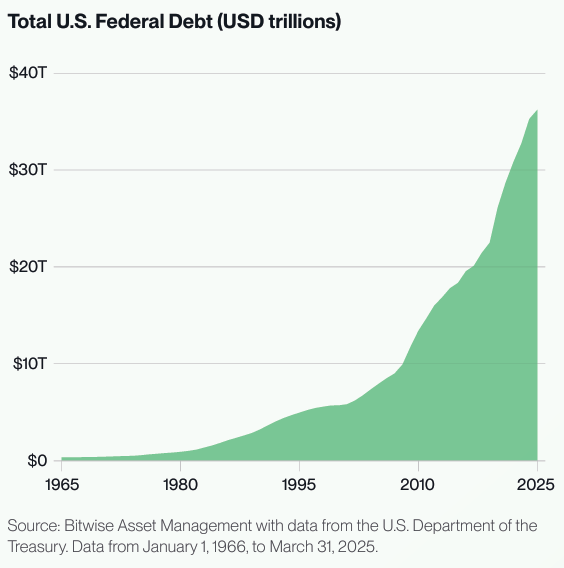
Today, every American citizen effectively owes more than $100,000, and interest payments on the national debt have become the fourth-largest line item in the federal budget at $952 billion annually. To put this debt burden in perspective, the table below shows what this means relative to income levels—helping readers understand just how significant this obligation has become for the average American.
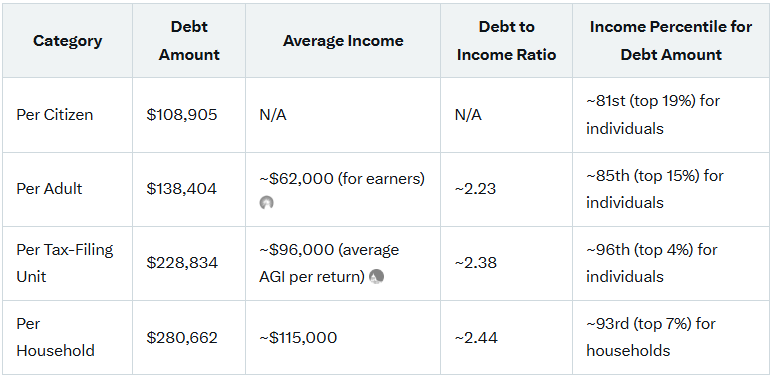
Chart updated to reflect current $37.3T debt per USAfacts.org.
"If one of the world's leading entrepreneurs—and an iconoclastic president unafraid of shaking up the establishment—cannot even marginally slow spending, we doubt anything will," Hougan observes, referring to the swift dissolution of Elon Musk's Department of Government Efficiency (DOGE). The harsh reality: deficit spending increased nearly 10% in just the first 80 days of the current administration.
This isn't a partisan issue—it's a mathematical inevitability. As Hougan notes, "The one thing we all agree on as a country is we should print and spend more money."
Bitcoin as a Service
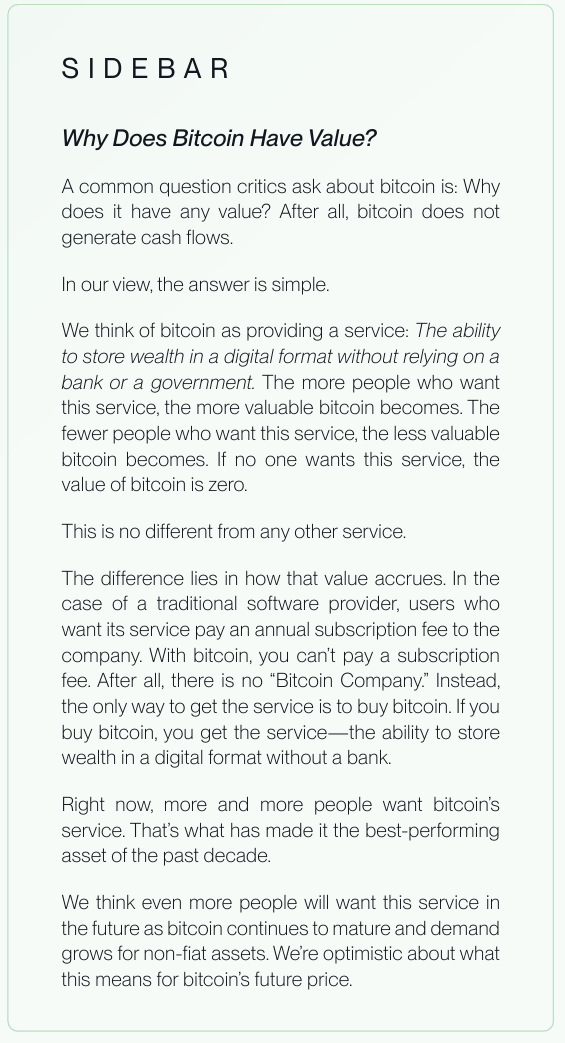
"Bitcoin provides a service: the ability to store wealth in a digital format without relying on a bank or a government." Hougan's simple description says it succinctly.
Think of it like Microsoft. The company provides software services, and the more people who want those services, the higher Microsoft's value rises. Bitcoin works identically, except you can't write a subscription check to "Bitcoin Inc." The only way to access Bitcoin's service is to buy Bitcoin itself.
Today, hundreds of millions of people worldwide want this service. With US debt spiraling and money printing accelerating globally, that demand is only growing, just as it has consistently for the past 15 years since its inception.
The Institutional Wave Is Just Starting
Perhaps the most compelling aspect of Hougan and Rasmussen's thesis is the institutional adoption runway ahead. Until 2024's launch of Bitcoin ETFs, most institutional investors couldn't easily access Bitcoin even if they wanted to. Now they can—and they're starting to allocate in meaningful size.
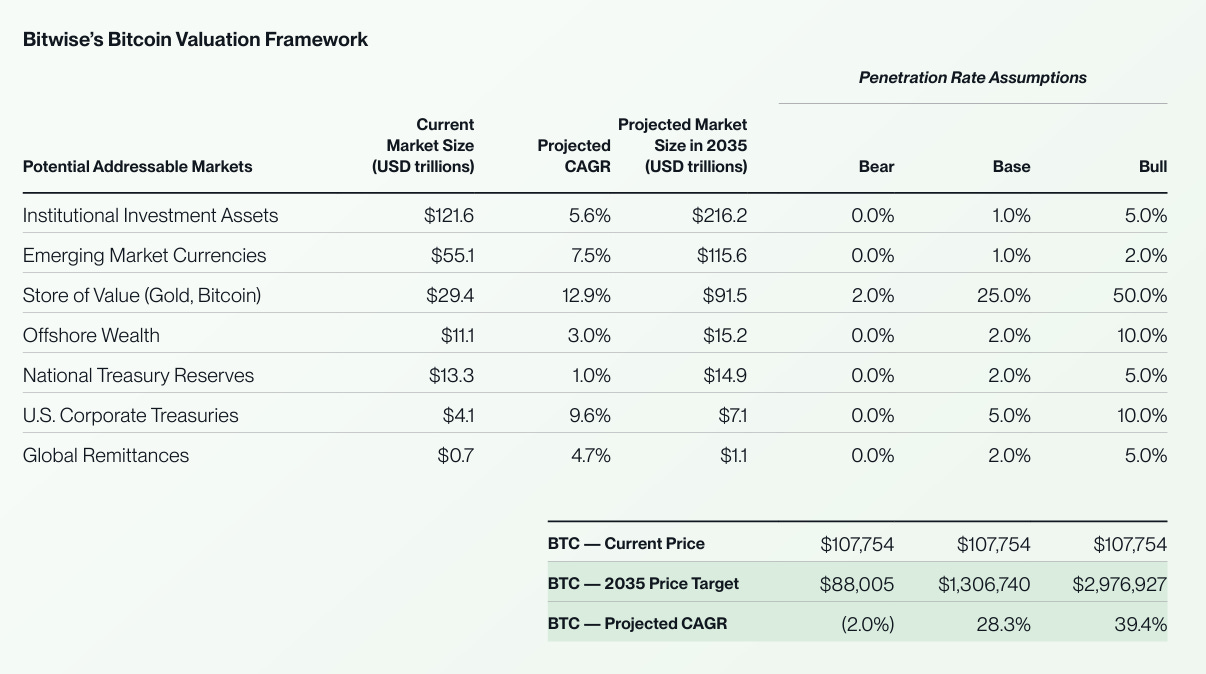
The World Bank estimates institutional investors control roughly $100 trillion in assets. Bitwise projects these investors will allocate between 1-5% to Bitcoin over the next decade—representing $1-5 trillion in potential buying pressure. Currently, Bitcoin ETFs hold just $170 billion, suggesting we're in the early innings of institutional adoption.
Corporate adoption is accelerating too. More than 150 public companies now hold Bitcoin on their balance sheets (up from 70 in April, 2025), controlling over 5% of Bitcoin's total supply. With companies holding $8 trillion in cash globally, even a modest 10% shift toward Bitcoin represents nearly $1 trillion in new demand.
The Gold Precedent
Critics often dismiss Bitcoin as having no "real" value, but Hougan draws a powerful parallel to gold's post-1971 journey. Before Nixon severed the gold standard, gold traded at a fixed $35 per ounce for decades. Once freed to float, gold soared to over $800 by 1980 - a prescient market signal of the undisciplined money-printing era that would follow, which has indeed proven out over the subsequent decades.
Bitcoin is following a similar path. Like gold in the 1970s - which had been dismissed by Keynes as a 'barbarous relic' - Bitcoin was initially met with skepticism and extreme volatility. Over time, as acceptance grew, gold's volatility declined to today's more stable levels.
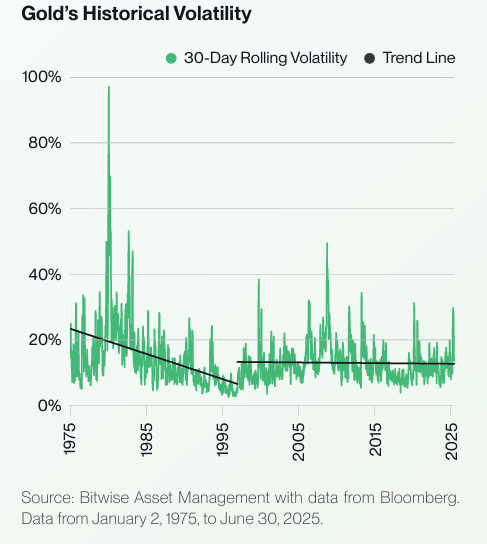
Bitcoin's volatility is following the same downward trajectory as institutional adoption increases.
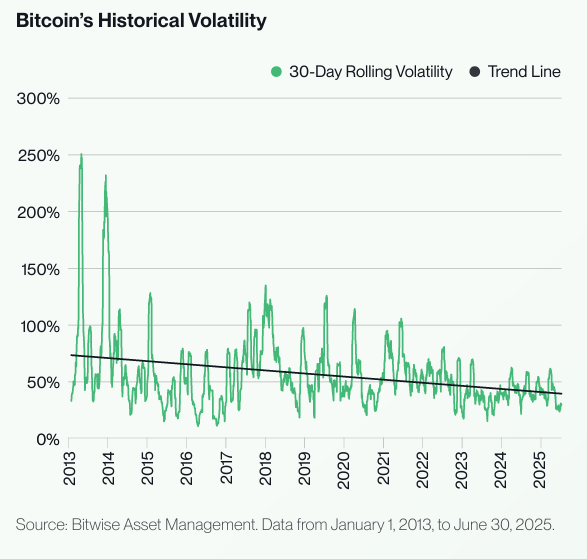
The key difference? Bitcoin is "infinitely more transportable, divisible, and useful than gold," positioning it as the next evolution of hard money.
Central Banks Are Paying Attention
Central bank gold purchases have nearly doubled in recent years as governments hedge against dollar dominance and geopolitical risks. The seizure of Russia's treasury assets sent a clear message: dollar reserves aren't truly sovereign.
Bitcoin offers an alternative. Already, more than a dozen countries hold Bitcoin, and this number is growing.
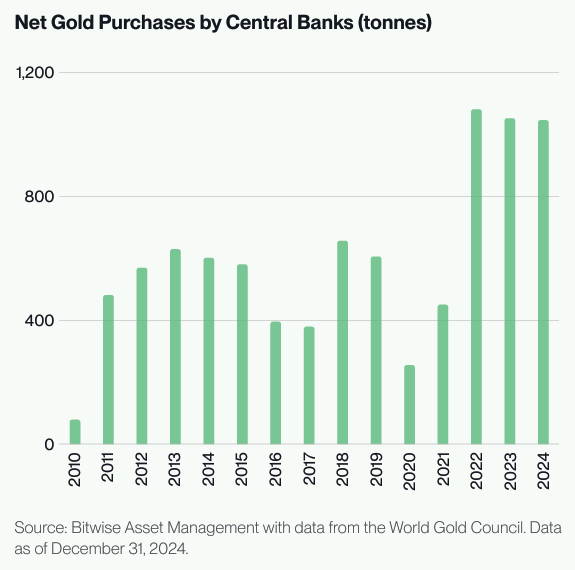
As Rasmussen notes, "One of the ways they move away from dollars as part of their foreign exchange reserves is by selling those dollars and buying gold. And we believe that the same trend will occur with Bitcoin. They will sell dollars and they will buy gold and they will buy Bitcoin."
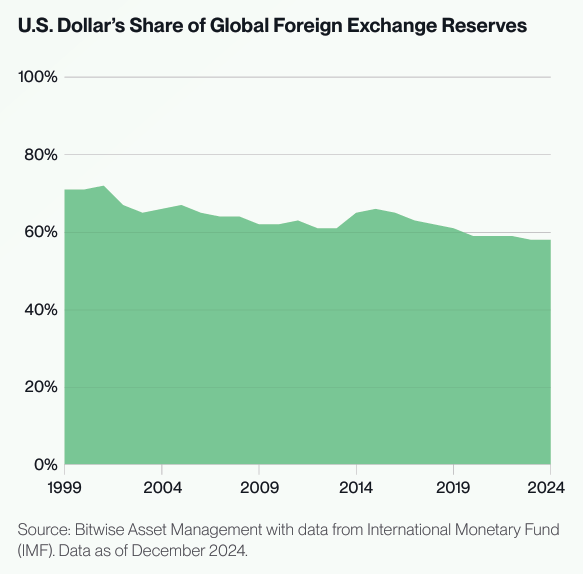
Meanwhile, the dollar's share of global reserves has been quietly declining from over 70% to under 60%—creating space for alternative reserve assets.
The Insurance Case Strengthens
Bitwise's base-case forecast projects Bitcoin reaching $1.3 million by 2035—a 28.3% compound annual growth rate. While that may look aggressive, it reflects a fundamental shift: Bitcoin's evolution from a retail-driven curiosity to an institutional-grade hedge against fiscal instability.
The regulatory environment has shifted decisively in Bitcoin's favor, with bipartisan support in Congress and pro-crypto leadership across key agencies. This appears more durable than a typical political swing, particularly given the breadth of Wall Street support—it represents institutional recognition that Bitcoin offers genuine portfolio diversification and protection against currency debasement.
The data speaks for itself—from debt trajectories to reserve currency shifts to central bank behavior, every trend points toward a world that needs Bitcoin's service more than ever. The debt/deficit math doesn't lie. Gold's recent surge to all-time highs may itself be signaling today as it did during its rise in the 1970s that significant dollar debasement will be the outcome. For those who accept this premise, Bitcoin offers three key advantages over gold: high prices cannot stimulate increased production, most investors globally have yet to adopt it as an acceptable hedge, and it's infinitely more transportable, divisible, and useful than gold. The question is whether you buy the insurance before you need it.
Bitwise Report: Bitwise-Bitcoin-Long-Term-Capital-Market-Assumptions-2025
Thank you very much to our sponsors:
Truflation: Learn about what prices are actually doing by going to do by going to https://truflation.com/marketplace/us-inflation-rate; BUY Truflation products and services with this code and save 10%: BOBDEW10.
Foundation: Protect your Bitcoin using the latest off-line technology with easy-to-use Passport. Their next product, Passport Prime will protect all passwords off-line with even-better technology. https://foundation.xyz/
River Financial: If not cold storage for your Bitcoin, I’d highly recommend River for buying and holding- River is engineered to protect your Bitcoin over the long run. Use this link for discounts: https://river.com/signup?r=T7GGAF7G