
Every once in a while, life gets busy, and when you lift your head up you make startling discoveries, and that happened to me this morning.
3 essays caught my attention that are central to the idea of today’s pessimism/optimism conundrum. The last one below is by far the most important! If you don’t have time, skip the first two paragraphs…
This article was important because retirement funding is a key component of a society’s prosperity. It underscored the power of compounding in rescuing pensioners from under-funded corporate pension plans. Kodak’s plan has a $30k surplus for every pensioner today, and the article explains the constraints put on corporate sponsors who are far more interested in retaining that surplus than offering it to their pensioners. It showed how our advanced capital markets offer solutions to pension deficiencies. Juxtaposed to this are estimates of as much as a $5 trillion shortfall in US public pension funds in the US, which is about a 50% funding to total liabilities, which is a hidden economic burden that needs to be addressed. (Source: https://siepr.stanford.edu/news/public-pensions-are-mixing-risky-investments-unrealistic-predictions)
WSJ: “The Rough Years That Turned Gen Z Into America’s Most Disillusioned Voters”
(https://www.wsj.com/politics/elections/gen-z-voters-election-tiktok-5bcdc524)
This article cuts to the core mission of my Substack and YouTube Channel (HERE).
There is a rising hopelessness (reaching beyond pessimism) among Gen Zers despite a generally favorable economic backdrop in the US. The article uses one anecdote to underscore this: the pandemic robbed one college student of opportunities who now has a low-paying job but created a TikTok channel that has grown to thousands of subscribers that she takes pride in… only to have distant politicians pass a law that threatens to take that away from her.
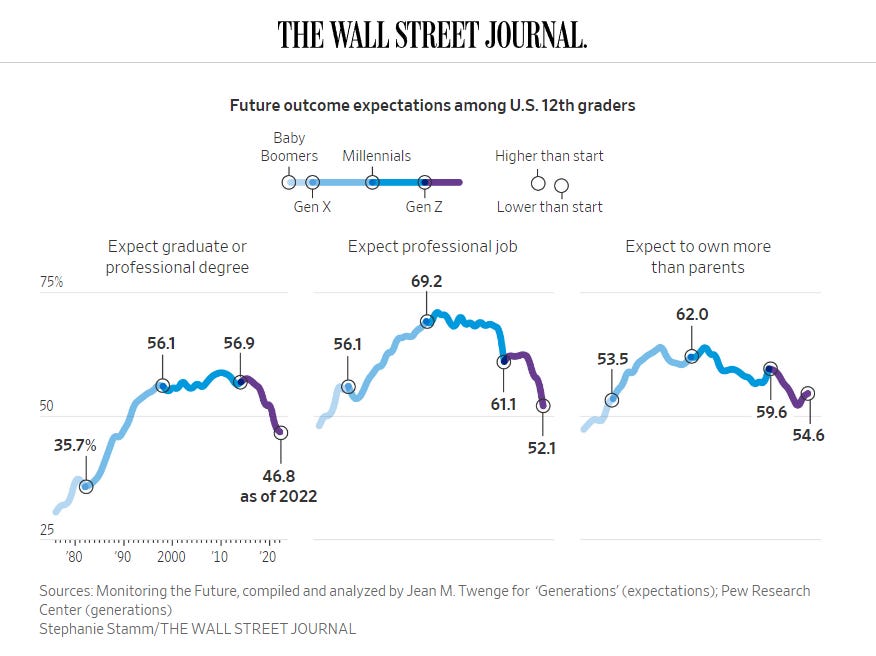
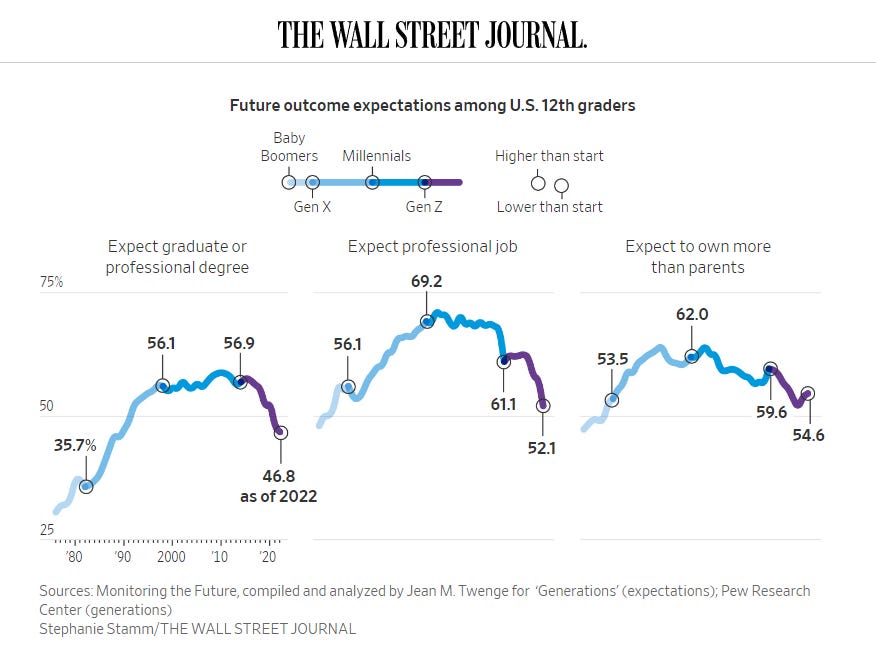
“More young people now say they find it hard to have hope for the world than at any time since at least 1976, according to a University of Michigan survey that has tracked public sentiment among 12th-graders for nearly five decades. Young people today are less optimistic than any generation in decades that they’ll get a professional job or surpass the success of their parents, the long-running survey has found. They increasingly believe the system is stacked against them and support major changes to the way the country operates.”
Larry Fink’s 2024 Shareholder Letter: Larry Fink’s 2024 Annual Chairman’s Letter to Investors | BlackRock
THIS IS A MUST READ! Don’t settle for news stories about it.
There are so many excellent observations he makes and conclusions he draws that any summary will not do it justice.
The reason I want to write about it is that our American society has created wealth that for the century has been sufficient for our government to establish “safety nets” for those in need. Perhaps much of the optimism Americans held over the past century has been because of the rise of these programs, if not some actual effectiveness of many of them.
Perhaps the most important component has been the pension systems that have grown over the past century intended to give seniors financial security and independence that had only applied to a precious few previously.
Fink’s letter is a comprehensive exploration of today’s pension situation. One critically important component of that lies at the heart of many pessimists’ distress and actually poses a threat to the well-being of the elderly: US Federal Debt and structural deficits. He writes emphatically “DEBT MATTERS.”
He proclaims there is a way out from under this debt burden- fostering a higher economic growth rate, which he pointed out requires “pro-growth policies.” Growth is key, especially because economists generally agree that high debt serves as a brake to economic growth. One of the key drivers of this gravitational effect on economic growth is the interest payment burdens which shifts capital from productive investment into non-productive debt service. Our Zero Interest Rate Policy (ZIRP) over much of the last decade obscured the effects of the interest expense burden through low rates, but it also obscured the principal repayment burden as well because US credit-worthiness was better with low rates, so selling new Treasuries was theoretically much easier.
Much of his commentary pointed to one of America’s greatest strengths- its capital markets- as a tool to improve capital allocation in infrastructure and energy, and most importantly the mutually reinforcing benefits of individuals making productive investments in the economy and those investments providing security and independence for them in retirement.
A critically important point he makes, citing the WSJ article above, is:
“Compared with 20 years ago, the current cohort of young Americans is 50% more likely to question whether life has a purpose. Four-in-10 say it’s “hard to have hope for the world.”41
I’ve been working in finance for almost 50 years. I’ve seen a lot of numbers. But no single data point has ever concerned me more than this one.”
It is this loss of confidence in America that poses the starkest threat to the capital markets because if you fear the future, you lose the incentive to invest. In his words:
“Arguably the biggest barrier to investing for retirement — or for anything — is fear.
“In finance, we sometimes think of “fear” as a fuzzy, emotional concept — not as a hard economic data point. But that’s what it is. Fear is as important and actionable a metric as GDP. After all, investment (or lack thereof) is just a measure of fear because no one lets their money sit in a stock or a bond for 30 or 40 years if they’re afraid the future is going to be worse than the present. That’s when they put their money in a bank. Or underneath the mattress.”
Not Investment Advice!: I have no position in Blackrock, and I am not giving financial advice, but I will pass on non-investment, educational advice from one of my favorite portfolio managers though, because Mr. Fink’s letter is so comprehensive. My friend said he loved April and May because he learned so much about the companies that he owned or could own by reading what CEO’s wrote in their annual letter to shareholders. He pointed out that one-on-one meetings with CEOs gave small insights from time to time, but these letters were the one time each year that CEOs could spend as much time as they wanted crafting their message to their core constituency. He said he could tell if they were being consistent, articulate, responsive, insightful, constructive, confident, apologetic, defensive, defiant, worried, etc, and whether they were effective at running a focused operation. This letter left an impression on me about the direction and progress at Blackrock, and it might on you too.