
This is the second in our series examining insights from our recent roundtable on the gold standard counterfactual. In our previous essay, we explored how Nixon's 1971 decision potentially reduced economic growth by up to 70%.
People have grown accustomed to governments running significant deficits since 1971 perhaps because these fiscal realities remain too abstract for many to understand why things might be different under an alternative monetary system. An analogy, while elementary, might prove instructive.
Imagine your neighborhood association discovers a special credit card with three unusual features:
the minimum payment is incredibly low;
the credit limit automatically increases when approached; and
most of the debt will be paid by future residents who haven't even moved in yet.
Initially, the elected association board funds reasonable expenses—maintaining common areas and organizing community events. But as board members realize how easy it is to charge purchases, spending becomes increasingly extravagant. They build an oversized clubhouse that sits mostly empty, hire excessive security, create elaborate landscaping requiring constant maintenance, and establish a neighborhood bureaucracy employing dozens.
The association begins directing business to community members—contracting exclusively with one resident for pool services, another for plumbing, and several others for various maintenance tasks. Some even start businesses where the association is their only customer, creating a network of dependence on continued association spending.
When residents question new expenditures, board members respond, "It's practically free—we're only paying 2% interest, and future residents will help cover the cost." Meanwhile, residents' disposable income shrinks as association dues consume an ever-larger portion of their budgets. A young couple mentions they can't afford to start a small business because so much of their income goes to the association.
Another family struggles with car payments, prompting association leaders to create a direct support programs households. Soon, they're hiring residents to administer various neighborhood programs. Beneficiaries and others become advocates for the association's expanded role and reliably vote for board members who promise even more generous benefits, helping to entrench the system regardless of its sustainability.
Eventually, the credit card comes due. With insufficient revenue to cover even minimum payments and no further credit available, the association faces bankruptcy.
However, this analogy is insufficient because it's missing a crucial power that governments have possessed since 1971 that our fictional association does not—the ability to issue currency. With this power, the association could extend the bankruptcy date significantly. Hence our discussion about the gold standard.
Since Nixon abandoned the gold standard in 1971, the dollar has declined in purchasing power by 68.7%.
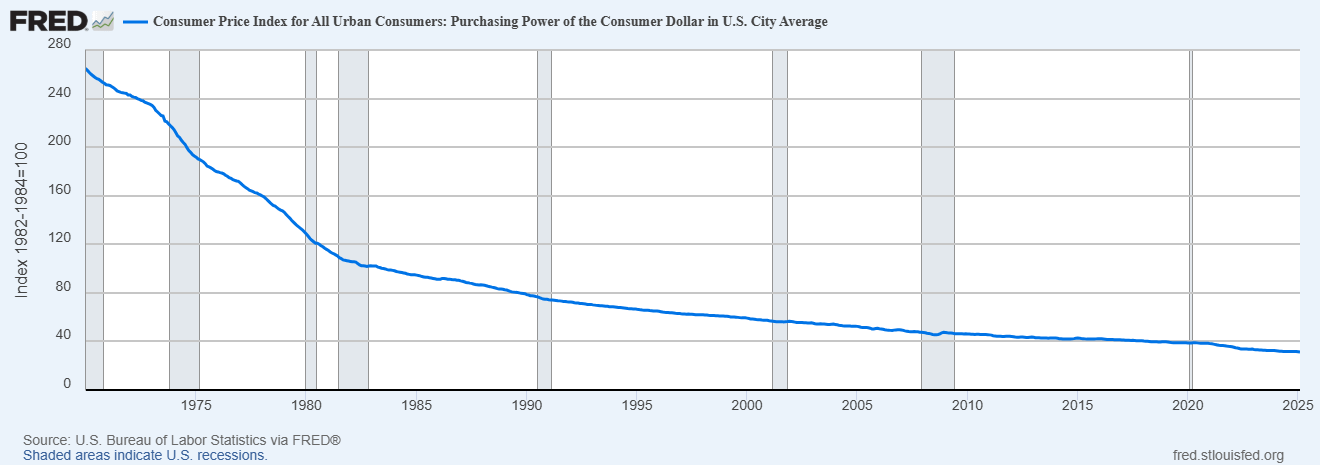
This currency debasement functions as an invisible taxation system—one that citizens rarely perceive directly but nonetheless reduces their purchasing power over time. As Lyn Alden noted in our roundtable, "Weak money or government-printed money does have an incentive and allowance for governments to get bigger with kind of fewer near-term risks to them."
An important dimension highlighted in our discussion concerns the difference between a country before excessive debt has accumulated versus after becoming over-indebted. Early in what economist Ray Dalio calls the "long-term debt cycle," countries have substantial flexibility to raise debt or print money with minimal negative consequences. However, as leverage increases, this flexibility diminishes significantly. What works for an underleveraged country can become destructive for an over-leveraged one—a reality increasingly relevant as global debt surpasses historic extremes.
By creating currency and other Federal Reserve activities like QE, prices of money become distorted through changes in the supply of money relative to the demand of T-bills and Treasuries, and sometimes other markets. Furthermore, when government becomes a major customer in the private economy, it can also distort market incentives in profound ways. As Troy Cross observed, "Price signals are a public epistemic good. They tell us in a free market, in a fair market, in a transparent market... how much stuff is available and what people want."
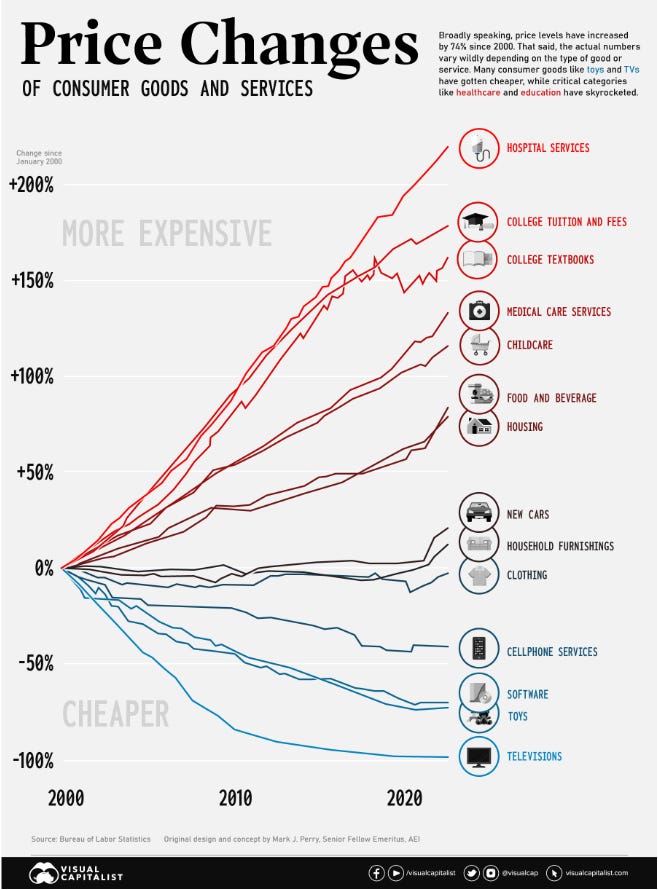
Industries serving government learn to master bureaucratic maneuvering rather than focusing on creating the best products at the best prices. This explains why sectors with heavy government involvement—healthcare, education, and housing—have seen the most dramatic price increases over recent decades, far outpacing overall inflation.
A gold standard imposes discipline by preventing unlimited monetary creation. It requires governments to either raise taxes or issue debt that must be repaid in gold-backed currency. This constraint forces prioritization and limits spending to what citizens actually support through taxation or lending.
Fiat currency fundamentally shifts power from individuals to governments, while hard money systems do the opposite. When individuals can freely choose currencies to store and spend their wealth, economic decision-making remains decentralized and responsive to actual needs and preferences. When governments can create money at will, power concentrates and individual economic sovereignty diminishes.
In our next essay, we'll explore how abandoning the gold standard has affected wealth distribution, examining Lyn Alden's insight that there are fundamentally two different types of wealth concentration: one driven by innovation and the other by financial arbitrage. We'll see how the post-1971 era has witnessed a dramatic shift toward the latter.
Exploring the Gold Standard Counterfactual: The Complete Series
This six-part series explores different dimensions of how our world might differ if Nixon had reinforced the gold standard in 1971:
• Part 1: Economic Growth - Examining Murphy's provocative claim that global GDP could be 70% higher today under a gold standard
• Part 2: Government Size and Spending - How monetary systems influence government's role in the economy
• Part 3: Wealth Distribution - Why fiat currency systems distort the distribution of wealth compared to hard money economies
• Part 4: Financial Markets - How monetary uncertainty transformed investment into speculation
• Part 5: War and Crisis Management - The tension between discipline and necessary flexibility
• Part 6: The Technological Challenge - Can Bitcoin solve what gold couldn't?
Thank you to our sponsors:
Truflation: Learn about what prices are actually doing by going to https://truflation.com/marketplace/us-inflation-rate
Foundation: Protect your Bitcoin using the latest off-line technology with easy-to-use Passport. Their next product, Passport Prime will protect all passwords off-line with even-better technology. https://foundation.xyz/
River Financial: If not cold storage for your Bitcoin, I’d highly recommend River for buying and holding- River is engineered to protect your Bitcoin over the long run. Use this link for discounts: https://river.com/signup?r=T7GGAF7G