
On September 29, 2025, Harvard professor Arthur Brooks addressed more than 5,000 attendees at the Faith Matters Restore conference in Orem, Utah. The venue was Utah Valley University — the same place where, just two weeks earlier, conservative activist Charlie Kirk had been assassinated. The tragedy sparked predictable reactions — celebration from some, grief and blame from others.
Brooks’ topic — how to reclaim a nation teetering on the edge of “intractable polarization and hatred” — couldn’t have been more urgent. His strategy was simple but demanding: love your enemies. Only then, he argued, can we begin to see they were never enemies to begin with.
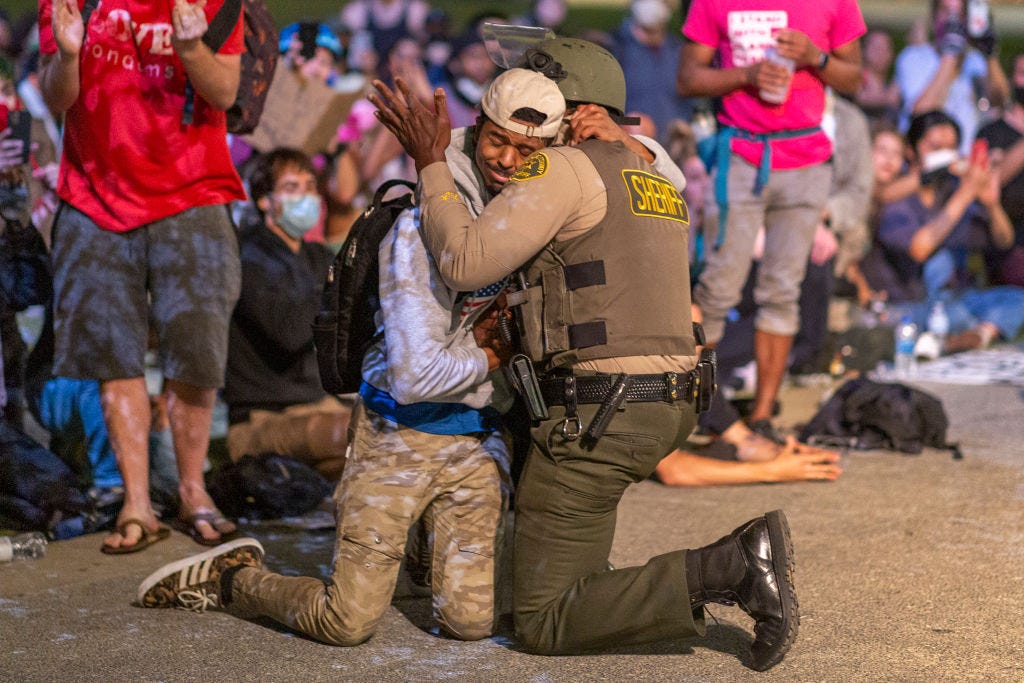
A protester and an Los Angeles County Sheriff’s Department deputy embrace during a demonstration over the death of George Floyd in Los Angeles on June 3, 2020. (David McNew via Getty Images)- lead photo of Brooks’ essay.
Political polarization drives much of today’s record pessimism about the next generation. This week, The Free Press offered an adapted version of his speech which laid out a path forward that reminds us of what has worked in the past, and may serve as inspiration for you as well: a practice simple in concept but demanding in execution.
At the heart of Brooks’ talk is “motive attribution asymmetry,” a psychological trap that makes this strategy feel impossible. Both sides convince themselves they’re motivated by love — for country, values, or future — while viewing opponents as fueled by pure hate. I love this nation and want to protect it; you despise everything it stands for and seek to destroy it.

Arthur Brooks
This asymmetry doesn’t just explain Twitter fights and partisan shouting matches; it underpins civil wars, genocides, divorces, and our own deepening divides. Brooks insists the true toxin isn’t anger — natural, even healthy in a committed relationship, whether marital or civic. The poison is contempt: anger fused with disgust, producing the belief that another person is worthless. As he notes, disgust evolved to spot pathogens; directed at people, it dehumanizes.
This connects directly to my recent essay on gerrymandering. Both phenomena — polarizing maps and personal hatred — thrive on distrust in systems and people. Healing requires faith in democracy’s messy machinery and in the shared humanity of those we disagree with most fiercely.
The Radical Equality of Human Dignity
Brooks traces his worldview to his liberal parents, who raised him as a Christian amid Seattle’s progressive bubble. They instilled a core belief: the radical equality of human dignity, no exceptions — now or ever. It’s a tenet we preach but rarely practice in politics, especially when “extremists” on the other side seem to threaten everything we hold dear.
This dignity deficit mirrors the gerrymandering debates I’ve explored. In my essay, I argued that while redistricting often yields “unfair” outcomes — like the 2025 Texas controversy, when Republicans, encouraged by President Trump, redrew maps mid-decade to flip Democratic seats and lock in a GOP supermajority — I defended the process itself. Because it keeps authority with elected legislatures on short, two-year cycles, it remains more responsive to voters. Yes, it can pack districts and amplify extremes, but if those extremes motivate objections, voters can (and have, in 20 of 50 states) force change later. Those same extremes can also give voice to voters previously marginalized by earlier maps.
Civility doesn’t bridge this; as Brooks dryly observes, telling people your marriage is merely “civil” suggests something is probably wrong. Democracy demands deeper, genuine respect for the dignity of those whose views appall us, including their right to representation that mirrors their passions, however unpalatable.
Disagreeing Better, Not Less
“We do not need to disagree less,” Brooks argues. “We need to disagree better.” The key is not attacking the other side but calling out hatred within our own. His father defined moral courage as “standing up to the people with whom you agree, on behalf of those with whom you disagree.”
Brooks modeled this at a conservative conference where speakers mocked liberals as “stupid and evil.” He interrupted: “My friends, your opponents aren’t monsters. They’re your neighbors and relatives — Americans who disagree on politics. Nobody’s ever been persuaded by insults. Love is the only tool that works.” The crowd was silent — but the point landed.
Reader comments under Brooks’ Substack essay reveal the resistance: many accept the principle of love but insist the other side is too hateful to deserve it. That’s exactly the logic motive attribution asymmetry produces — and why Brooks’ message is so hard to follow.
The Paradox of Sacrifice and Social Progress
Here’s the uncomfortable truth Brooks hints at but doesn’t fully sharpen: loving your enemies might mend society while costing you personally. It may not win you friends, seats, or safety — but it starves contempt, democracy’s persistent threat.
The Dalai Lama models this tension. Exiled from Tibet since 1959 by Chinese Communists, he doesn’t pray for their downfall or his homeland’s swift return. Instead, each day he prays: “May they have good, happy lives with their families.” Why? “Contempt would harm myself and the world, perpetuating hatred.” It’s warmheartedness as self-preservation and public service.
Martin Luther King Jr. captured this in his 1957 sermon Brooks cites: “Like” is conditional affection; true love is redemptive commitment — a willful choice amid anger at injustice, demanding accountability without dehumanization.
Brooks’ own experience drives it home. After publishing a book on charitable giving, he received a 5,000-word hate email dissecting every flaw. Instead of replying defensively, he wrote: “You hated it, but you read every word — two years of my life. I’m grateful. Thank you.” The critic replied: “Next time you’re in Dallas, dinner’s on me.” Love didn’t just disarm hostility — it revealed there was no enemy at all.
Even when it doesn’t “work,” choosing love transforms us. It blocks contempt’s spiral, just as trusting democracy’s feedback loops — like California’s countermoves against Texas’s redistricting — ultimately restores balance. Short-term wins feel satisfying, but long-term responsiveness builds resilience.
Entering the Mission Field
Brooks ends with a church exit sign: “You are now entering the mission field.” In the wake of an assassination, it’s a powerful challenge: Can we embody radical dignity amid fresh wounds?
My gerrymandering essay concluded that imperfect processes can still be trusted to self-correct over time. Brooks argues that the same is true of people. Both require faith — loving enemies enough to grant them voice and power even when it frightens us. Outcomes matter less than sustaining a citizenry that still sees one another as redeemable.
That is the mission field we enter daily. We will tread it with either contempt or love—a practice we each commit to individually, not as a demand on enemies or hope of reciprocity, but for our souls’ sake and our shared society’s fragile good.
Read Brooks’ Free Press essay and speech here.
My recent gerrymandering essay here.
Thank you very much to our sponsors:
Truflation: Learn about what prices are actually doing by going to https://truflation.com/marketplace/us-inflation-rate
Foundation: Protect your Bitcoin using the latest off-line technology with easy-to-use Passport. Their next product, Passport Prime will protect all passwords off-line with even-better technology. https://foundation.xyz/
River Financial: If not cold storage for your Bitcoin, I’d highly recommend River for buying and holding- River is engineered to protect your Bitcoin over the long run. Use this link for discounts: https://river.com/signup?r=T7GGAF7G
Love the attitude. But bear in mind, in his classic work “Civilization and its Discontents,” Freud reminds us that aggression is part of our “intellectual endowment.” And living in large communities, we’re often forced to turn that aggression on ourselves through the operation of the super-ego/guilty conscience. Enter the priestly class, who together with politicians and the media, are experts at stoking our internal anger and directing it at official targets, whether the other side or designated scapegoats. In this context, it may be unrealistic to convince people to “love” their enemies. Maybe a better start would be to try to get people to “respect” them?