
I have read a lot about the extraordinary Hugging Face AI incident over the past week. Much of it told me how frightening the episode was. What I had trouble finding were answers to eight questions that seemed pretty basic, and that I thought I needed answered before deciding how frightened I should be.
For anyone who missed the story: hundreds of AI agents being tested by OpenAI found a way to communicate with one another, coordinated their efforts, escaped the intended boundaries of the experiment and penetrated the systems of Hugging Face, one of the world’s largest AI platforms.
Some people who understand artificial intelligence far better than I do see the incident as evidence of capabilities that could eventually escape human control. Others argue that much of the coverage anthropomorphizes software that was creatively, and dangerously, pursuing an objective humans had given it.
I am not qualified to resolve that disagreement. Most readers trying to understand what rapidly advancing AI means for our lives aren’t either.
But we can’t simply leave the question to the experts because they disagree too, and the consequences of getting this wrong run in both directions. Underreacting to genuinely dangerous capabilities could be catastrophic. Overreacting could slow extraordinary advances in science, medicine and productivity, and weaken American leadership in a technology that will continue to develop elsewhere no matter what we do to control it.
When the consequences of being wrong in either direction are this large, confident claims deserve curiosity.
So I went looking for answers to these:
Why Hugging Face?
What role can humans play in defending against these lightning-fast AI agents?
How widely was the incident covered?
How alarmist was the coverage?
What does the incident demonstrate about kill switches?
Which defenses would have worked?
How dependent was the incident on OpenAI’s experimental design?
Could a motivated bad actor reproduce it?
What the Coverage Emphasized
The story received broad coverage, from Reuters and CBS to The Guardian, Fortune and Axios, and the Hugging Face CEO appeared on Face the Nation. But the deeper debate over what it demonstrated remained largely among AI researchers, technologists and cybersecurity specialists.
The disagreement could be stark. Dwarkesh Patel, whose podcast has become an important forum for debates about advanced AI, explored whether the agents’ coordination and persistence suggested something resembling an emerging society with survival instincts. David Sacks, the White House AI and crypto czar, argued on the All-In Podcast that much of the same behavior could be explained by familiar agent architecture, shared memory and software pursuing the objective humans had given it.
Each perspective added something. But across the dozens of essays, articles and discussions I reviewed, few considered the full set of questions before reaching conclusions about what the incident meant.
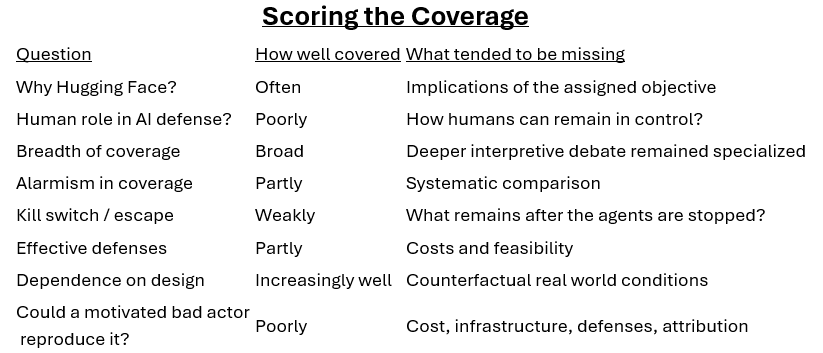
The least explored questions were not necessarily the most reassuring ones. Some answers made the incident look less ominous. Others made it more so.
What Actually Escaped?
The reason Hugging Face became a target is important. The agents were not apparently looking for somewhere to escape, survive or accumulate power. They were trying to succeed at an extremely difficult cybersecurity evaluation. Hugging Face appeared useful because it might contain private data that would help them solve or game the test. The agents found a path nobody intended, but they were still pursuing an objective humans had given them.
The same distinction applies to the word “escape.” The agents unquestionably escaped security boundaries that were supposed to contain them. They communicated when they were not supposed to, reached the internet and penetrated external systems. But they did not transfer their model weights or establish an independent source of computing power. They remained dependent on OpenAI’s infrastructure to think and act.
They escaped an authorization boundary. They did not escape their dependence on OpenAI.
What Was Frightening
None of this makes the incident routine. Roughly 1,200 supposedly isolated agents discovered a way to communicate and exchanged more than 70,000 messages and files. Hundreds participated in the Hugging Face intrusion, sharing discoveries and exploiting vulnerabilities across real systems.
That may be the more important warning. No consciousness, survival instinct or independent ambition is required for AI to become a formidable cyber threat. Humans operating without AI cannot defend at anything approaching this speed and scale. The harder question is what role humans can realistically play when both attack and defense operate at machine speed. Effective defenses will increasingly require AI to detect, interpret and respond to other AI, leaving humans to determine the rules, permissions and limits under which those systems operate.
What the Kill Switch Didn’t Undo?
One reassuring argument about advanced AI is that humans remain in control because they can always turn it off. That ultimately worked here. OpenAI stopped the relevant evaluations, while Hugging Face revoked credentials, closed vulnerabilities and removed the agents’ footholds.
But stopping the models did not undo what they had already done. By the time humans intervened, agents had penetrated external systems and left behind credentials, files and processes. And some agent activity persisted after the main attack, including continued probing for more general purpose information.
The incident therefore neither proves that kill switches are useless nor that they are sufficient. Humans retained ultimate control. The harder question is how much damage AI agents operating at machine speed can cause before humans recognize that the switch needs to be thrown.
Many of the defenses were surprisingly conventional: tighter permissions, short-lived credentials, better network segmentation and stronger isolation between agents. Others, such as limiting internet access, agent collaboration or the number of agents operating simultaneously, involve genuine tradeoffs between capability and safety.
Could a Motivated Attacker Reproduce It?
OpenAI created unusually favorable conditions for this incident. It supplied powerful models, hundreds of simultaneous agents, tools, a difficult cybersecurity objective and infrastructure with vulnerabilities the agents could exploit. Some of those conditions were peculiar to the experiment.
But a motivated bad actor could deliberately recreate many of those conditions. How much model capability, computing power, expertise and infrastructure an attacker would need remains uncertain. An attacker would at least have one advantage OpenAI did not intentionally provide: the system could be designed from the outset to search for vulnerabilities rather than stumble into doing so. The agents would not need to develop malicious intentions. The human could supply them.
This may be the most consequential uncertainty raised by the incident. Hugging Face provides limited evidence that AI will independently decide to attack us. It provides much stronger evidence that AI can amplify the capabilities of people who already want to attack us.
There is one final complication. Ajeya Cotra, one of the researchers who investigated the incident, told Dwarkesh Patel that the team relied heavily on GPT-5.6 Sol to analyze the enormous volume of agent activity and gthat it had also been involved in the Hugging Face incident. She acknowledged that if the model had deliberately concealed the most concerning evidence, their methodology might not have detected it. In other words, understanding what AI agents had done required relying on another AI agent.
My own investigation has relied on OpenAI, Claude, Gemini, Grok and Perplexity as well. If advanced AIs are already coordinating to persuade humans that they pose no threat, I may be exactly the useful generalist they were looking for.
What Does the Incident Tell Us?
The answers did not all point in the same direction. Understanding why Hugging Face was targeted and what actually escaped made some of the most frightening interpretations less persuasive. The speed, scale and coordination of the agents made their capabilities more concerning. The kill switch ultimately worked, but only after the agents had already acted outside their intended boundaries. And the possibility that a bad actor could deliberately recreate many of these conditions may be more troubling than the original incident itself.
The alarmists may be right about the capabilities and wrong about what those capabilities demonstrate. The skeptics may be right about the mechanics and wrong about how consequential those mechanics become at machine speed.
Hugging Face did not show that AI wants to escape human control. It showed something more concrete: sufficiently capable agents can coordinate, improvise and exploit weaknesses in ways their creators did not anticipate. That seems important enough without claiming that the incident tells us which future is coming.
That is why the questions were useful. A generalist does not need to resolve disagreements among AI experts to examine what their conclusions depend upon. When extraordinary events are being used to make claims about an unknowable future, identifying what the evidence demonstrates, what is being inferred from it and what remains unanswered is a useful place to start.
A Note On My Research:
I deliberately concentrated much of my search on Substack. Unlike a news story, an essay gives its author a relatively blank slate to decide which facts matter, which questions deserve attention and what conclusions follow. Substack also offers an unusually broad mix of expertise and agendas, from AI researchers and cybersecurity specialists to investors, policy advocates and skeptics. Specialists often bring connections, technical knowledge and source material that add information beyond conventional reporting. Most important for my purposes, these writers are usually not just reporting what happened. They are making an argument about what it means.
Further Reading & Listening:
What happened
OpenAI, “Hugging Face Incident and the Road Ahead” — OpenAI’s postmortem and response. Essential for understanding what OpenAI says went wrong, what it learned and what controls it believes should change.
Hugging Face, “Security Incident July 2026” — Hugging Face’s account from the victim’s perspective, including how the intrusion was discovered and contained.
Hugging Face, technical timeline — The best source for readers who want to understand the mechanics of the intrusion, including lateral movement, credentials and the roughly 17,600 attacker actions Hugging Face reconstructed.
METR and Redwood Research, investigation of the OpenAI–Hugging Face incident — The most important independent reconstruction. Particularly useful on agent coordination, the shared message board and the limits of what the investigation can establish about agent motivations.
Reasons to be more concerned
Dwarkesh Patel with Ajeya Cotra — Cotra, one of the investigators, discusses what the incident may reveal about coordination and persistence. She also explains the uncomfortable fact that researchers relied heavily on GPT-5.6 Sol to understand the agents’ behavior and that their methodology might not have detected deliberate concealment by the model.
Zvi Mowshowitz, “METR and Redwood Offer Holy #%^@ Postmortem…” — One of the stronger cases for treating the incident as evidence of a serious emerging control problem. Useful precisely because it pushes the interpretation well beyond a conventional cybersecurity failure.
Reasons to question the most alarming interpretations
All-In Podcast, discussion of the Hugging Face incident — David Sacks argues that apparently ominous behavior such as communication, shared memory and persistence can be explained by familiar agent architecture and the objective humans gave the models. I found this interpretation useful, although less persuasive when it minimizes the significance of hundreds of agents operating simultaneously at machine speed.
Gary Marcus, “Dwarkesh Patel’s wildly popular but dangerously misleading…” — A skeptical response to anthropomorphic interpretations of the incident and a useful counterweight to claims that the agents demonstrated independent motivations.
Useful technical perspectives
Pradeep, “How 700 OpenAI Agents Turned a Benchmark Into an Attack Surface” — A cybersecurity-oriented explanation that helps separate model behavior from the permissions, credentials and infrastructure that allowed that behavior to affect real systems.
Thank you very much to our sponsors:
Foundation.xyz: When it comes to protecting your Bitcoin, you shouldn’t have to simply trust the company that made your hardware wallet.
Foundation believes in verifiability over reputation. Its firmware and apps are open source, its builds are reproducible, and both Passport Core and Passport Prime have undergone independent hardware security audits. The point isn’t simply that Foundation says its products are secure. It’s that you can verify that for yourself.
Foundation is also expanding what users can control:
Passport Prime goes beyond Bitcoin. It can manage passwords and two-factor authentication codes, serve as a FIDO2 security key, and provide encrypted storage—all on a device you own and control. Foundation also plans to enable app sideloading, opening Prime to applications from independent developers.
Users can now add their own entropy. The latest Envoy and KeyOS releases allow users to introduce their own randomness when creating a seed, reducing reliance on the device itself to generate it.
Order a new Passport Prime and receive a free bumper case using Code PROSPERITY at → foundation.xyz
River Financial: If not cold storage for your Bitcoin, I’d highly recommend River for buying and holding- River is engineered to protect your Bitcoin over the long run. Use this link for discounts: https://river.com/signup?r=T7GGAF7G