
In an interview with Stefan Rust of Truflation last month HERE, and also with Fixed Income PM Caleb Tommasini last year HERE, I deepened my understanding of inflation.
Professional investors know that the CPI is a mere approximation of a measurement of rising prices of a basket of consumer goods over time.
Professional EQUITY investors (where I spent my career) do not need to follow the details of the CPI but are nonetheless watchful of it, especially when is changing rapidly. The stock market is considered to be vulnerable to decline in periods of rising inflation, but it is actually more sensitive to rising rates that normally accompany rising inflation.
Professional BOND investors, especially RATE investors (Government bonds) more than CREDIT investors (Corporate and other bonds where repayment is at risk of being variable), need to know much about inflation indicators like CPI because inflation erodes the value of future interest payments and repayments of principal, and therefore impact the daily trading of government bonds.
Government bond traders/investors have long studied CPI, PPI, PCE, and other published indicators of inflation. And everyone knows they are structurally flawed.
Here are some shortcomings:
1) Survey work represents a significant portion of the indices.
2) Much data collection is manual or slow and creates a time lag.
3) Data collection is limited to certain anachronistic datasets and procedures in an era of data abundance.
4) There are thousands of employees gathering and analyzing the data and survey results and there is a high propensity for (human) error.
5) Much of the reporting is subject to revisions, often without forewarning.
6) The Bureau of Labor Statistics (BLS) makes adjustments to smooth out inflation over time to some of the variables.
7) The government generates these inflation indices and has a strong vested interest in understating inflation for public dissemination.
Ironically, as flawed as these are, investors have always just accepted that any index would have to make significant assumptions (about spending mix, current pricing of long term assets like housing, adjustments to mix resulting from demand changes from changing prices, mix impacted by deflationary goods like photos, etc) and therefore the flaws were viewed as a necessary evil of the process.
But Stefan Rust, the Founder and CEO of Truflation has created a process of collecting a sufficiently broad set of data (over 13mm pricing datapoints) in real time that would be available by API to researchers, investors, corporate planners, or anyone at all, to allow for the creation of infinite alternative measures of any user’s “True Inflation.”.
Truflation, the company:
i) leverages data availability to eliminate lag and the need for surveys,
ii) leverages blockchains to eliminate revisions and create version histories that are immutable, and
iii) leverages technology to eliminate huge labor force and reduce error rates.
Truflation has created its own process to identify the best estimate of what real inflation is, and this measure tends to move in small cycles above and below CPI, as their data is not attempting to “smooth” changes, it is attempting to reflect true prices changes.
More importantly, Truflation also uses Bureau of Labor Statistics (BLS) procedures to predict what each CPI release will reveal, and given its real time access to data, can predict with high accuracy. This is a breakthrough for RATEs bond investors.
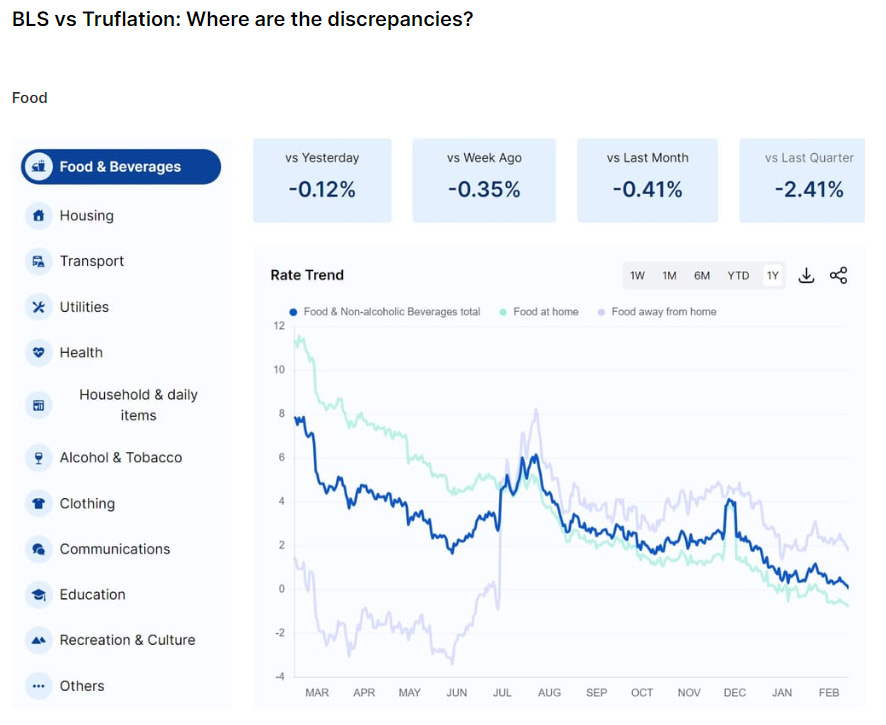
Truflation’s inflation indicator is more volatile than the CPI because it reflects real time data and does not need to be adjusted. Clients have access to category by category comparisons between their data and the CPI components as this chart from its web-site shows:
Let me know if you’d like an introduction to the company to better manage your COGS or your trading/investment strategies.