
The Stress Test
For several uneasy weeks, the market appeared to deliver its verdict on one of the fastest-growing experiments in modern finance. Preferred securities issued by Bitcoin Treasury Companies traded sharply below their intended range.
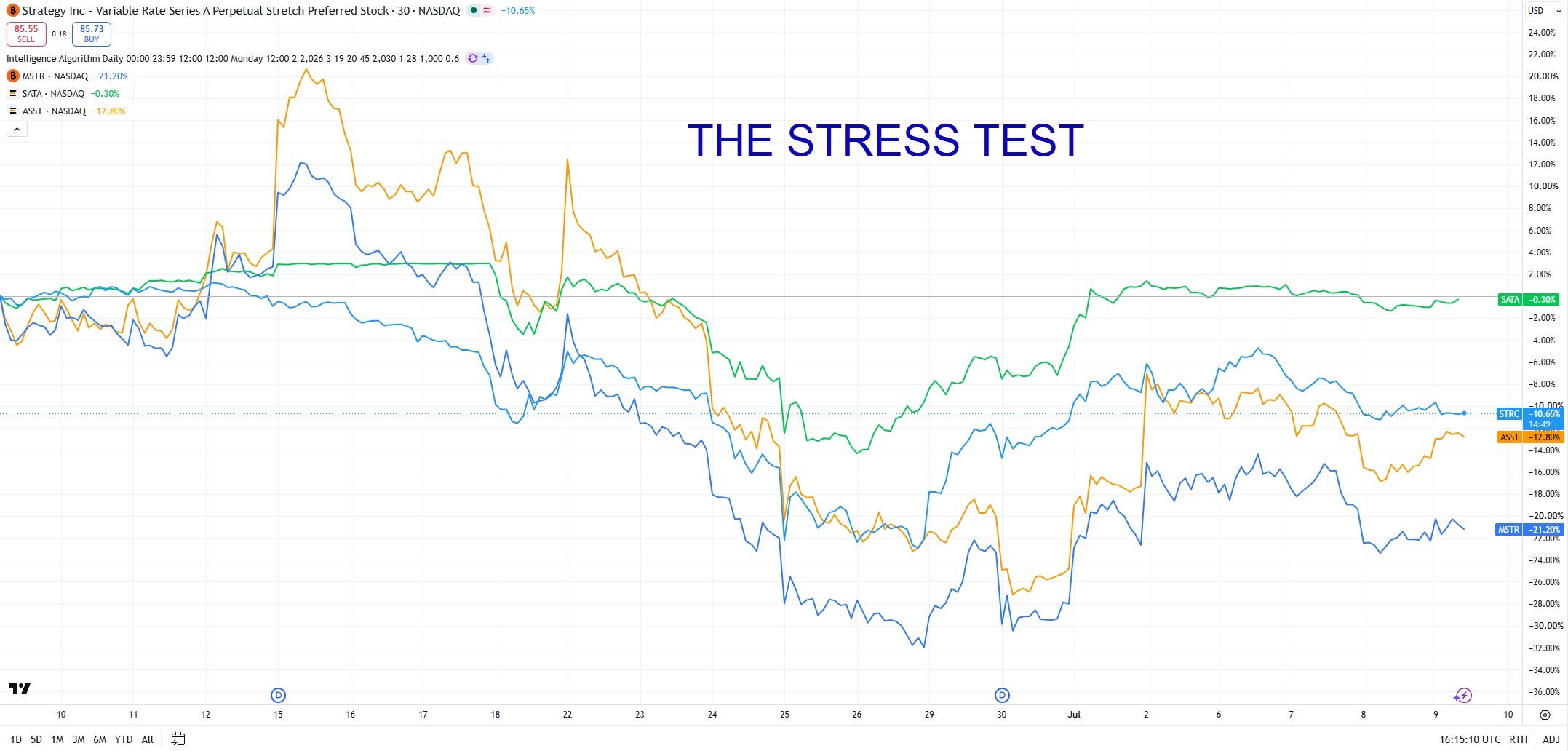
Critics argued the business model had been exposed, and social media filled with predictions of Bitcoin’s demise. The question was no longer whether these companies represented financial innovation. It was whether the innovation had already failed.
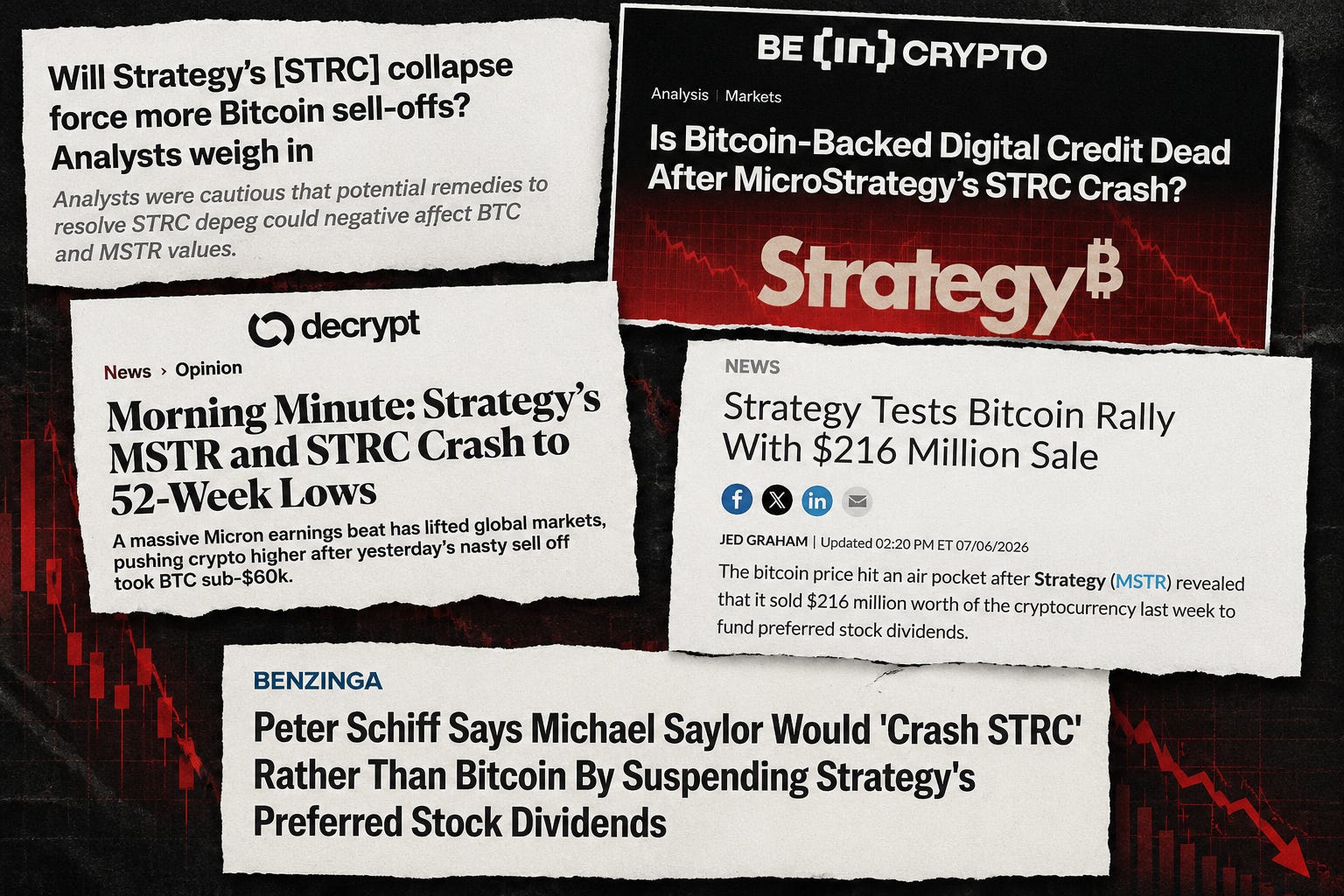
I sat down with Strategy CEO Phong Le and Strive CEO Matt Cole just as both companies were responding to that turbulence. Both spoke candidly about what they had learned and how they intended to adapt. The more interesting story is how the market forced those conclusions in the first place.
Financial innovation rarely unfolds in a straight line. New products arrive with a set of assumptions, investors test those assumptions with real money, and management responds. Sometimes the process exposes a fatal flaw. Sometimes it produces a better product. Either way, markets discover information neither critics nor management possessed when the experiment began.
When Markets Disagree
One moment from our discussion captured that process well. Strategy had reduced its cash reserves to retire a significant amount of convertible debt, believing a stronger balance sheet compensated for the lower cash position. Investors saw it differently.
“We did not realize how important that U.S. dollar reserve was to our Stretch investors,” Le told me. Institutional investors, he said, placed considerably more value on readily available cash than management had expected, despite the company’s significant Bitcoin holdings.
Management believed one form of financial strength counted most. Investors preferred another. Neither side won the argument through debate. Prices settled it immediately. Strategy rebuilt its cash reserve to levels higher than before and earmarked those funds for dividend and interest obligations. Markets often become participants in product development, revealing assumptions that only real capital can test.
Innovation Happens in Public
Looking backward, successful innovations often appear inevitable. Looking forward, they almost never do. The first iPhone lacked an App Store. SpaceX reached orbit only after a series of visible failures. Early versions rarely survive unchanged, because markets reveal information designers could not fully anticipate.
Cole sees financial innovation through the same lens. “I don’t think it’s fair to expect V1 to be the best final form of innovation,” he said. “That is literally why innovation exists.” Products become durable, in his view, when companies absorb market feedback and rebuild around it.
Whether Bitcoin Treasury Companies eventually follow that path remains uncertain. The recent redesigns could prove to be meaningful improvements, or they could postpone larger problems. Markets have begun asking more useful questions than they were asking a month ago.
Looking Past the Labels
When I asked Le about the criticism that Bitcoin Treasury Companies are “merely financial engineering,” I expected him to distance himself from the phrase. Instead, he embraced it. “Financial engineering is the practical application of finance,” he said, comparing it to mortgage-backed securities, which connected homebuyers with investors seeking income. Like any engineering discipline, it can produce useful or harmful outcomes. The relevant question is whether it solved a real economic problem.
Cole reached a similar conclusion by way of Liar’s Poker, the book on the mortgage-backed securities market that shaped his early thinking. Financial structures create value, he said, by matching investors with different objectives. “If you are doing your job well in financial engineering, the sum of the parts are greater than the whole because you’re providing unique and valuable solutions to select investors.”
History offers reasons for caution too. Mortgage-backed securities became synonymous with the financial crisis once poor underwriting and excessive leverage overwhelmed them. Some innovations change markets for good. Others delay the recognition of risk.
Why Borrow? Why Lend?
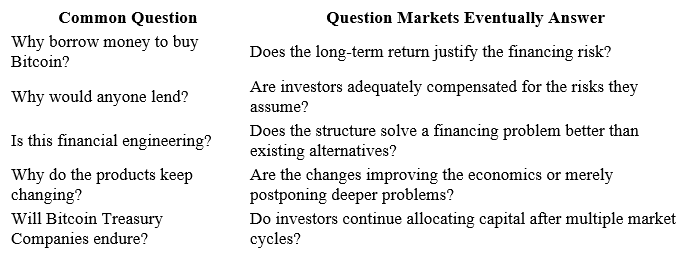
The first two questions deserve particular attention. Why would a company borrow money to buy Bitcoin, and why would anyone provide the financing?
To many observers, the first question answers itself. Borrowing to buy a volatile asset sounds speculative. Yet borrowing to acquire assets expected to appreciate is one of the oldest activities in finance, from families buying homes to private equity firms acquiring companies. The calculation is the same each time: if the long-term return exceeds the cost of the financing, borrowing creates value. If not, it destroys value.
Le described Bitcoin Treasury Companies in similar terms. If Bitcoin is “a unique underlying asset that can appreciate thirty, forty percent a year,” he said, the next question is why public companies should not own it. Treasury Companies exist to provide exposure for investors who cannot or choose not to own Bitcoin directly.
The more interesting question may be why anyone would lend. The answer has less to do with enthusiasm for Bitcoin than in the diversity of capital markets. Pension funds, insurance companies, and endowments often operate under mandates restricting what they can own, some barred from Bitcoin directly, others required to hold publicly traded or income-producing securities.
As Cole noted, fixed-income investors ultimately care about total return, not whether that return comes through coupons, capital appreciation, or some combination of both. If Bitcoin-based securities eventually provide attractive risk-adjusted returns within those mandates, capital will continue flowing toward them. If they do not, it won’t. Markets will make that determination over time.
Bitcoin Doesn’t Need Them
The distinction between Bitcoin and the companies built around it is often overlooked. Critics frequently treat Bitcoin Treasury Companies as though they are essential to Bitcoin’s future. I asked both executives whether that premise was even true.
Neither executive hesitated. “No,” Le replied. “Does Bitcoin need us? No. Do our investors need us? Yes.” Companies like Strategy expand access for investors who otherwise could never own Bitcoin, because of mandates or regulatory constraints. Bitcoin would likely keep appreciating without them, though perhaps more slowly.
Cole answered from a different angle, “I don’t think Bitcoin needs the United States to have a strategic Bitcoin reserve. I think the United States would be stronger if it had a strategic Bitcoin reserve. And that similar principle applies to corporations.” Treasury Companies may strengthen Bitcoin’s adoption, but that differs from claiming Bitcoin depends on them.
Much of the public debate treats Bitcoin and Bitcoin Treasury Companies as though they succeed or fail together. These companies are wagering on Bitcoin’s future. They are not deciding it. If their assumptions prove correct, they may create substantial value for shareholders. If wrong, the companies will struggle regardless of how innovative their capital structures may be.
Time Is the Judge
The recent turbulence may eventually be remembered as a volatile chapter in the early history of a new asset class, or as the first sign that the business model contains weaknesses that grow more apparent over time. Neither conclusion is available yet.
What the episode has already revealed is how financial innovation evolves. Management teams begin with assumptions, investors test those assumptions with real capital. and prices reveal where expectations differ. Companies adjust, investors respond again, and the cycle repeats until markets settle whether a product deserves wider acceptance or a place among the ideas that failed to endure. That process is usually slower than either enthusiasts or critics prefer and Bitcoin Treasury Companies have not reached the end of it.
Only time will say which one Bitcoin Treasury Companies turn out to be.
Here’s the full interview.
Thank you very much to our sponsors:
Foundation: Secure your digital life—from passwords, 2FA, files and Bitcoin with Passport Prime, an all-in-one personal security platform. Visit them at https://foundation.xyz/
River Financial: If not cold storage for your Bitcoin, I’d highly recommend River for buying and holding- River is engineered to protect your Bitcoin over the long run. Use this link for discounts: https://river.com/signup?r=T7GGAF7G