
The second month in a row of rising inflation sent shockwaves through the financial world on Wednesday. The latest Consumer Price Index (CPI) of 3.5% suggests a potential reversal of the low inflation trends we've seen since the peak in 2022. This gives investors reason to fear a decline in the value of stocks and all risk assets.
My interview with Caleb Tommasini (HERE), Senior Portfolio Manager at PERA, revealed many of the nuances of CPI that make anticipating its impact on bond markets more of an art than a science. Caleb lays out the potential for a spiraling of budget deficits as rates rise to attract buyers to treasuries.
He explains many of the differences between CPI, PCE, and PPI and how he uses them to interpret market reactions. He shows examples of why they diverge and why these are each merely approximations of real inflation despite everyone’s belief that it is inflation; for instance, much of the CPI is based on surveys.
A key challenge for market participants is inconsistency by the Federal Reserve. It has changed its focus over the years between the CPI and PCE, and from component to component. It has also changed its communications policies, and ironically its preference a decade ago to give forward guidance to smooth market reactions has resulted in damaged credibility from faulty proclamations.
Inflation is insidious as Caleb points out that inflation begets inflation for several reasons, including that much government spending is adjusted upwards based on the CPI. Truflation CEO Stefan Rust highlighted in my recent interview with him HERE that this is a powerful conflict of interest for the federal government tasked with measuring such a subjective indicator of currency depreciation.
The rising rates are changing the investment regime as well. Higher short term treasury yields are drawing investment dollars away from the productive economy. Interest payments on federal debt are stimulative to parts of the economy that benefit from that income; for instance, net corporate interest expense has declined over the past year while refinancing has been deferred and interest income has surged.
In our conversation, we compare the fiscal situation today with the 1940s because that was the last time the US fiscal deficits and total debt was similar to today. How did we escape and recover a sound financial footing? Spending reductions, financial repression, and productivity gains.
United States Gross Federal Debt to GDP topped out in 1946 at 118.9% and in 2023 it is at 131.5% and note that interest expense will rise significantly in 2024 which should push this higher.
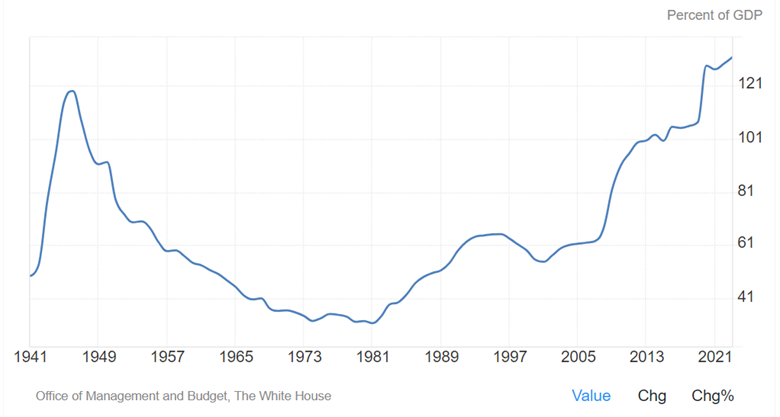
Part of the rapid decline through 1951 can be attributed to dramatic cuts to Federal Outlays from its peak in 1944 of $42.7B to $11.4B in 1948, a reduction of 73.3%. See also that deficit spending dropped from a peak of $29.6B to a surplus of $4.5B.
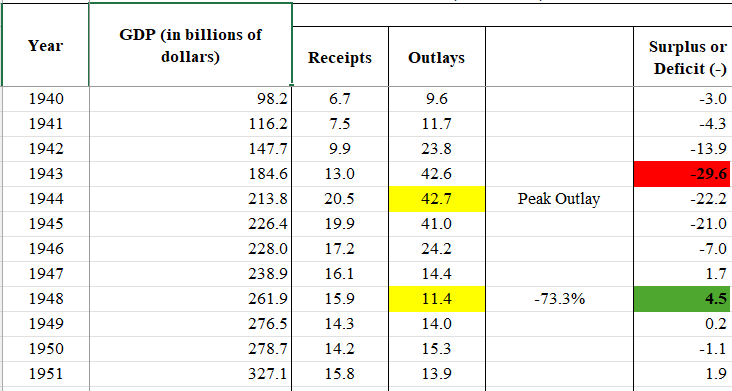
Source: https://www.whitehouse.gov/omb/budget/analytical-perspectives/
Another contributing factor to the reduction in debt/GDP in the 1940s was financial repression that Lyn Alden explains in my interview HERE. The Federal Reserve and the investing public cooperated with the government’s need to keep rates below inflation in order to devalue dollars to ease debt reduction.
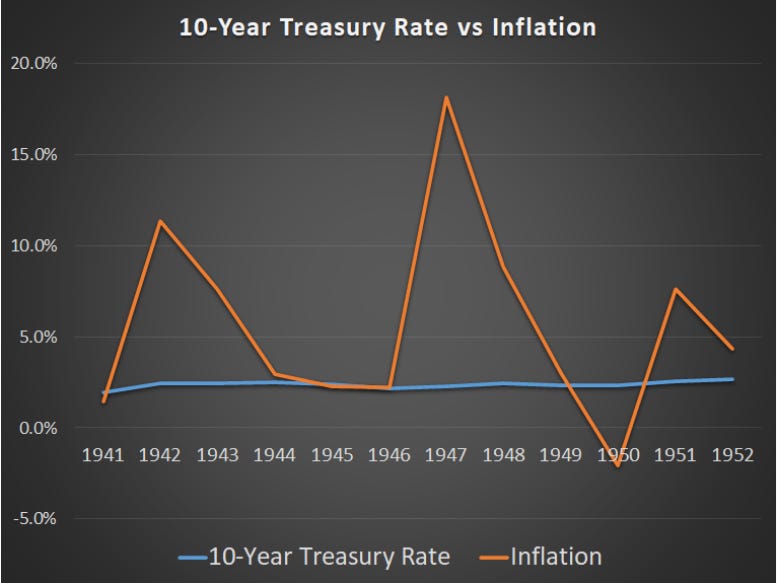
Source: Lyn Alden Research
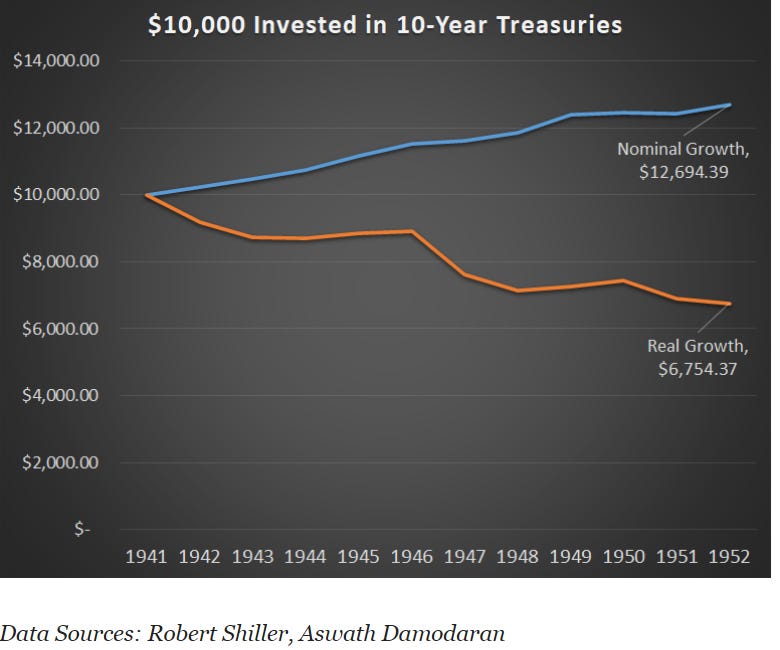
Source: Lyn Alden Research
Productivity gains were also significant. In 1940, US output per hour for all persons in the US indexed to 1970 was 36.5 and by 1948 it had risen 27.7% to 47.7.1
Many are predicting that AI might prove to be a boost to productivity making this a more promising source of federal budget improvement, but it is unlikely to produce enough to generate sufficient surpluses.
A Vicious Cycle? The scenario of inflation remaining above the Fed’s 2% target poses a threat that the fiscal challenges facing the US are likely to worsen which puts upward pressure on inflation creating a vicious cycle. I hope you enjoy Caleb’s investment reasoning in this interview.