
In 1971, President Nixon's decision to abandon the gold standard dramatically reshaped the global economy. This essay begins a six-part series examining the alternative: what if he had reinforced it? A roundtable discussion, linked below, provides further insights into the scenarios we'll explore.
On August 15, 1971, President Nixon suspended dollar convertibility to gold, ending the Bretton Woods system and ushering in our current fiat currency era. This "temporary" measure became permanent, fundamentally altering how money functions globally.
Fifty-four years later, our economy appears to be OK— US GDP growth has seemed strong (especially relative to other nations), our equity market capitalization has reached 60% of the global total, and we're home to 30% of the world's billionaires. Yet our federal government consumes about 24% of GDP, our national debt approaches $37 trillion, and unfunded liabilities exceed $100 trillion.
What if Nixon had made a different choice? In our recent roundtable discussion, economist Bob Murphy made a provocative claim: global GDP could be approximately 70% higher today had the world maintained the gold standard after 1971.
Murphy's analysis breaks this estimate into four components:
A smaller financial sector (+4% GDP): Under a gold standard, the financial sector would likely be significantly smaller. Murphy noted that it has grown from 2% of GDP in 1950 to nearly 8% today. With stable money, fewer resources would be devoted to currency speculation and hedging, and fewer talented individuals would be "sucked into Wall Street" rather than productive enterprise.
Dampened business cycles (+26% GDP): The Austrian theory of business cycles suggests that credit expansion drives boom-bust cycles. Murphy highlighted that U.S. real GDP growth averaged 4.0% annually from 1951-1971 but only 3.2% from 1971-1991. A gold standard would have restrained credit expansion, potentially preventing the destructive malinvestment cycles we've experienced since.
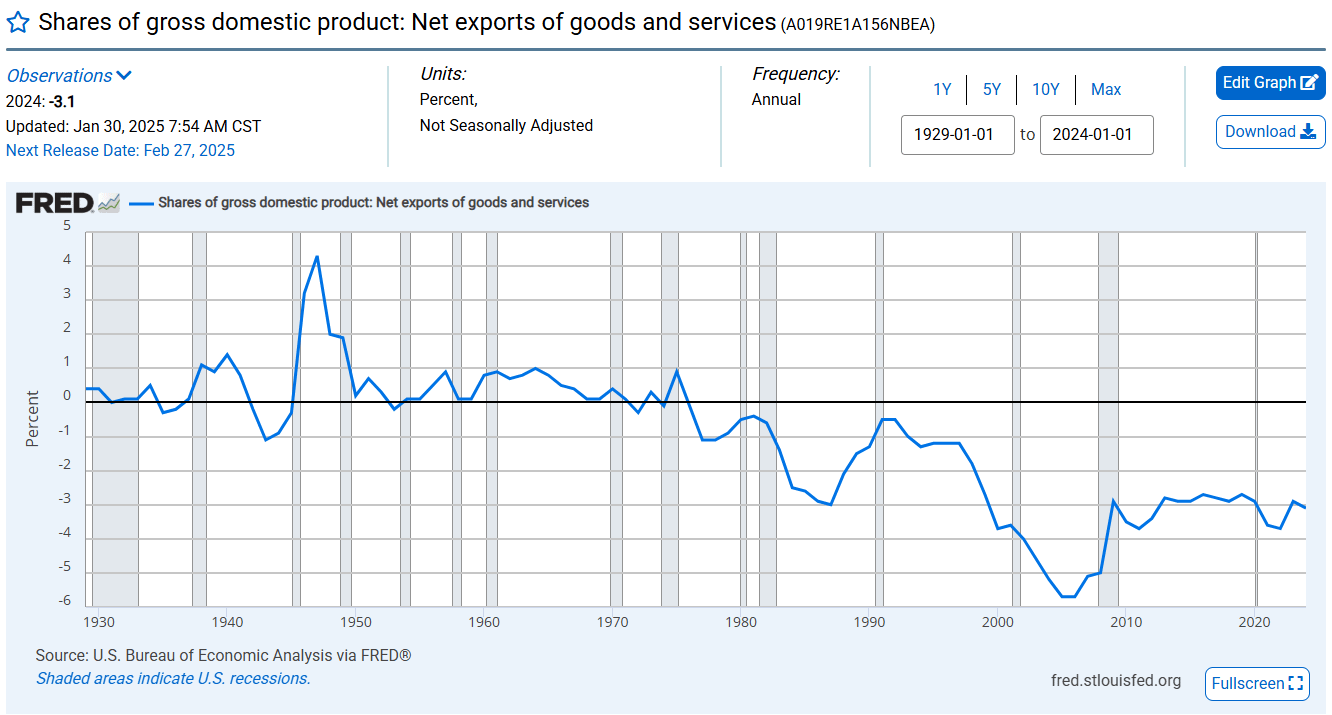
Balanced global trade (+10% GDP): Before 1971, U.S. trade was generally balanced. After Nixon's decision, persistent deficits became the norm. Under a gold standard, trade patterns would be determined more by genuine productivity differences and less by monetary manipulation, allowing resources to flow to their most productive global uses.
Reduced military spending (+30% GDP): Murphy argued that monetary constraints would have limited military adventures: "If we had been stuck to the gold standard, we wouldn't have been able to engage in Vietnam. And I think most Americans would say, yeah, that would have been a good thing." Resources directed away from military spending could instead have fueled productive investment. (Part five of this essay series will discuss this in far greater detail.)
Historical context adds nuance to Murphy's analysis. The classical gold standard era (1870-1914) saw remarkable growth and innovation, though it experienced periodic recessions. These fluctuations led to the creation of the Federal Reserve in 1913, ostensibly to dampen business cycles. Yet as Murphy noted in our roundtable, the Austrian school of economics maintains that it's precisely this type of intervention that drives boom-bust cycles rather than preventing them, especially as total debt accumulates from chronic deficit spending. While proponents of our current system argue that flexible monetary policy prevents deeper recessions and enables faster technology adoption, the post-1971 data show declining growth rates, an expanding financial sector, and dramatically shifted trade patterns—all consistent with Murphy's thesis.
The implications for living standards would be profound. Murphy's analysis suggests that the average family today might enjoy 70% higher real income under a gold standard economy. This wouldn't just mean more luxury goods but fundamentally different life possibilities: less debt dependence, greater financial security, more entrepreneurial opportunity, and potentially more leisure time. As the roundtable discussion highlighted, when an economy directs more resources toward productive enterprise rather than financial engineering or military expenditure, it creates more genuine wealth that benefits broader segments of society. The stability of hard money would particularly benefit those without sophisticated financial strategies to hedge against currency devaluation—typically middle and working-class families.
In our next essay, we'll examine how abandoning the gold standard affected government size and spending, enabling expansion beyond what citizens would likely support through direct taxation. We'll explore how this transformed the relationship between citizens and the state, using a metaphor to put some context around unconstrained government spending.
Exploring the Gold Standard Counterfactual: The Complete Series
This six-part series explores different dimensions of how our world might differ if Nixon had reinforced the gold standard in 1971:
Part 1: Economic Growth - “Nixon’s Monetary Pivot”- Examining Murphy's provocative claim that global GDP could be 70% higher today under a gold standard
Part 2: Government Size and Spending - How monetary systems influence government's role in the economy
Part 3: Wealth Distribution - Why fiat currency systems distort the distribution of wealth compared to hard money economies
Part 4: Financial Markets - How monetary uncertainty transformed investment into speculation
Part 5: War and Crisis Management - The tension between discipline and necessary flexibility
Part 6: The Technological Challenge - Can Bitcoin solve what gold couldn't?
Understanding this counterfactual isn't merely academic. As we face unprecedented debt levels, growing inequality, and increasingly extreme monetary interventions, Nixon's road not taken offers crucial insights for navigating our economic future.
Thank you to our sponsors:
Truflation: Learn about what prices are actually doing by going to https://truflation.com/marketplace/us-inflation-rate
Foundation: Protect your Bitcoin using the latest off-line technology with easy-to-use Passport. Their next product, Passport Prime will protect all passwords off-line with even-better technology. https://foundation.xyz/
River Financial: If not cold storage for your Bitcoin, I’d highly recommend River for buying and holding- River is engineered to protect your Bitcoin over the long run. Use this link for discounts: https://river.com/signup?r=T7GGAF7G