
Recently, I spent several days in conversation with Erik Townsend, discussing what might be one of the most consequential yet underappreciated challenges of our time: how we power human prosperity in the coming decades. Our timing couldn't have been better. Just one month ago, China confirmed the successful operation of their thorium-fueled molten salt reactor in the Gobi Desert – a technology that Erik has been researching and advocating for years before it captured wider attention.
Erik is the host of the popular MacroVoices podcast, focusing on financial and macroeconomic analysis for sophisticated investors. His background spans technology entrepreneurship and financial markets, before developing a deep interest in energy systems and their economic implications. Erik produced the documentary series "Energy Transition Crisis" and has written extensively about nuclear energy solutions on his Substack. Our first conversation in this series is now available on YouTube [LINK] where he explains why abundant energy is essential to human prosperity, why wind and solar have fundamental scaling limitations, and why advanced nuclear offers a transformative solution worth exploring.
I should note that I'm not a nuclear energy specialist and I approached these conversations as a motivated and curious generalist. However, Erik's thoughts are well-founded in both technical and economic realities, offering a compelling hypothesis about our energy future that deserves wider consideration. While there are certainly criticisms of his approach—which I plan to explore in future essays—these focus primarily on what critics see as overly optimistic timelines, technical implementation challenges, and his singular focus on thorium-based technology over a more diversified approach. What's striking, though, is that few critics dispute that nuclear energy offers an excellent solution to our growing global energy needs - the disagreements center primarily on which nuclear path to pursue.
While many energy discussions center on climate implications alone, Erik's approach is refreshingly different, focusing on the fundamental link between energy abundance and human flourishing. It's this perspective—that the question isn't whether we need abundant, affordable clean energy, but rather the best path to achieve it—that compelled me to share our conversation in both podcast and essay form.
The Forgotten Link Between Energy and Prosperity
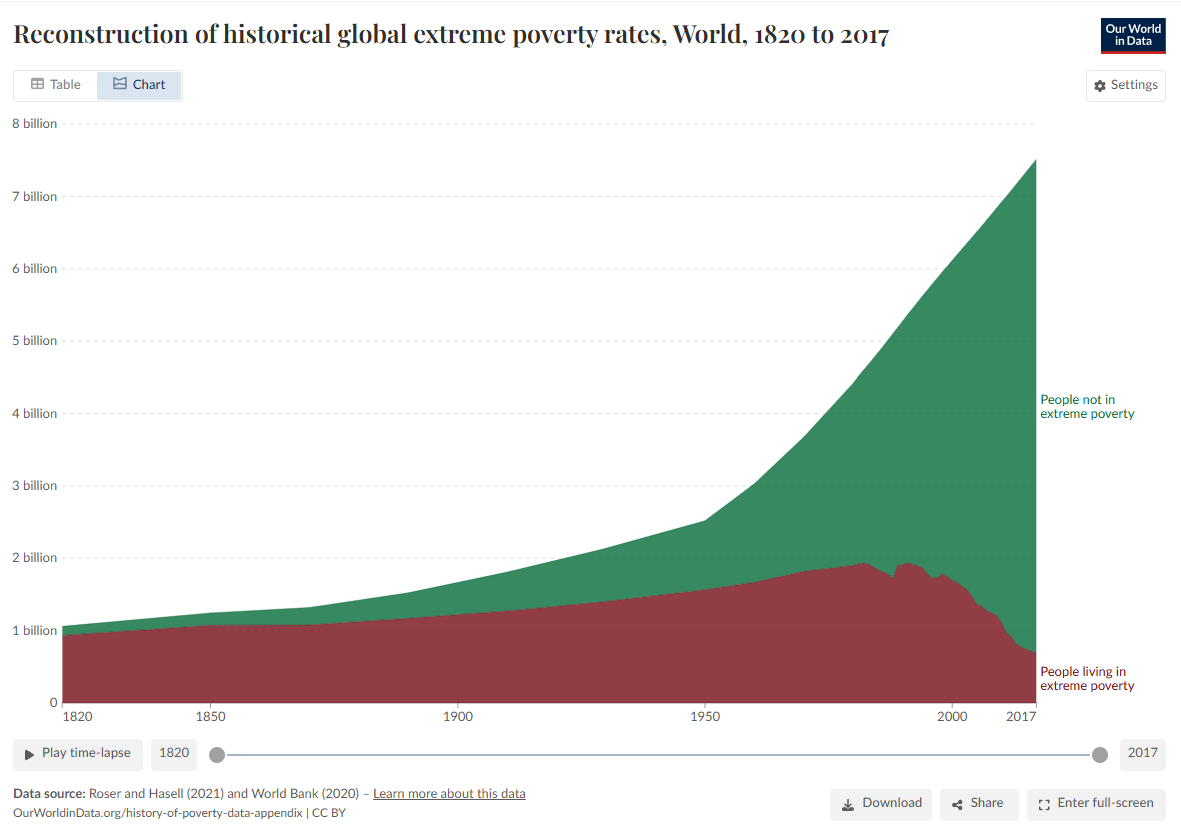
For 250 years, human progress has been inextricably tied to our ability to harness energy. As Erik pointed out during our discussion, the dramatic transition from an agrarian society (where 90% of humanity lived in poverty in 1820) to our modern world wasn't merely a technological revolution – it was fundamentally an energy revolution.
The chart Erik shared of U.S. per capita energy consumption tells a revealing story: from the end of World War II until approximately 1974, Americans enjoyed steadily increasing energy consumption per person, which directly correlated with rising prosperity. Then something changed. The chart flatlined for the remainder of the 20th century, and in the 21st century, we've experienced a slow but steady decline.
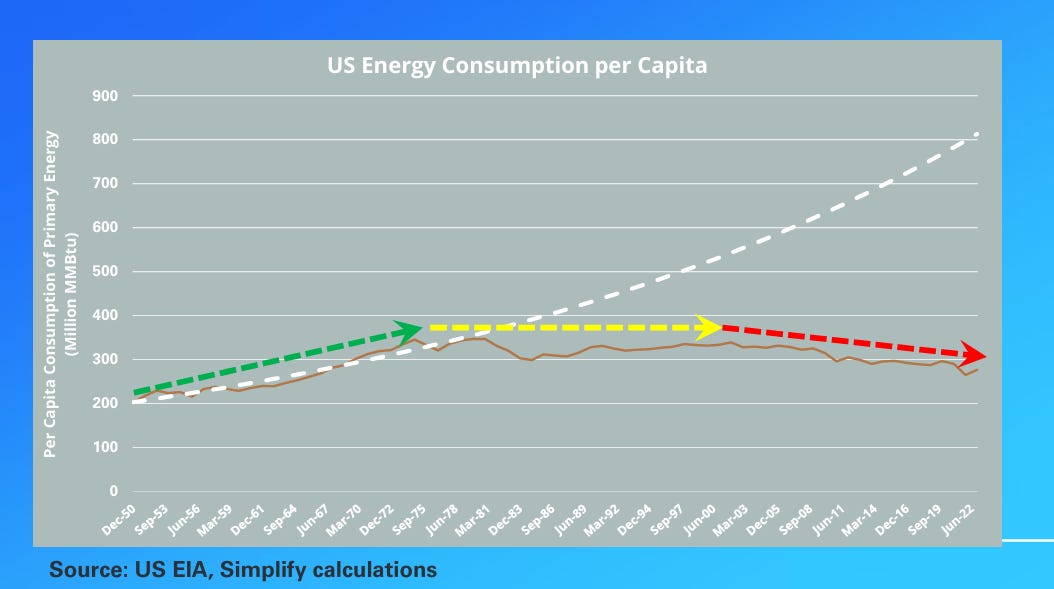
This decline in per-capita energy consumption tracks with many economic challenges we face today. Erik makes a compelling case that this isn't coincidental – it may be causal. We've somehow adopted a mindset that using less energy is inherently virtuous, when in fact, the opposite is true. Human prosperity depends on abundant energy; the key isn't using less, but rather ensuring what we use doesn't damage our environment.
This challenge will only intensify as AI's energy appetite grows exponentially and developing nations rightfully pursue higher standards of living. We're not facing an energy plateau – we're facing an energy demand surge that current solutions cannot meet.
The Renewable Reality Check
After 25 years and approximately $5 trillion invested in renewable energy, wind and solar provide only about 5% of global energy needs. Meanwhile, fossil fuel consumption continues to rise every year. As Erik bluntly puts it, "We've reduced coal, oil, and gas consumption by exactly zero.”
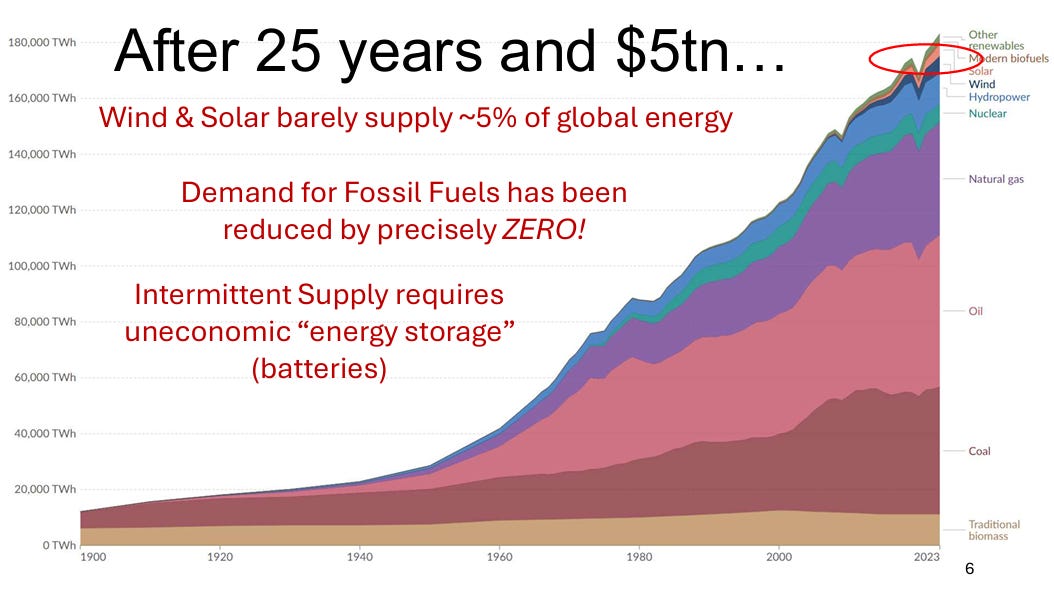
This isn't an argument against renewables, but rather an acknowledgment of their limitations for powering a modern society that requires reliable, 24/7 energy. The recent power outage in Spain and Portugal offers a sobering case study: their grids crashed when attempting to integrate large amounts of intermittent renewable energy. It's what Erik describes as "trying to fit the square peg of intermittent supply into the round hole of baseload demand."
The reality is that many renewable sources face inherent constraints. Hydropower works beautifully – but we've already built dams wherever geology permits. Geothermal would be ideal if we could drill deep enough through solid rock at 400°C temperatures – but we lack that technology. Wind and solar are valuable additions to our energy mix, but their intermittency creates fundamental challenges that battery storage cannot economically solve at grid scale. And other solutions like fusion are still in their infancy and so far can’t be relied upon as a solution.
The Nuclear Dilemma
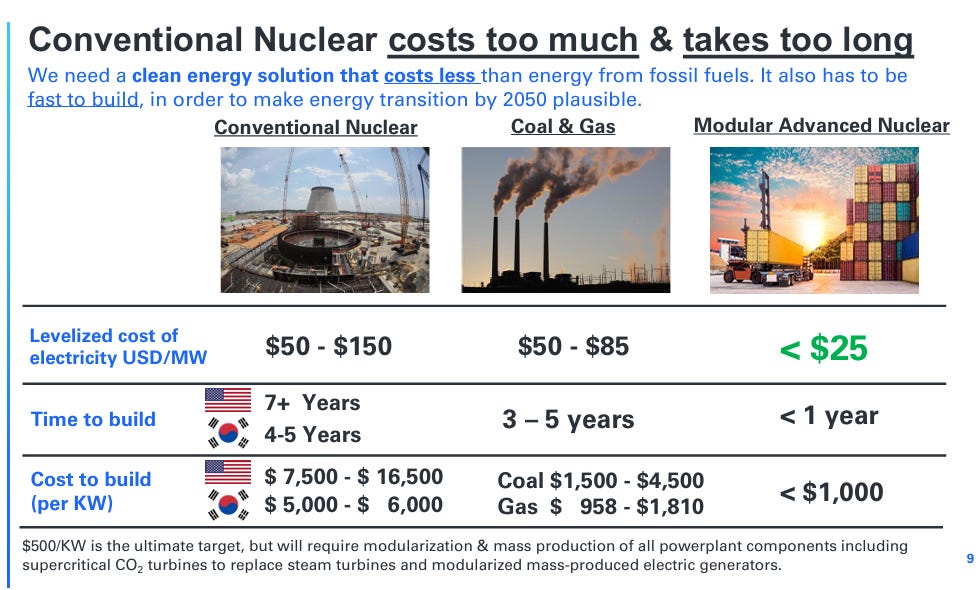
Conventional nuclear power plants are, statistically speaking, the safest form of energy humanity has ever developed. Yet they face two major obstacles: they cost too much and take too long to build. The latest generation of light-water reactors (Generation III+) have impressive safety features that make the kind of accidents we saw at Three Mile Island, Chernobyl, and Fukushima extremely unlikely, and some claim virtually impossible. As Erik explained in our conversation, each of those historical incidents resulted primarily from human operators overriding automated safety systems – a possibility that's been engineered out of modern designs.
The much-discussed plan to "triple nuclear by 2050" represents an important step forward. However, as Erik calculates, replacing all energy currently derived from fossil fuels would require not tripling but increasing nuclear 24-fold. This simply isn't achievable with conventional light-water reactor technology, both due to cost constraints and uranium supply limitations.
Then there's the waste issue – which Erik convincingly argues is a policy problem, not a technological one. Since the 1940s, we've known how to reprocess spent nuclear fuel to recover valuable materials and reduce storage requirements from thousands of years to just a few hundred. France has been doing this successfully for decades, while American policy (dating to the Carter administration) has prevented us from implementing similar solutions.
The Henry Ford Moment for Nuclear
The centerpiece of my conversations with Erik was his vision for what he calls "The Nuclear Henry Ford Moment" – a fundamental rethinking of nuclear power production. Just as Ford revolutionized manufacturing by moving from custom-built cars to assembly lines, Erik sees a similar transformation for nuclear energy.
His McDonald's restaurant analogy perfectly illustrates this concept. Today's McDonald's locations can be built in just 24 hours because they arrive as pre-manufactured modules in shipping containers. By applying this same approach to nuclear, Erik envisions reactors manufactured in standard 40-foot shipping container form factors on robotic assembly lines – quality-controlled and dramatically less expensive than today's bespoke nuclear plants. The example he shared from Copenhagen Atomics (a company he's invested in) demonstrates the potential: a 100-megawatt thermal reactor contained entirely within a standard shipping container. To produce the same energy with coal would require burning 131,000 metric tons annually at a cost of $20 million. The thorium-fueled reactor would use just 36 kilograms of fuel, costing less than $2,000.
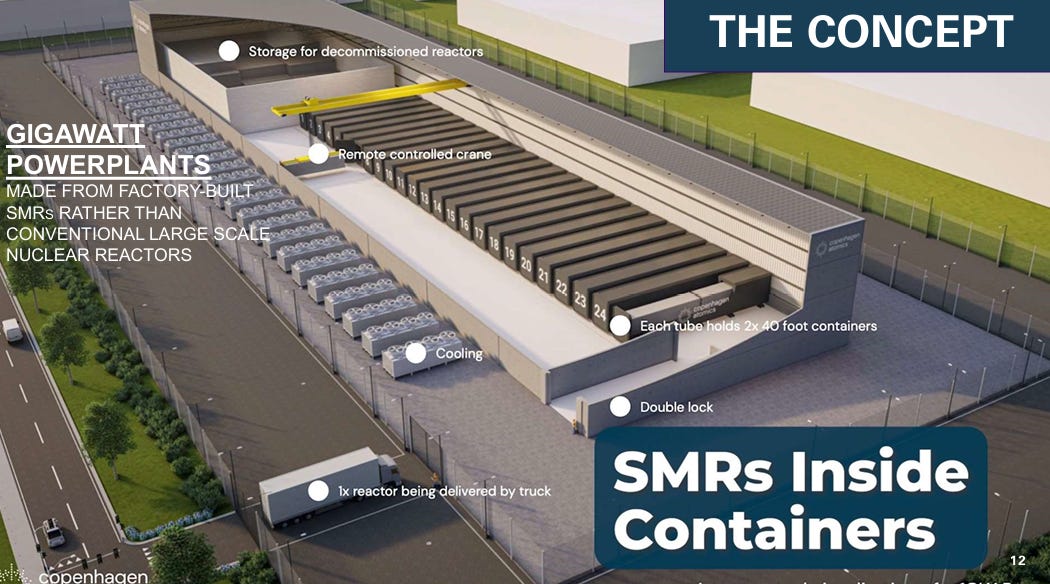
The economic implications are profound. When nuclear energy costs less than fossil fuels – Erik's critical "tipping point" – market forces will drive the transition naturally, without requiring carbon taxes or government mandates. The assembly-line approach could reduce construction time from 10+ years to less than one year, while bringing costs below $1,200 per kilowatt – competitive with natural gas plants.
Looking Forward
These initial conversations with Erik only scratch the surface of this topic's importance. In the next episodes and essays, I'll share his insights into thorium reactor technology, the economics that could make it cheaper than coal and gas, and the geopolitical implications of China's evident lead in this field.
What struck me most in Erik's analysis was how he connected seemingly disparate domains – engineering, economics, geopolitics, and human well-being – into a coherent vision. This isn't just about solving climate change, though it would certainly help. It's about creating the conditions for human flourishing on an unprecedented scale.
Conclusion
Our energy conversation needs reframing. Rather than focusing exclusively on reducing carbon emissions by constraining energy use, we should be pursuing abundant clean energy that costs less than fossil fuels. Advanced nuclear technology, particularly thorium-fueled molten salt reactors mass-produced on assembly lines, offers a path to that future.
This may be one of the most important technological inflection points of our lifetime. China certainly seems to think so, given their investments and their successes. The question is whether the West will recognize this opportunity and respond accordingly.
I invite you to follow the rest of this series as we explore the technology, economics, and geopolitics of what could be our generation's most consequential energy revolution. As Erik would say, the key isn't just to make nuclear energy clean and safe – we've already done that. The key is to make it cheap.
I highly recommend subscribing to Erik Townsend’s Substack here:

Stay tuned for the next essay where we'll dive deeper into thorium reactor technology and why it represents such a promising path forward.
Thank you very much to our sponsors:
Truflation: Learn about what prices are actually doing by going to https://truflation.com/marketplace/us-inflation-rate
Foundation: Protect your Bitcoin using the latest off-line technology with easy-to-use Passport. Their next product, Passport Prime will protect all passwords off-line with even-better technology. https://foundation.xyz/
River Financial: If not cold storage for your Bitcoin, I’d highly recommend River for buying and holding- River is engineered to protect your Bitcoin over the long run. Use this link for discounts: https://river.com/signup?r=T7GGAF7G