
For nearly 275 years - since approximately 1750 - human progress has been inextricably linked to our ability to harness energy. The Industrial Revolution marked the beginning of an unprecedented era where each major advance in human prosperity was either enabled or perhaps even caused by innovations in energy technology. From steam power to electricity to nuclear fission, our capacity to generate and utilize energy has consistently expanded to meet the needs of economic growth.
One of the deepest sources of pessimism about our children's future stems from what appears to be an insurmountable conflict: continuing this centuries-long march of progress requires ever-increasing energy use, yet many believe our primary energy sources are sowing the seeds of environmental catastrophe. As climate change activists gain political influence, their push to reduce fossil fuel consumption - well-intentioned as it may be - threatens to choke off the very engine of progress that has lifted billions from poverty.
Today, I want to explore a possible technological path through this dilemma, drawing from a fascinating two-part discussion that suggests we might not have to choose between prosperity and planetary health. Rather than conduct my own interview on this complex topic, I'm directing readers to a recent MacroVoices podcast featuring host Erik Townsend and Thomas Jam Pedersen, founder and CEO of Copenhagen Atomics, a company that offers a nuclear technology that they believe can help solve this problem. In the interest of transparency, Townsend discloses his position as an angel investor in Copenhagen Atomics. I'm not qualified to evaluate the company's investment merits, but these two podcasts give significant information that is not available elsewhere for anyone to evaluate on their own.
The following is a summary of what they discussed and I hope you find it as educational as I did. With the incoming Trump Administration’s focus on nuclear alternatives, this may be a good base of knowledge for news on this front.
Thank you to my sponsor Truflation. Learn more at www.truflation.com.
The Scale of the Challenge
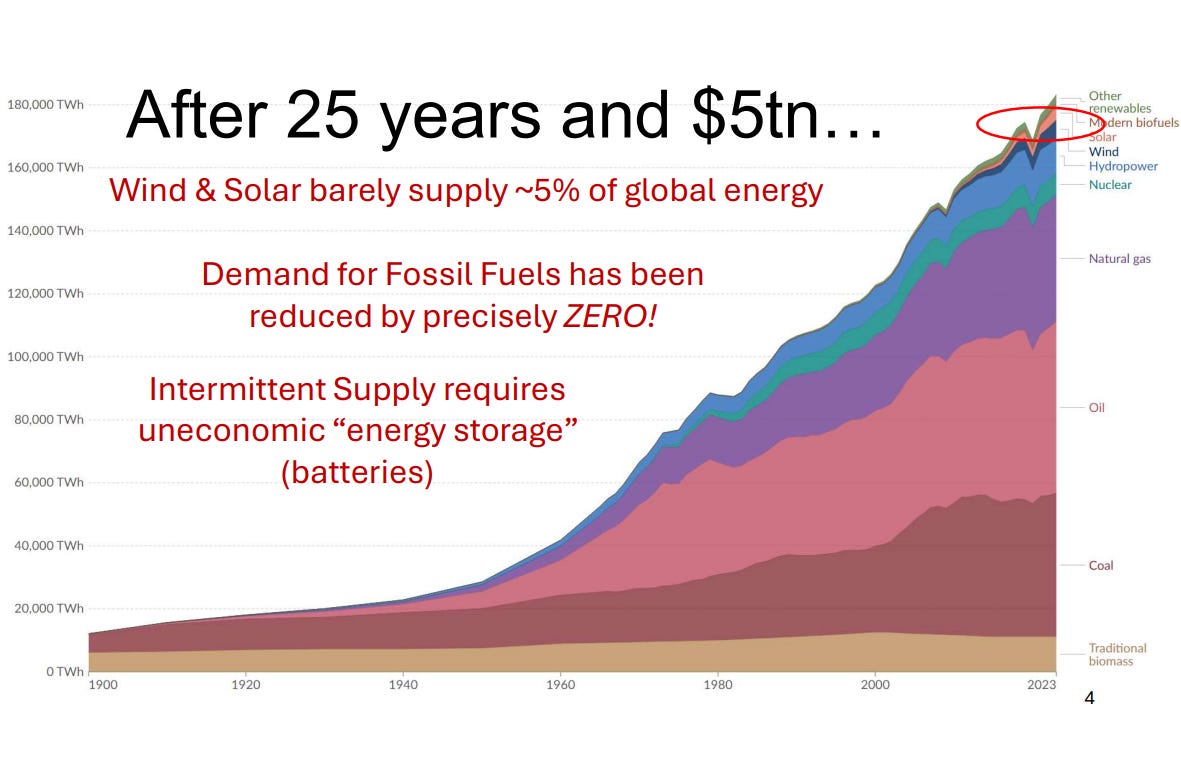
This chart tells a sobering story. Despite 25 years and roughly $5 trillion of investment, wind and solar provide only about 5% of global energy needs. Meanwhile, fossil fuel consumption continues its relentless climb. Climate activists would achieve far more success by acknowledging humanity's growing energy needs alongside their push for fossil fuel reductions. The solution must be additive, not just subtractive.
Energy Returned on Investment (EROI) helps explain why some energy solutions drive economic growth better than others - essentially measuring how many units of energy we get compared to how many we invest. Modern society developed on fossil fuels' once-high EROIs. These returns decline as we access harder-to-reach deposits. Carbon credit systems attempt to further reduce fossil fuels' effective EROI by increasing usage costs and dampening returns. (See my interview with Triangle Digital CEO Darren Wolfberg entitled "Carbon Capitalism" from December 20 HERE). Real progress demands energy sources with fundamentally superior EROI.
To understand why this challenge is more complex than many realize, we need to look at how humanity actually uses energy:
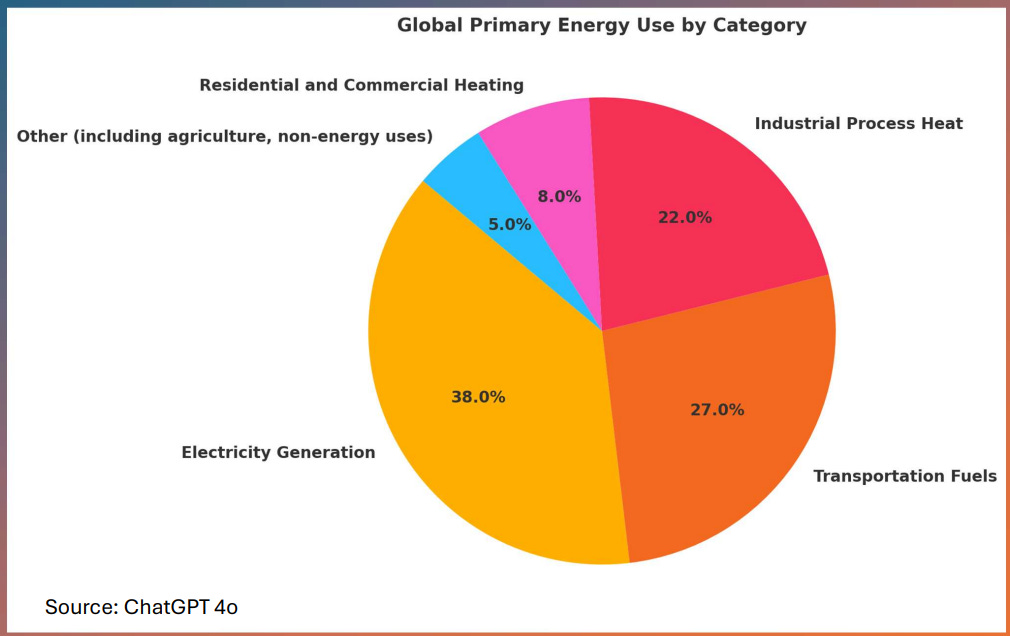
Electricity generation - the focus of most clean energy discussions - represents only 38% of global energy use. Even powering all electricity generation with wind and solar would leave 62% of energy needs unaddressed.
Industrial process heat presents a particular challenge at 22% of global energy use. Steel and cement manufacturing require temperatures above 1400 degrees Celsius. Converting fossil fuel heat to electricity and back wastes over half the energy. Electric vehicles improve efficiency, but electrifying industrial heating creates enormous waste.
Transportation fuels account for 27% of energy use. Electric passenger vehicles show promise, but long-haul aviation remains impractical for battery power. Current and foreseeable battery technology can't match the required energy density.
Even residential and commercial heating at 8% creates unique problems. Wind and solar's intermittent nature necessitates massive battery installations for heating through long winter nights or cloudy days - an expensive and resource-intensive solution.
These realities impact human prosperity. Over a billion people live without basic necessities like refrigeration, running water, or reliable electricity. Lifting these populations from poverty requires new energy production. Simply constraining energy use isn't viable if we care about both human poverty and environmental protection.
If wind and solar struggle with just electricity generation, how can we possibly address the full spectrum of global energy needs? Recent innovations in nuclear technology offer solutions that could tackle multiple challenges simultaneously - from industrial heat to waste management to economic viability.
The Nuclear Renaissance and Advanced Technology
Recent innovations in nuclear technology offer promising solutions. Unlike wind and solar with their relatively low EROI ratios, advanced nuclear designs achieve energy returns that rival or exceed the golden age of fossil fuels. This high EROI translates directly into economic viability.
Conventional nuclear plants use water as coolant, requiring extremely high pressure - around 150 atmospheres - to prevent boiling. This necessitates massive containment structures and complex safety systems. These plants typically convert less than 5% of their fuel's energy into power, creating significant waste storage requirements. Their complexity leads to steadily rising costs and construction times often reaching 10-15 years.
Generation IV nuclear designs tackle these limitations through various innovations. TerraPower and Oklo develop sodium-cooled fast reactors. X-energy focuses on high-temperature gas-cooled designs. Small Modular Reactor (SMR) manufacturers aim to reduce costs through standardization and factory production. Each approach offers distinct advantages.
Fear dominated nuclear energy discussions for decades and drove ever-increasing regulatory burdens and costs for water-cooled reactors. Data shows conventional nuclear power caused far fewer deaths per unit of energy than coal, oil, or gas power generation. The nuclear industry responded with innovations making many traditional concerns physically impossible through fundamental design changes, as this comparison shows:
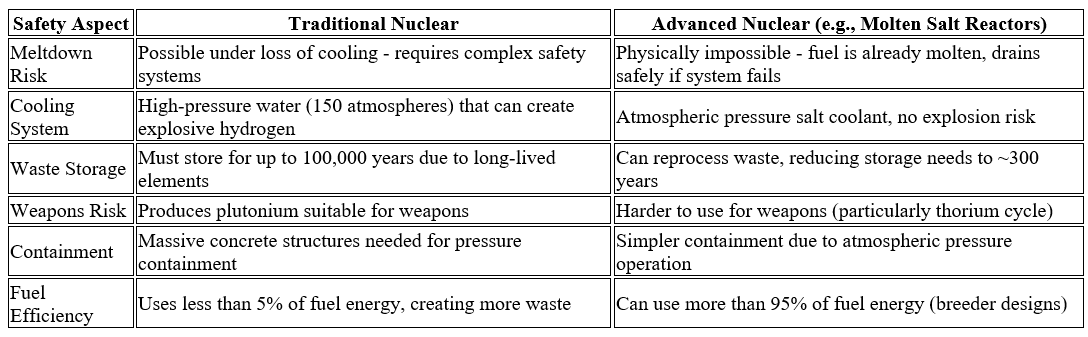
These advances transform the risk equation. Modern designs physically cannot melt down. In modern molten salt designs, the fuel already exists in liquid form mixed with salt. System power or cooling loss triggers automatic gravity drainage of the liquid fuel-salt mixture into specially designed tanks. The mixture spreads out and naturally cools, stopping the nuclear reaction. The physics makes catastrophic meltdown impossible.
Beyond safety, the economics of advanced nuclear technology are compelling:
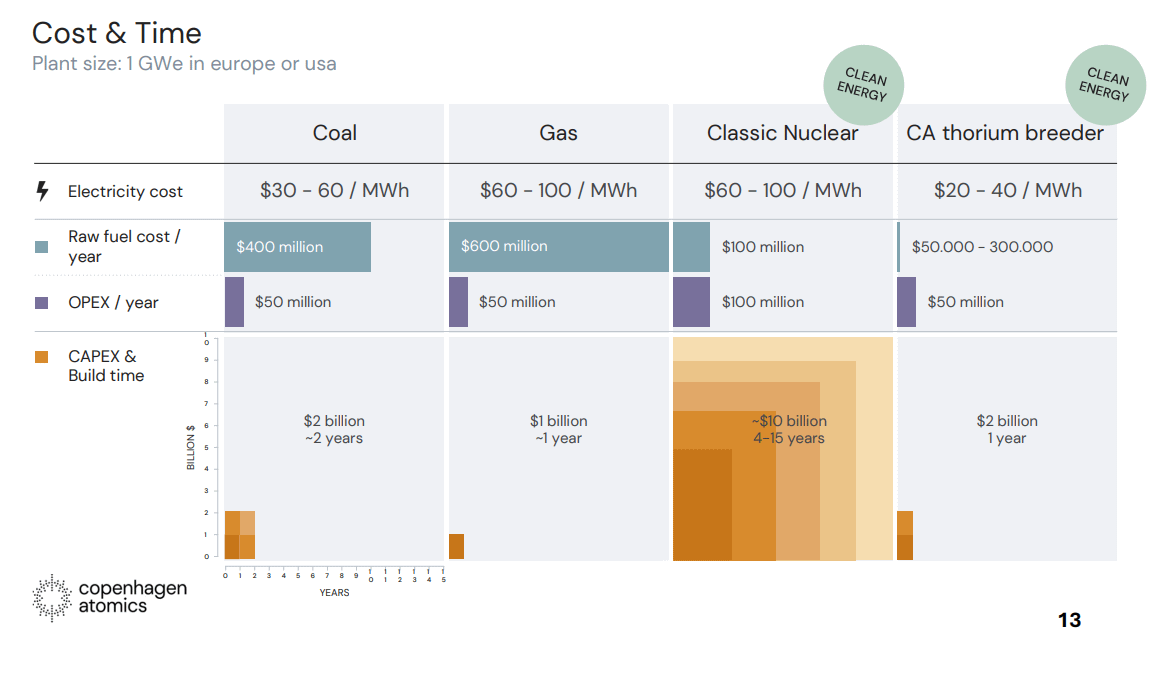
This comparison shows how advanced reactors, particularly thorium breeder designs, could potentially deliver clean energy at $20-40 per megawatt hour – lower than even coal-fired power plants – while requiring far less construction time than conventional nuclear facilities. The fuel cost differences are particularly striking: $50,000-300,000 per year versus hundreds of millions for fossil fuel plants.
While the first MacroVoices interview examines various Generation IV technologies, the second focuses specifically on thorium molten salt reactors. These designs use liquid fuel dissolved in molten salt, operating at atmospheric pressure and higher temperatures than water-cooled reactors. This approach addresses multiple challenges simultaneously:
Providing both electricity and high-temperature process heat
Achieving superior fuel efficiency
Enabling simpler, inherently safe operation
Dramatically reducing waste storage requirements
Allowing faster, less expensive construction
Breaking Through Previous Limitations
Thorium molten salt reactors overcome historical nuclear power limitations. The safety improvements extend beyond meltdown prevention - these reactors consume existing nuclear waste as fuel, potentially eliminating long-term storage challenges. Atmospheric pressure operation eliminates massive containment structures. The liquid fuel allows continuous removal of fission products that would otherwise poison the nuclear reaction.
The economic advantages stand out sharply. A conventional nuclear plant requires around $10 billion in capital costs and takes 10-15 years to build. Advanced modular designs could be mass-manufactured for a fraction of the cost. Copenhagen Atomics estimates their 100-megawatt thermal reactors could be produced for under 10 million euros each at scale.
Waste management sees revolutionary improvements. Rather than creating waste requiring 100,000-year storage, thorium reactors can consume existing nuclear waste. This reduces storage requirements to 300 years for the small amount of remaining fission products. Many fission products have valuable medical and industrial applications, potentially transforming liabilities into assets.
Policy Momentum and Market Reality
The technology shows immense promise, but widespread adoption faces both opportunities and challenges. Growing policy support for nuclear innovation focuses primarily on SMRs, though most designs still use conventional technology rather than more advanced approaches.
Section 123 of the Atomic Energy Act currently requires countries seeking nuclear cooperation with the US to forgo fuel recycling capabilities - a policy created in a different era that now hinders deployment of advanced reactor designs.
Full-scale manufacturing could begin within 5-7 years of regulatory approval with production potentially reaching one reactor per day within a decade. Some analysts project we would need to achieve production rates of one reactor per hour to fully replace fossil fuel usage by 2050.
American competitiveness remains crucial. The U.S. pioneered many of these technologies decades ago, but countries like China now make major investments in advanced nuclear designs. Maintaining technological leadership alongside safety and security requires thoughtful policy evolution.
For decades, nuclear energy has faced an understandable yet challenging 'not in my backyard' mentality - despite compelling data showing it's far safer than fossil fuel alternatives. But as society grapples with exploding energy demands, particularly from nascent Generative AI, these fears need to may give way to practical necessity. The first chart in this piece tells the real story: when populations need energy for growth and prosperity, they find ways to produce it progress will wins regardless. The real question is whether we'll meet those growing energy needs with fossil fuels or seize the opportunity to scale nuclear technology that can both match our expanding requirements and reduce environmental impact. We have the technical capabilities, now we need the social and political will to deploy them.