
The Crisis of Faith in American Democracy
A number of close friends recently expressed deep frustration about gerrymandering, a problem laid bare in the 2025 Texas redistricting controversy, where Republican lawmakers, encouraged by President Trump, pushed mid-decade map redraws to flip Democratic seats and secure a stronger GOP majority ahead of the 2026 midterms. This sparked a reactive arms race, with California Democrats swiftly passing bills to redraw their own maps, aiming to counter by gaining up to five seats for their party. Their reaction mirrors a broader national anxiety: gerrymandering represents escalating polarization that threatens our system of government, creating a downward spiral that just keeps getting "worse and worse."
This perspective reflects what the Exploring Prosperity research reveals about American pessimism—political problems like polarization fuel deep concerns about prospects for the next generation. Yet this crisis of faith may stem from a fundamental confusion: mixing up disappointing political outcomes with flawed political processes. As Churchill observed, democracy is "the worst form of government except for all the others." The question isn't whether gerrymandering produces outcomes that feel unfair—it often does, and in this case it clearly has. The question is whether the methodology itself serves democratic principles and remains responsive to public will.
Here lies the paradox at the heart of American redistricting: the very process that seems most threatening to democracy may actually exemplify democracy working as designed. Someone must have the authority to draw the geographical boundaries that determine representation in Washington. When that authority rests with elected state legislatures operating on two-year cycles, it remains closest to the electorate and most responsive to shifting public sentiment. The outrage over Texas gerrymandering—spreading to California's retaliatory moves and other states—may not signal democratic breakdown but democratic correction in action
Tellingly, searches for defenses of gerrymandering yield few academic or journalistic articles because it is an unnacceptable outcome whenever it hits the headlines. But there is research into how bad the outcomes are, and whether the consequences of gerrymandering actually cause the problems that critics assume. This essay attempts to reveal the history, examine the major criticisms, and ask whether our current democratic processes, however outrageous their outcomes, best serve the people's will over time.
The Five Core Criticisms
Before examining the evidence, let's acknowledge the main arguments against gerrymandering that generate widespread public support. Most Americans intuitively accept these criticisms, as did I initially, which form the foundation for reform efforts nationwide.
Safe seats breed political extremism. When districts lean heavily toward one party, representatives only worry about primary elections, incentivizing appeals to partisan bases rather than general election moderates. This creates a legislature full of ideological warriors rather than pragmatic problem-solvers.
Politicians choosing their voters violates democratic principles. The fundamental concept of democracy requires voters to select representatives, not the reverse. When legislators draw their own districts, they manipulate the system for personal advantage rather than serving public interest.
Modern technology makes gerrymandering unprecedentedly dangerous. Computer modeling and big data enable surgical precision in district drawing that makes historical manipulation look primitive. This technological arms race threatens to lock in political advantages permanently.
Gerrymandering undermines public faith in democracy. When citizens believe their votes don't matter because districts are rigged, they disengage from democratic participation. This creates a downward spiral of cynicism that weakens democratic legitimacy.
Independent commissions provide more fair and representative outcomes. Removing elected officials from redistricting and replacing them with appointed commissioners or nonpartisan staff will produce more equitable maps that better represent voter preferences without manipulation.
These criticisms seem compelling and generate bipartisan support. Yet examining them through the lens of long-term democratic responsiveness reveals a more complex picture—one where even entrenched advantages in one-party-dominant states may face slower but eventual voter backlash.
The Historical Reality and Democratic Authorization
The Constitution didn't mandate congressional districts at all. When the first Congress convened in 1789, most states used at-large elections where voters statewide picked all representatives. Only a few states like Virginia voluntarily drew districts through their legislatures—and manipulated them from the start, as Virginia did in 1788 to sideline James Madison.
The system evolved through democratic processes, not constitutional design. The 1792 Apportionment Act increased seats after the first census but left methods to states. The infamous 1812 "gerrymander" in Massachusetts gave us the term—coined when Governor Elbridge Gerry signed a redistricting plan creating a salamander-shaped district—though similar tactics had occurred since the 1790s. Throughout the mid-19th century, some states persisted with at-large systems until the 1842 Act required single-member districts amid fears of partisan sweeps.
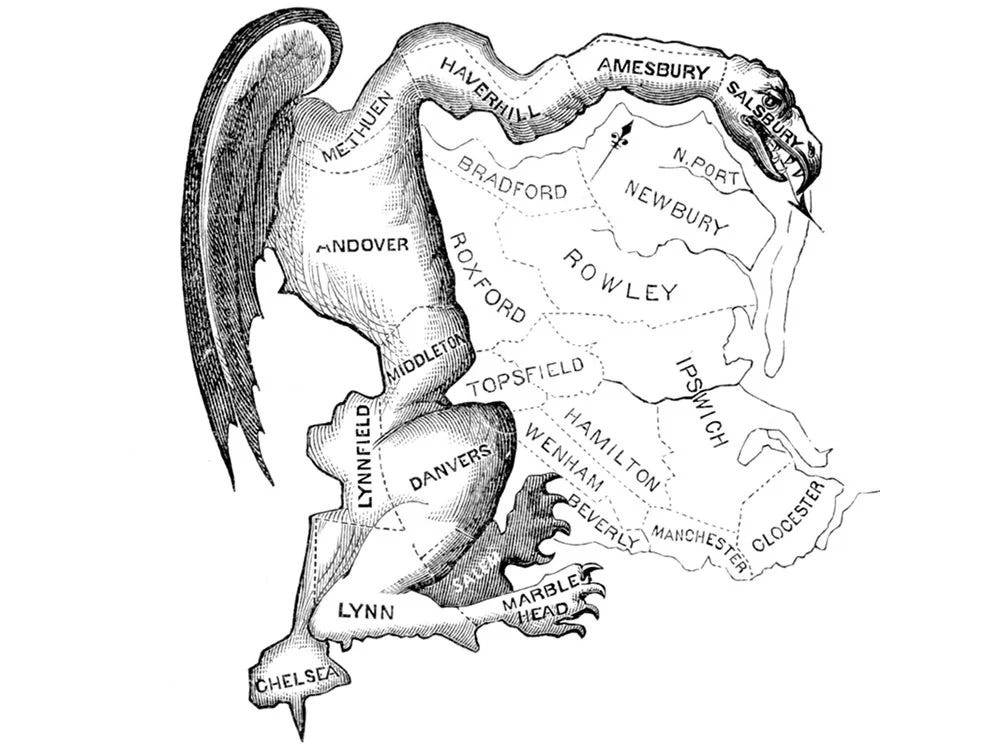
The term "gerrymander" originated in 1812 from Massachusetts Governor Elbridge Gerry’s name and a salamander-shaped electoral district created under his administration.
This history reveals a crucial insight: geography doesn't organize itself into legislative districts. Someone must always make inherently political decisions about boundaries, communities of interest, and competing criteria. The question isn't whether to have political influence in redistricting—that's inevitable and appropriate—but where to locate that influence and how to make it accountable.
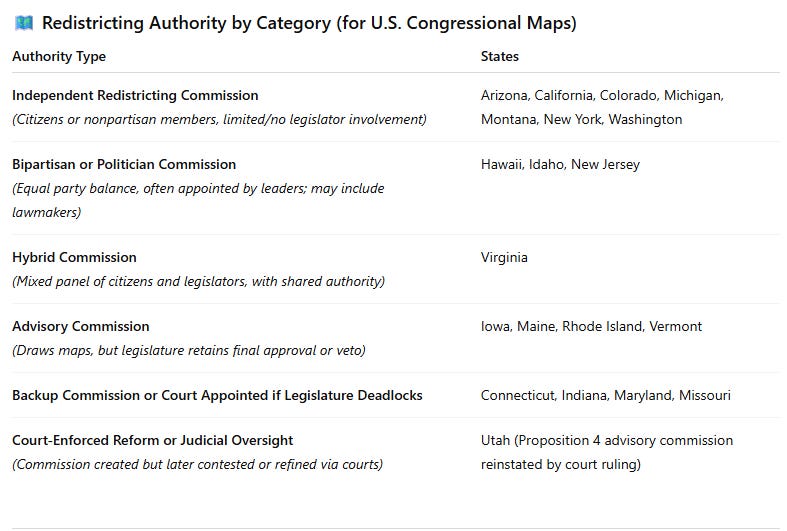
All 50 states began using legislatures to draw congressional districts. Today, only 30 remain, while 20 reformed their systems. Here's the critical fact that undermines court intervention arguments: every single reform came through democratic processes. The 20 states using commissions or alternative methods established them through voter ballot initiatives or constitutional amendments (California, Michigan, Arizona, Colorado); legislative referenda where voters approved changes (Ohio, Virginia); or legislative reforms with clear public support (Iowa, Washington). There are zero examples where courts unilaterally imposed commissions based on broad "fairness" rationales. Court interventions addressed specific legal violations—racial discrimination, population inequality—not subjective fairness standards.
This pattern matters enormously. When redistricting authority flows from democratic authorization, it maintains legitimacy even when outcomes disappoint. California's independent commission generates ongoing controversy, but citizens accept results because they chose the system. When courts impose solutions based on "fairness," they bypass democratic processes and create precedents for further judicial management of political questions.
The Accountability Advantage and the Extremism Question
Legislative redistricting, however self-interested, remains immediately accountable to voters who can replace legislators in two-year cycles. This responsiveness distinguishes it from alternatives that insulate decision-makers from electoral consequences. When citizens disapprove of legislative maps, they have clear recourse: vote the legislators out. When they disapprove of commission maps, their options become murky—commissioners often serve fixed terms, and changing commission structures requires constitutional amendments taking years to accomplish.
The criticism that "politicians choose their voters" is true in the action itself, but obscures this accountability mechanism. Politicians who abuse redistricting authority face electoral consequences when public outrage reaches sufficient levels. The 20 states that reformed their systems demonstrate this democratic correction in action—legislators who overreached eventually faced voter backlash that forced institutional changes.
That said, in heavily one-party states, this correction can be slower, potentially allowing advantages to persist until broader shifts occur.
The assumption that gerrymandering creates political extremism appears logical: safer districts should produce more partisan representatives who cater to primary voters rather than general election moderates. Yet research reveals this relationship explains far less polarization than critics assume. Studies show gerrymandering accounts for only 10-15% of political polarization since the 1970s.1 The remaining 85-90% stems from demographic sorting, ideological consistency, and media fragmentation that redistricting reforms cannot address. Influential research by McCarty, Poole, and Rosenthal2 demonstrates that Senate polarization mirrors House trends despite senators facing statewide elections unaffected by gerrymandering.
This suggests that American polarization reflects genuine voter preferences rather than electoral manipulation. Liberals concentrate in cities, conservatives in rural areas, creating naturally polarized constituencies that deserve representatives reflecting their views. Artificially competitive districts might force representatives to obscure rather than clarify policy differences, potentially reducing democratic accountability. A 2023 Harvard analysis3 does show gerrymandering reducing electoral competition, potentially incentivizing extreme positions to avoid primary challenges. But this effect remains secondary to broader voter-driven polarization that would exist regardless of district boundaries, with mixed evidence overall on its precise impact.4
The moderation assumption deserves scrutiny too. In an era of genuine ideological differences, moderate representatives might misrepresent constituent preferences rather than serve democratic accountability. A progressive district might prefer a liberal representative over a centrist, just as a conservative district might prefer a traditional conservative over a moderate. The Senate comparison strengthens this argument: senators face the ultimate competitive election—statewide contests that cannot be gerrymandered—yet display similar polarization patterns to House members.
Technology and Democratic Correction
Modern redistricting does enable unprecedented precision through computer modeling and big data analysis. Software can test thousands of map variations and optimize for specific partisan outcomes with remarkable accuracy. This technological evolution represents a qualitative change from historical gerrymandering. However, the same technology that enables manipulation also enables detection and resistance. Academic researchers, advocacy groups, and journalists now identify gerrymandering with equal sophistication. Mathematical measures like the efficiency gap can quantify partisan bias precisely, making abuse more visible than ever.
More importantly, technological precision doesn't alter the fundamental democratic constraint: two-year election cycles that enable rapid correction when public outrage reaches sufficient levels. No matter how surgically drawn, districts remain accountable to voters who can replace legislators if they disapprove of redistricting decisions. Texas's 2025 redistricting attempt generated immediate, widespread opposition precisely because modern communication and analysis tools enabled rapid recognition and outrage.
The Faith in Democracy Criticism
It is hard to argue that gerrymandering does not undermine faith in our democratic system for those who become depondent about the outcomes. However, the evidence shows that when results are eggregious enough, more people become motivated by those outcomes than withdraw, and that leads to corrective action.
Missouri illustrates the correction cycle: voters approved redistricting reforms in 2018 with 61%, then repealed many of them in 2020 by 51% as preferences shifted. In Utah, voters approved establishing an independent commission that legislators tried to overturn which the Utah Supreme Court restored when it ruled unanimously that it violated the intentions of the voters. Colorado adopted independent commissions via a 2018 voter initiative after dissatisfaction with legislative maps. Michigan followed similar patterns in 2018. Yet Virginia's commission system deadlocked in 2021, requiring court intervention that many viewed as partisan. New York's independent commission produced maps that courts struck down, leading to judicial districts that generated new controversy.
The pattern reveals that even reformed systems produce politically contested outcomes. The difference isn't outcome fairness but process legitimacy and democratic responsiveness when results disappoint.
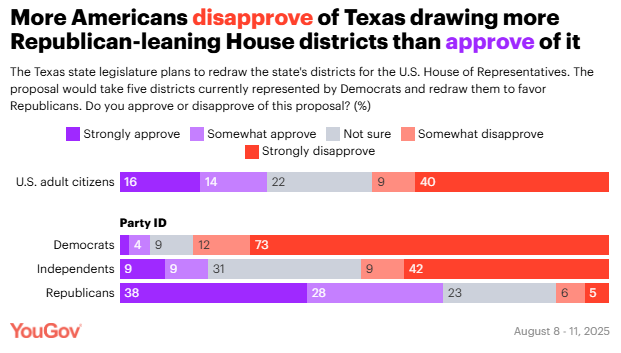
And let’s see what happens in Texasin its next election cycle. Polling data shows how this process created political pressure in Texas: while Republicans largely support the effort (around 60% approve) and Democrats strongly oppose it (over 80% disapprove), crucial independent voters lean against it (only about 20% approve and 51% disapprove).
Every generation believes its political problems uniquely threaten democratic governance. Americans in 1920 faced seemingly intractable issues like systematic corruption, unpopular Prohibition, restrictive immigration, economic inequality, limited women's rights, and foreign policy paralysis. Editorial writers declared them permanently entrenched. Yet democratic processes addressed each: corruption through ethics reforms, Prohibition via repeal, and so on. Today's challenges—money in politics, incumbency advantages, Electoral College criticism, Social Security fiscal woes, and polarization—follow similar patterns, with creative solutions like ballot initiatives and interstate compacts emerging through electoral competition.
Commission Effectiveness Reality
Independent commissions remain popular because they promise to remove politics from inherently political decisions. Yet evidence for their effectiveness remains mixed, as a 2024 report on redistricting commissions highlights. Many if not most redistricting maps are challenged and approved only after revision and are frequently criticized by both parties. Iowa's nonpartisan system produces compact, competitive districts with low partisan bias. Arizona's independent commission has survived legal challenges while drawing criticism from both parties, suggesting evenhandedness but ongoing bipartisan discontent. However, other experiences reveal complications: Virginia's commission deadlocked, requiring court intervention; New York's commission produced maps struck down as gerrymandered; Ohio's backup system required multiple redraws amid litigation.
More fundamentally, commissions must still make political choices about competing criteria: compactness versus communities of interest, competitiveness versus minority representation, preserving boundaries versus population equality. These trade-offs reflect value judgments that commissioners make through political processes, just less transparently than legislative deliberation.
The accountability problem looms largest. Citizens who disapprove of commission maps have more limited recourse beyond constitutional amendments requiring years to accomplish. Legislative maps remain immediately accountable through electoral replacement, providing democratic correction mechanisms that commission systems often lack. Crucially, all successful commission systems emerged through democratic authorization—voter initiatives, constitutional amendments, legislative referenda. Their legitimacy depends not on institutional design but on democratic choice about redistricting authority.
To illustrate the trade-offs, consider this comparison:
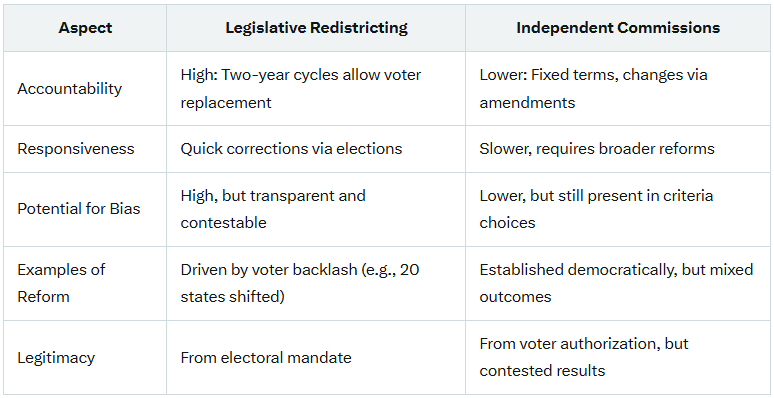
Interestingly, of the 20 states using alternative (non-legislative) redistricting systems, only California (in 2010) has seen a voter initiative aimed at reversing that structure—and it did not gather a majority to succeed. So in the cases where state legislatures have lost their authority in drawing districts, this solution has satisfied the public will to date.
Courts vs. Democratic Processes
Federal courts appropriately intervene when clear legal violations occur—racial discrimination under the Voting Rights Act, population inequality violating equal protection, or procedural failures under state law. These represent objective legal standards that courts can apply consistently.
The 2019 Rucho v. Common Cause decision acknowledged the crucial distinction by declaring partisan gerrymandering non-justiciable. The Supreme Court recognized that partisan fairness involves subjective judgments about representation that democratic processes, not legal doctrine, should resolve. Unlike racial discrimination or population equality, partisan fairness lacks manageable judicial standards for distinguishing acceptable from unacceptable political influence.
Were courts to intervene in political questions based on "fairness" rather than legal violations, they would be bypassing the democratic processes that successfully reformed redistricting in 20 states so far. This judicial overreach would undermine democratic responsiveness by removing decisions from elected officials accountable to voters. The pattern also holds internationally: successful redistricting systems in the United Kingdom, Canada, and Australia derive legitimacy from legislative authorization and clear legal mandates, not judicial imposition.
Conclusion: Trusting Democratic Processes Over Democratic Outcomes
"Where the whole power of the government is in the hands of the people, there is the less pretense for the use of violent remedies in partial or occasional distempers of the State. The natural cure for an ill-administration, in a popular or representative constitution, is a change of men." Alexander Hamilton's insight from Federalist 22 captures the essential argument for trusting democratic processes even when they produce disappointing outcomes.
The gerrymandering paradox reveals democracy's deeper challenge: maintaining faith in messy, imperfect processes that enable long-term responsiveness to public will. The five major criticisms of gerrymandering each contain important insights but may overlook that temporary outcomes do not equate to permanent process failure.
The extremism criticism overlooks that 85-90% of polarization stems from genuine voter preferences rather than district manipulation.
The reversed democracy criticism ignores that someone must always draw boundaries, and legislative authority remains most accountable to democratic correction.
The technology criticism acknowledges increased precision but misses that detection and resistance capabilities have evolved equally.
The damaged faith criticism confuses outcome disappointment with process failure, repeating pessimistic patterns from every era of American history.
The commission alternative criticism assumes institutional design matters more than democratic authorization and accountability, despite mixed evidence on their superiority.
The evidence supports a different conclusion: democratic processes, however imperfect their immediate results, provide superior long-term solutions to political problems. The two-year legislative cycle enables rapid correction when public outrage demands change. The 20 states that reformed redistricting did so through voter initiatives and legislative action, not judicial imposition. Historical examples from 1920 to today demonstrate democracy's capacity to address seemingly permanent problems through adaptive responses that rigid alternatives cannot match.
This doesn't defend unfair gerrymandering outcomes or dismiss legitimate concerns about representation. It argues that responsive democratic processes, accountable to voters through regular elections, better serve the people's will over time than alternatives that prioritize immediate fairness over democratic accountability.
In our dynamic republic, the real solution isn't eliminating political influence from redistricting—impossible and undesirable—but ensuring political influence remains answerable to citizens who can demand change when outcomes no longer serve their interests. As the 2026 midterms approach, watch how voter responses in Texas, California, and beyond test this resilience.
Thank You To Our Sponsors:
Truflation: Learn about what prices are actually doing by going to https://truflation.com/ Use code BOBDEW10 to get 10% off purchases.
Foundation: Protect your Bitcoin using the latest off-line technology with easy-to-use Passport. Their next product, Passport Prime will protect all passwords off-line with even-better technology. https://foundation.xyz/
River Financial: If not cold storage for your Bitcoin, I’d highly recommend River for buying and holding- River is engineered to protect your Bitcoin over the long run. Use this link for discounts: https://river.com/signup?r=T7GGAF7G
https://www.princeton.edu/~nmccarty/gerrymander11.pdf ; https://mysite.du.edu/~smasket/Redistricting.pdf
https://chicagounbound.uchicago.edu/cgi/viewcontent.cgi?article=1550&context=uclf
https://news.harvard.edu/gazette/story/2023/07/biggest-problem-with-gerrymandering/
https://www.researchgate.net/publication/249691966_Redistricting_and_Party_Polarization_in_the_US_House_of_Representatives