
An Eighty-Year Shake-Up
America may be undertaking the most consequential reform of government science funding in eighty years. It is also creating enough uncertainty that some of its best scientists are considering leaving.
Near the end of my recent interview1 with Samir Varma, I asked which long-term reform would contribute most to American prosperity.
“We need to reform—and it’s so easy to do—our scientific funding system,” he said.
Samir favored creating multiple DARPA-style agencies led by accomplished scientists with broad authority to make unconventional bets. But he was also alarmed by the Trump administration’s current approach. Its real target, he had heard, was elite universities it disliked. Scientific research was becoming collateral damage.
Even after a project had passed peer review, Samir said, “some political committee” could decide that the research should not proceed. He was particularly troubled by “the withholding of money—and the capriciousness of that too.”
Eminent researchers he knew personally were already leaving for countries such as Canada. America’s postwar scientific leadership had been built partly by researchers driven out of Europe. Samir feared that the United States had begun reversing the flow that helped make it the world’s technological leader.
Coincidentally, only two days earlier, the Trump White House had released a 122-page report2 calling for the first comprehensive rethinking of America’s scientific enterprise since 1945.
Then, within the past week, The All-In Podcast released two extended interviews examining the same subject from sharply different directions. Michael Kratsios, the White House science adviser who wrote the report, defended the administration’s actions and explained its proposed reforms3. Eric Weinstein, one of the scientific establishment’s most uncompromising critics, argued that peer review should lose its dominant role and that government should fund exceptional people rather than carefully packaged proposals4. Together, the conversations exposed both the depth of the existing system’s failures and the risks of trying to overturn it.
The Question Kratsios Did Not Answer
Yet for all the ground covered by the report and the two interviews, the most immediate danger identified by Samir received remarkably little attention.
The report condemns grant requirements that forced scientists to conform to “the political fashions of the day.” It is right to do so. Scientific proposals should not have been judged by their alignment with progressive priorities involving diversity or other social objectives. But replacing one ideological test with another would not restore scientific neutrality. It would merely change who administers the test.
An elected government must decide how much public money to spend on science and which broad national objectives deserve priority. It may reasonably favor fusion, quantum computing, biotechnology, or fundamental physics over other fields. But setting priorities is different from withholding funding from individual projects because the administration is engaged in an unrelated political conflict with the university conducting them.
Neither the report nor the Kratsios interview establishes that distinction. When Friedberg pressed him about the canceled funding and scientists considering leaving the country, Kratsios largely dodged both questions, redirecting the conversation toward politicized grants and the need for broader reform. He did not confront the danger of making previously approved research dependent on political judgments imposed after scientific review. A government demanding greater accountability from universities and funding agencies must also make its own interventions transparent, consistent, and subject to evaluation.
A System That Does Not Study Itself
Those omissions are substantial, but they do not invalidate the report’s broader diagnosis. Science: A New Golden Age is unusually introspective for a government document. It does not simply celebrate past accomplishments or ask for more money. It questions whether the institutions built to support American science after World War II still fit the way discovery occurs today.
The report describes a system in which scientists can spend months preparing grant applications and nearly half their research time on administrative requirements. Peer review tends to favor established fields, institutions, and investigators, while federal agencies face little pressure to reconsider how they allocate money. Meanwhile, private industry has become by far the largest source of American research and development spending, eroding the old assumption that basic discovery happens in universities before moving in a straight line toward commercial application.
Tyler Cowen and Alex Tabarrok 5 reached a similar conclusion a decade ago in a skeptical examination of National Science Foundation funding for economics. They accepted the conventional case for government support of science but argued that the relevant question was not whether public funding was better than no funding. It was whether each additional dollar produced more value than its alternatives. They found that more than half of NSF economics grants since 2005 had gone to just 11 universities and the National Bureau of Economic Research, while the agency appeared to have done little to determine which of its previous expenditures had produced the greatest marginal value.
Not every statistic or causal claim in the White House report can be independently confirmed. Some examples clearly reflect the administration’s political priorities. But its central concerns have also been raised by scientists, economists, philanthropists, and critics across the political spectrum. The evidence is strong enough to regard the diagnosis as at least directionally correct and probably substantially so.
Most important, the report treats these weaknesses as a call to action. It asks government to apply experimentation not only to the science it funds, but to the institutions deciding which science receives support.
Sputnik shows that disruption can revive institutions that have become complacent. But the American response did more than tear down an inadequate system: it created ARPA and NASA, expanded scientific education, and supplied new institutions and missions. Productive disruption identifies a weakness and builds something better. Arbitrary disruption creates uncertainty without establishing a replacement.
The need to allocate public money more intelligently has grown as government’s role has changed. In the decades after World War II, government supplied roughly 70% of American research and development funding and the private sector 30%. Today, those proportions have reversed. Kratsios called the current balance reasonable, and extraordinary private-sector advances in artificial intelligence, quantum computing, biotechnology, and medicine support his confidence.
But private research naturally gravitates toward discoveries capable of producing valuable products. Government remains essential where the benefits may be widely dispersed, impossible to own, or decades away. With a narrower and more distinctive role than it held in 1945, government has even greater reason to ensure that no single funding mechanism determines which discoveries receive support.
The report’s framework makes the emerging division of labor clearer. Universities, corporate laboratories, and federal laboratories each remain well suited to some kinds of work and poorly suited to others. New institutions should be designed specifically to occupy the gaps.
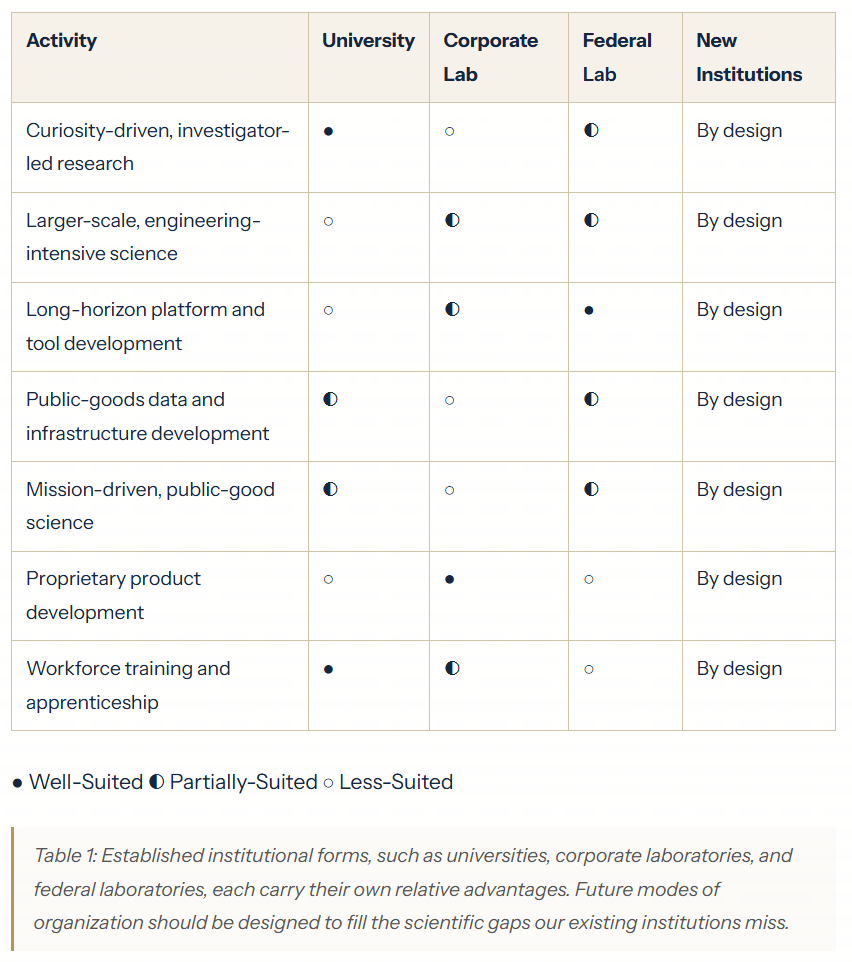
Source: White House, Science: A New Golden Age
More Than Peer Review
The White House report does not propose replacing the current system with one new model. Its more promising idea is to create a portfolio of funding mechanisms suited to different kinds of scientific work.
Traditional peer review remains useful for determining whether a proposal is rigorous and grounded in existing knowledge. But committees often struggle to distinguish exceptional ideas from merely good ones. Proposals that divide reviewers may be precisely those most likely to challenge an established field, yet consensus-driven panels favor work that everyone finds defensible.
One alternative is a “golden ticket,” which allows an individual reviewer to fund an unconventional proposal even when the rest of the panel is unpersuaded. Another is to support accomplished scientists for long periods rather than requiring them to specify each project in advance. The Howard Hughes Medical Institute has used this approach privately, while the NIH Director’s Pioneer Award has demonstrated that government can also fund people rather than proposals.
Other problems require different tools. Fast grants can provide modest funding before an opportunity disappears. Prizes can reward a clearly defined result without requiring the government to identify the likely winner beforehand. Regranting can place money in the hands of scientists close enough to the frontier to recognize talent before it becomes widely accepted. Independent research organizations can assemble permanent teams for projects too large for one university laboratory but too speculative for a commercial company.
Samir’s proposal for multiple DARPA-style agencies fits within this broader portfolio. DARPA gives individual program managers substantial authority to pursue ambitious objectives, assemble teams, and terminate projects that fail. Its success comes not from eliminating accountability, but from placing responsibility clearly on identifiable decision-makers rather than diffusing it across committees.
The common principle is not that peer review has failed. It is that no single mechanism should carry nearly the entire burden of deciding which discoveries deserve support.
Reform or Indiscriminate Cutting?
The administration’s actions must now be judged against the quality of its proposals. Friedberg estimated that approximately $3 billion remained unspent on frozen or terminated research grants. For perspective, that equals about 6% of the NIH’s roughly $47 billion annual budget, although the comparison is imperfect: the $3 billion apparently includes remaining balances from both NIH and NSF grants rather than one year’s spending by a single agency.
The more important question is what happened to the money. Was it permanently eliminated, temporarily withheld, or redirected toward the more promising mechanisms described in the report? Were individual projects evaluated on their scientific merits? Did the disruption produce better research, or did it interrupt existing work before any replacement was ready?
A reform agenda based on experimentation should be able to answer those questions. It must also account for consequences beyond the dollars withheld, including whether the manner in which grants were frozen or terminated created avoidable uncertainty and encouraged valuable scientists to leave the country. Without clear objectives, transparent criteria, and measurable results, even an intellectually serious reform risks becoming indistinguishable from indiscriminate cutting.
Make the Funder Scientific
The report’s most important proposal may be its least dramatic: every major funding agency should establish a metascience unit to study how science itself is funded. Different agencies could test peer review against golden tickets, fast grants, prizes, regranting, and long-term support for individual researchers. The results should be published, compared, and used to redirect money toward the approaches that work best.
A decade ago, Cowen and Tabarrok could not identify a serious NSF study determining which of its previous economics grants had produced the greatest marginal value. An institution devoted to advancing knowledge should be equally committed to learning from its own decisions.
No evaluation system will reveal every discovery that might have occurred or prevent politics from influencing national priorities. But it can force funding agencies, and the administrations overseeing them, to define their objectives, examine results, and change course when the evidence demands it.
Scientists must be free to undertake experiments that fail. Funding agencies must be required to undertake experiments from which they learn. The government should apply the scientific method not only to the research it funds, but to the institutions distributing the money and its own exercise of political power.
America’s scientific establishment needs disruption. Whether this moment produces renewal or decline will depend on whether we disrupt the institutions that resist learning—or the scientists whose discoveries make future prosperity possible.
Thank you very much to our sponsors:
Foundation.xyz: When it comes to protecting your Bitcoin, you shouldn’t have to simply trust the company that made your hardware wallet.
Foundation believes in verifiability over reputation. Its firmware and apps are open source, its builds are reproducible, and both Passport Core and Passport Prime have undergone independent hardware security audits. The point isn’t simply that Foundation says its products are secure. It’s that you can verify that for yourself.
Foundation is also expanding what users can control:
Passport Prime goes beyond Bitcoin. It can manage passwords and two-factor authentication codes, serve as a FIDO2 security key, and provide encrypted storage—all on a device you own and control. Foundation also plans to enable app sideloading, opening Prime to applications from independent developers.
Users can now add their own entropy. The latest Envoy and KeyOS releases allow users to introduce their own randomness when creating a seed, reducing reliance on the device itself to generate it.
Learn more about Foundation and receive a free bumper case when you purchase a Passport Prime using Code PROSPERITY at → https://foundation.xyz/?ref=PROSPERITY
River Financial: If not cold storage for your Bitcoin, I’d highly recommend River for buying and holding- River is engineered to protect your Bitcoin over the long run. Use this link for discounts: https://river.com/signup?r=T7GGAF7G
Where Disciplines Intersect

Many of the greatest advances of the past century have come through increasing specialization. As knowledge has expanded, researchers have focused on ever narrower fields, developing expertise that has transformed science, medicine, engineering, and economics.
Science- A New Golden Age by Micahel Kratsios https://www.whitehouse.gov/science/
A Skeptical View of the National Science Foundation’s Role in Economic Research by Cown and Tabarrok https://pubs.aeaweb.org/doi/pdfplus/10.1257/jep.30.3.235