
For four years, blockchain technology has carried a scarlet letter. High-profile criminal cases, from ransomware attacks to international money laundering, convinced policymakers and the public that cryptocurrency was inherently dangerous—a technology whose criminal applications outweighed its economic promise. But the law enforcement reality tells a different story.
Connecticut State Police Detective Matt Hogan, one of America's specialized blockchain investigators, sees this backward. "The reality isn't that cryptocurrency lacks criminal activity," he explains, "criminals naturally gravitate toward any tool that might make their operations easier." The critical questions aren't whether criminals use new technology—they always do, from the internet to encrypted phones to digital payments—but whether blockchain ultimately makes law enforcement's job harder or easier, and whether society should stifle innovation simply because criminals also exploit these tools.
Highlight clip:
Hogan's daily experience contradicts public fears about cryptocurrency's supposed anonymity. "I need the wallet address that you sent money to. I can trace it," he explains. "That's all I care about right now—I need to follow that money until it gets to an off ramp." Unlike traditional banking investigations requiring subpoenas, search warrants, and months of bureaucratic delays, blockchain provides real-time transparency. "Blockchain is open source. I can hop right on and monitor the wallet address... It's all there. I don't need any permission."
This advantage proves crucial against sophisticated operations like "pig butchering"—elaborate romance and investment frauds run by Chinese organized crime from Southeast Asia. These criminals employ "PhD-type quality people to write scripts" for psychological manipulation, building multi-billion dollar enterprises around social engineering. Yet their Achilles' heel remains blockchain's permanent record of every transaction. Hogan's team handles over 100 cryptocurrency fraud cases annually, achieving a 10% recovery rate through systematic blockchain investigation.
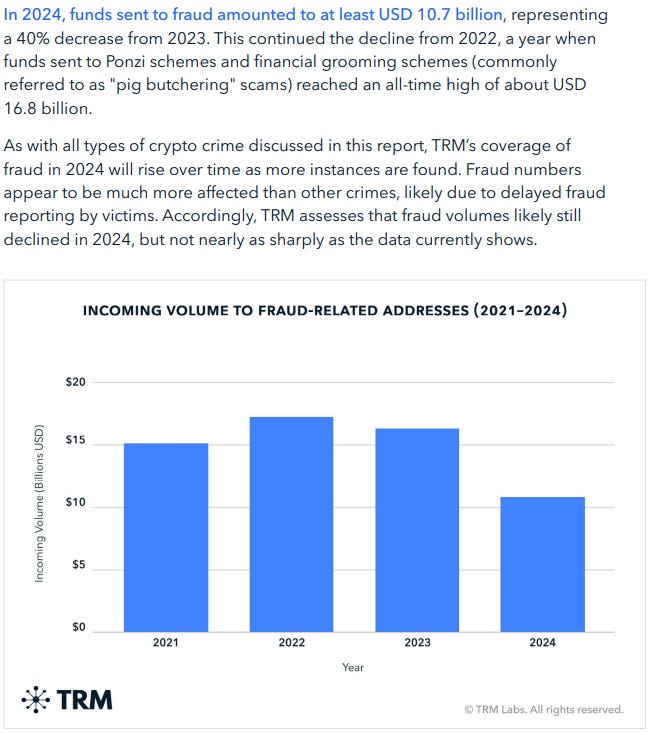
Source: TRM Labs 2024 Crime Report
The real investigative challenges lie elsewhere: encrypted messaging platforms where criminal coordination occurs. When someone suggests "switching over to WhatsApp, it's a fraud almost immediately—no one uses WhatsApp to communicate unless it's fraud or you're trying to hide something." Telegram presents even greater concerns. "I'm terrified of Telegram," Hogan admits, "because now you're bringing an entire ecosystem of end-to-end encryption on top of a blockchain." Criminal communications remain hidden while financial outcomes stay visible—creating investigative blind spots.
Full interview:
These realities expose flawed federal policy under the previous administration, which increasingly targeted blockchain protocol developers when criminals used their technology. Hogan finds this approach fundamentally misguided: "Am I going to arrest the US Navy for creating Tor? You're not going to arrest the naval officers who create Tor. It just doesn't make any sense." His analogy extends further: "I'm not going to arrest Jamie Dimon for people laundering money through JP Morgan."
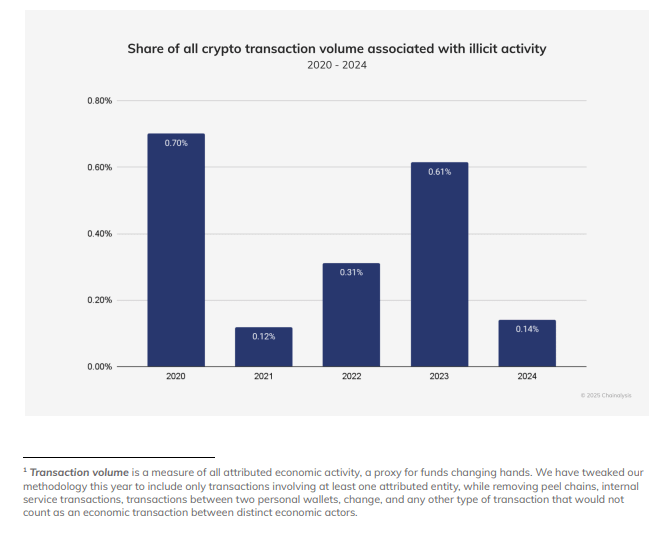
The share of all crypto transaction volume associated with illicit activity remains very low according to Chainalysis:
For individuals, Hogan offers practical protection advice: never engage with unsolicited cryptocurrency investment opportunities, especially those directing you to messaging apps. "If you don't know someone in your text messages, just disregard it."
The future of financial crime investigation lies in embracing blockchain's transparency while developing methods for penetrating encrypted communications. As Hogan's work demonstrates, cryptocurrency isn't the criminal's perfect tool—it's potentially law enforcement's greatest advantage. In an era where every transaction leaves permanent digital evidence, perhaps the real question isn't whether crypto enables crime, but whether society will embrace a technology that makes financial crime more traceable than ever before.
Thank you very much to our sponsors:
Truflation: Learn about what prices are actually doing by going to do by going to https://truflation.com/marketplace/us-inflation-rate; BUY Truflation products and services with this code and save 10%: BOBDEW10.
Foundation: Protect your Bitcoin using the latest off-line technology with easy-to-use Passport. Their next product, Passport Prime will protect all passwords off-line with even-better technology. https://foundation.xyz/
River Financial: If not cold storage for your Bitcoin, I’d highly recommend River for buying and holding- River is engineered to protect your Bitcoin over the long run. Use this link for discounts: https://river.com/signup?r=T7GGAF7G
Interactive Brokers: I highly recommend using Interactive Brokers (IBKR) because it is consistently praised by experienced and active investors/traders for its low costs, extensive global market access, powerful execution tools, and customization capabilities. Use this link to visit: https://www.interactivebrokers.com/mkt/?src=bobdN&url=%2Fen%2Fwhyib%2Foverview.php
This content is provided by a paid Influencer of Interactive Brokers. Influencer is not employed by, partnered with, or otherwise affiliated with Interactive Brokers in any additional fashion. This content represents the opinions of Influencer, which are not necessarily shared by Interactive Brokers. The experiences of the Influencer may not be representative of other customers, and nothing within this content is a guarantee of future performance or success.
None of the information contained herein constitutes a recommendation, promotion, offer, or solicitation of an offer by Interactive Brokers to buy, sell or hold any security, financial product or instrument or to engage in any specific investment strategy. Investment involves risks. Investors should obtain their own independent financial advice and understand the risks associated with investment products and services before making investment decisions. Risk disclosure statements can be found on the Interactive Brokers website.
Interactive Brokers is a FINRA registered broker and SIPC member, as well as a National Futures Association registered Futures Commission Merchant. Interactive Brokers provides execution and clearing services to its customers. For more information regarding Interactive Brokers or any Interactive Brokers products or services referred to in this video, please visit www.interactivebrokers.com.
Digital Assets:
Trading in digital assets, including cryptocurrencies, is especially risky and is only for individuals with a high-risk tolerance and the financial ability to sustain losses. For more information about the risks surrounding the trading of Digital Assets please see the "Disclosure of Risks of Trading Digital Assets”.
Any trading symbols, entities or investment products displayed or named in this podcast are for illustrative purposes only and are not intended to portray recommendations.
Futures, event contracts and forecast contracts are not suitable for all investors. Before trading these products, please read the CFTC Risk Disclosure. For a copy visit https://www.interactivebrokers.com/en/general/homepage-disclosures.php
Margin Trading:
Trading on margin is only for sophisticated investors with high risk tolerance. You may lose more than your initial investment. For additional information regarding margin loan rates, see ibkr.com/interest