
A recent essay by Lyn Alden explored how humanity became prosperous through the interaction of energy, technology, institutions, markets, and information. One section focused on a challenge that many people already sense intuitively: advances in communication technology expanded humanity's shared reality, while artificial intelligence is making authentic information increasingly difficult to distinguish from synthetic information.
The essay caught my attention and a few days later Lyn was able to join me on Exploring Prosperity to discuss the implcations. One theme ran through both the essay and our conversation: what happens when confidence in information begins to erode?
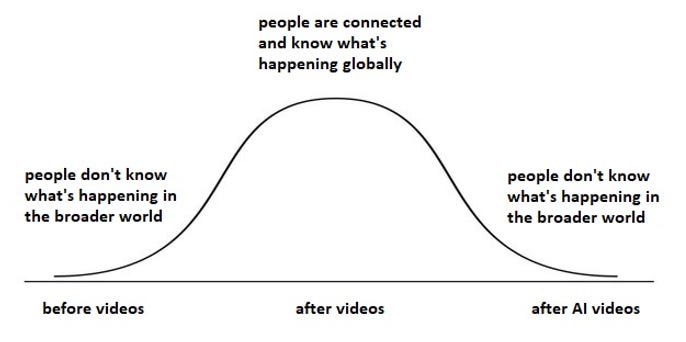
Source: Lyn Alden https://www.lynalden.com/june-2026-newsletter/?mc_cid=2145880acd&mc_eid=e505233e70
The chart clarifies the concern. For most of human history, information remained local. People generally knew what was happening in their village or region and little beyond it. Over time, communication technologies expanded the radius of information and helped create a broader shared reality. Artificial intelligence introduces a new challenge. The cost of producing information is approaching zero while the cost of determining authenticity is high when it is even possible.
If this is so, how do societies determine what is true in the first place?
Science is one answer. Journalism, education, and democratic institutions are others. Yet prosperous societies rely on additional truth-determining systems that receive far less attention. Entrepreneurs, businesses, and markets spend every day testing ideas against reality.
An entrepreneur resembles a scientist more than many people realize. Both begin with a hypothesis, but neither knows the answer with certainty. The scientist conducts experiments and gathers evidence. The entrepreneur receives feedback through customer behavior, revenues, costs, and competition. In both cases, information is generated through testing. What was previously unknown becomes known.
This process sits at the heart of rising living standards. Prosperous societies do not simply accumulate knowledge. They create systems that continuously generate new knowledge by forcing ideas to confront reality.
Markets play a central role in that process. Product markets reveal whether customers value a solution. Financial markets help determine whether additional resources should be devoted to expanding it. One evaluates usefulness. The other evaluates scale. Together they form a decentralized problem-solving system that continuously tests ideas and allocates resources based on the results.
What makes these systems so powerful is that they do not require universal agreement. Customers and entrepreneurs may disagree about politics, culture, or current events. Investors and founders may consume entirely different sources of information. The system functions because participants can rely on feedback. Customers buy or they don’t. Revenues exceed costs or they don’t. Investments succeed or fail. Reality remains the scorecard.
Trust has always played an important role in this process. In many ways, the history of prosperity can be viewed as the expansion of trust. Human cooperation expanded from family to tribe, from village to city, from nation to global commerce. Markets, contracts, money, brands, and institutions allowed people to cooperate successfully with strangers. As the radius of trust expanded, so did the scale of human problem solving.
Economic historians have pointed to numerous examples. The Dutch Republic developed commercial and financial institutions that allowed merchants to transact across vast distances with greater confidence, helping fuel one of history’s great commercial expansions. Later, England’s institutional reforms following the Glorious Revolution strengthened property rights and confidence in long term investment, helping lay part of the foundation for the economic transformation that followed. More recently, Argentina’s recurring inflation and policy instability illustrate the opposite dynamic. The challenge was not simply declining trust in government. Money became a less reliable measuring stick. Long term planning became more difficult. Investment horizons shortened. Signals that businesses and investors relied upon became less dependable.12
The common thread across these examples is that trust improves the quality of feedback.
When people have confidence in contracts, property rights, money, and institutions, the signals they receive become more reliable. Better signals lead to better decisions. Better decisions contribute to higher living standards.
This brings us back to the challenge Lyn identified. Shared reality has immense value. Scientific discoveries spread more effectively when people trust the institutions that produce them. Markets function more efficiently when participants have confidence in the information they receive. Trust in information supports many of the systems that modern societies depend upon.
Entrepreneurship offers a useful perspective on this challenge. Entrepreneurs profit by identifying problems and creating solutions. If declining confidence in information becomes one of the defining challenges of the AI era, increasing resources will likely be devoted toward solving it. This would hardly be unprecedented. Banks helped people trust transactions. Brands helped consumers trust products. Auditors helped investors trust financial statements. Entire industries emerged because trust created economic value. In many respects, they became part of society's trust infrastructure.
During our discussion, Lyn pointed to Guatemala’s national election, where records were timestamped on the Bitcoin blockchain to create a verifiable record that could not be altered after the fact. It is an early example of how technologies designed to establish authenticity and provenance may become increasingly valuable in a digital world. If confidence in information continues to erode, products and services that help establish authenticity, credibility, and trust may become some of the most valuable offerings of the AI era.
None of this eliminates the challenge Lyn identified. A broadly shared reality remains enormously valuable, and technological solutions may never fully replace it. Yet the history of prosperity suggests that societies do not merely react to new problems. They develop institutions, technologies, and businesses that attempt to solve them. If confidence in information becomes scarcer, the same entrepreneurial system that has helped humanity solve countless other problems may increasingly be directed toward restoring it.
Prosperity has always depended on our ability to determine what is true. The next chapter may depend on how effectively we preserve the feedback systems that allow us to recognize it.
Full interview here:
Thank you very much to our sponsors:
Foundation: Secure your digital life—from passwords, 2FA, files and Bitcoin with Passport Prime, an all-in-one personal security platform. Visit them at https://foundation.xyz/
River Financial: If not cold storage for your Bitcoin, I’d highly recommend River for buying and holding- River is engineered to protect your Bitcoin over the long run. Use this link for discounts: https://river.com/signup?r=T7GGAF7G
Douglass North and Barry Weingast, Constitutions and Commitment: The Evolution of Institutions Governing Public Choice in Seventeenth-Century England (1989).
Jared Rubin, How the World Became Rich (2024).
I'd say it differently - feedback improves the quality of trust, not vice versa. What the social media revolution did was so effectively disseminate information, that the poor quality narratives of previously trusted institutions were revealed as frauds. Like Fauci and the NIH etc. this is good. It forces those institutions to do better. Trust is the willingness to skip due diligence, so it promotes efficiency and leverage. Too much trust leads to bubbles. Too little leads to panics. More feedback leads to the right level of trust, whatever it should be
Excellent point Ken. I like your framing that feedback improves the quality of trust rather than the reverse. One way I think about the entrepreneur is as someone constantly testing hypotheses against reality. Markets generate that feedback. Trust then emerges from systems that repeatedly prove reliable. I also agree that more information doesn't only create noise. It can expose institutional failures that might otherwise have remained hidden. The challenge in the AI era is preserving the ability to distinguish genuine feedback from fabricated signals.