
A seismic shift is underway in the global economic order, revealed through news stories and layers of increasingly forward-looking indicators. While the transformation appears subtle in some metrics, market signals suggest we're approaching an inflection point in American economic leadership.
The key question isn't just how far this divergence might go, but whether it will help or hurt the competitiveness of Europe, China, Japan, India, and other economies. Could America's growing advantages actually spark a global economic renaissance by leaving other countries no alternative but to improve?
The GDP Stability Illusion
The headline numbers look deceptively stable. In constant 2015 US dollars, regional shares of global GDP show remarkable consistency over the past decade. The US has maintained roughly 24% of global output, with only minimal fluctuation. China's gradual rise to 18% and the EU's modest decline to 17% might suggest a slow-motion power shift rather than a dramatic realignment.
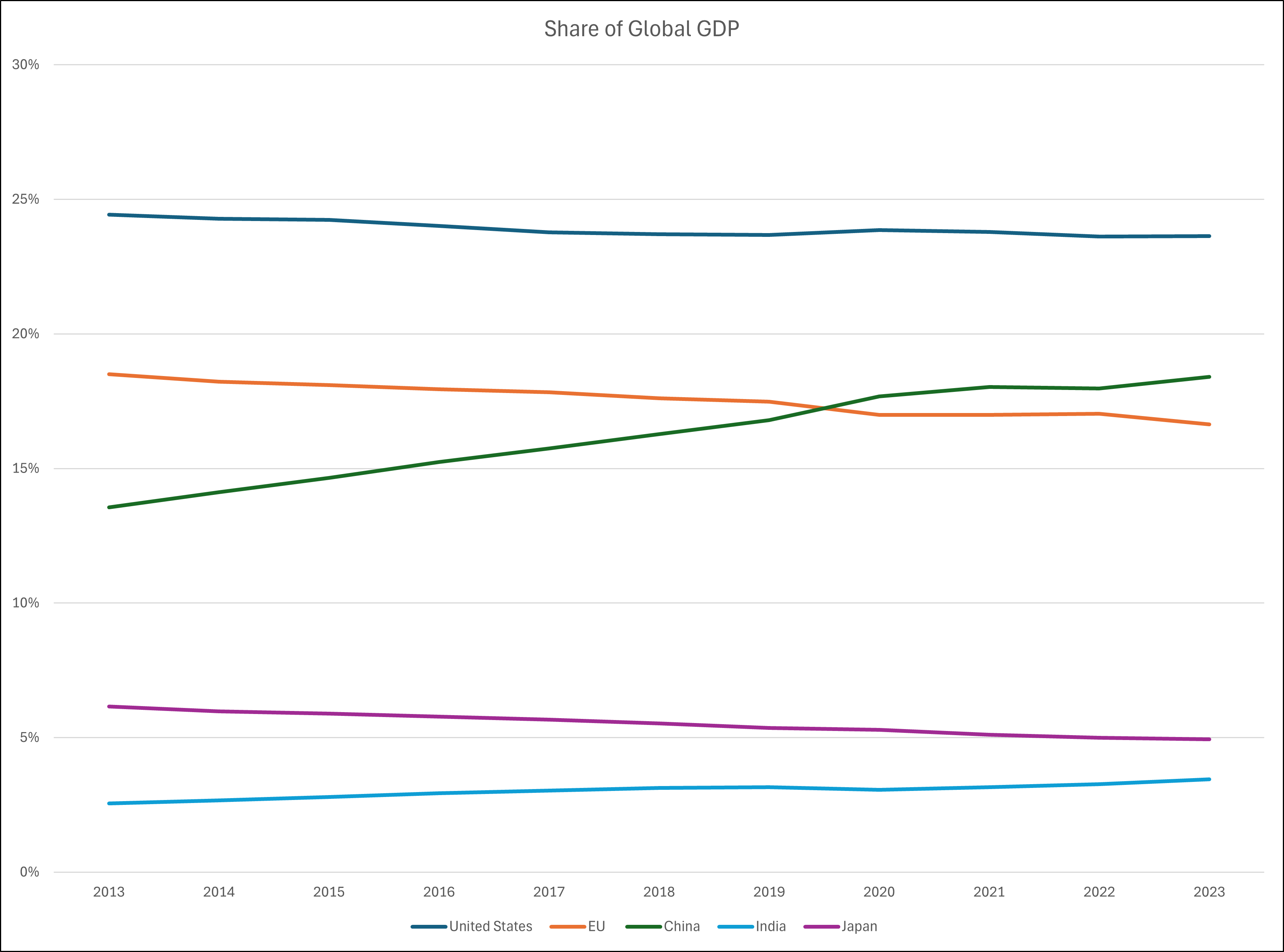
But this surface-level stability masks deeper structural changes. GDP, as a backward-looking measure, fails to capture the building momentum of American advantages in crucial areas like AI, energy, and productivity enhancement.
Thank you to our sponsor Truflation. Learn more at www.truflation.com
Markets Are Pricing a Revolution
The equity markets tell a more dramatic story. The ratio of US to global market capitalization has surged to historic highs, with American stocks now representing over 63% of global market value up from a low of 49% in early 2019. This isn't just about current earnings – it reflects the market's conviction about future value creation and competitive advantage.
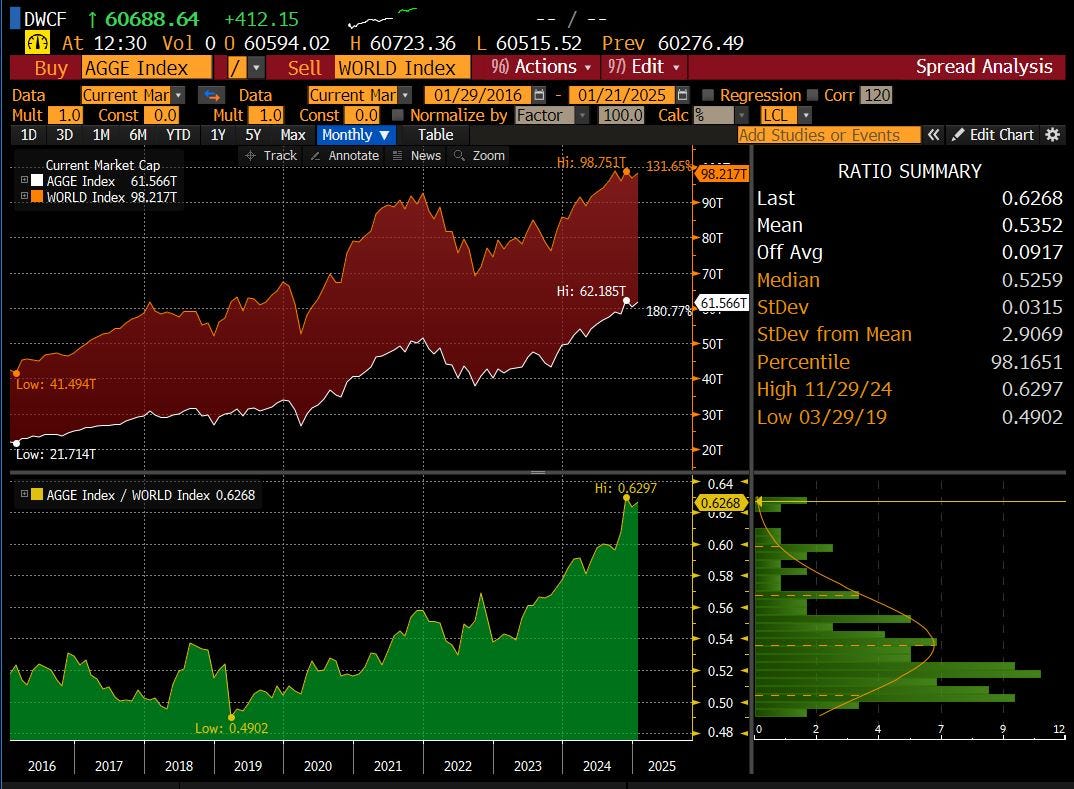
This dramatic repricing suggests investors are seeing something transformative. Consider CEO of Salesforce Mark Benioff’s comment at Davos that they do not need to hire any more engineers, and Wall Street expects it to grow 9% in 2025 anyway. This points to a productivity revolution that could reshape global economic hierarchies. However, economies like Europe and China have been restricting access to US technology products and services through various barriers. If they continue this protectionist approach, they risk falling further behind by cutting themselves off from the very tools and innovations they need to keep pace with US productivity gains. Access to leading US technology, particularly in AI and enterprise software, may become increasingly critical for maintaining global competitiveness.
Currencies: The Full Verdict
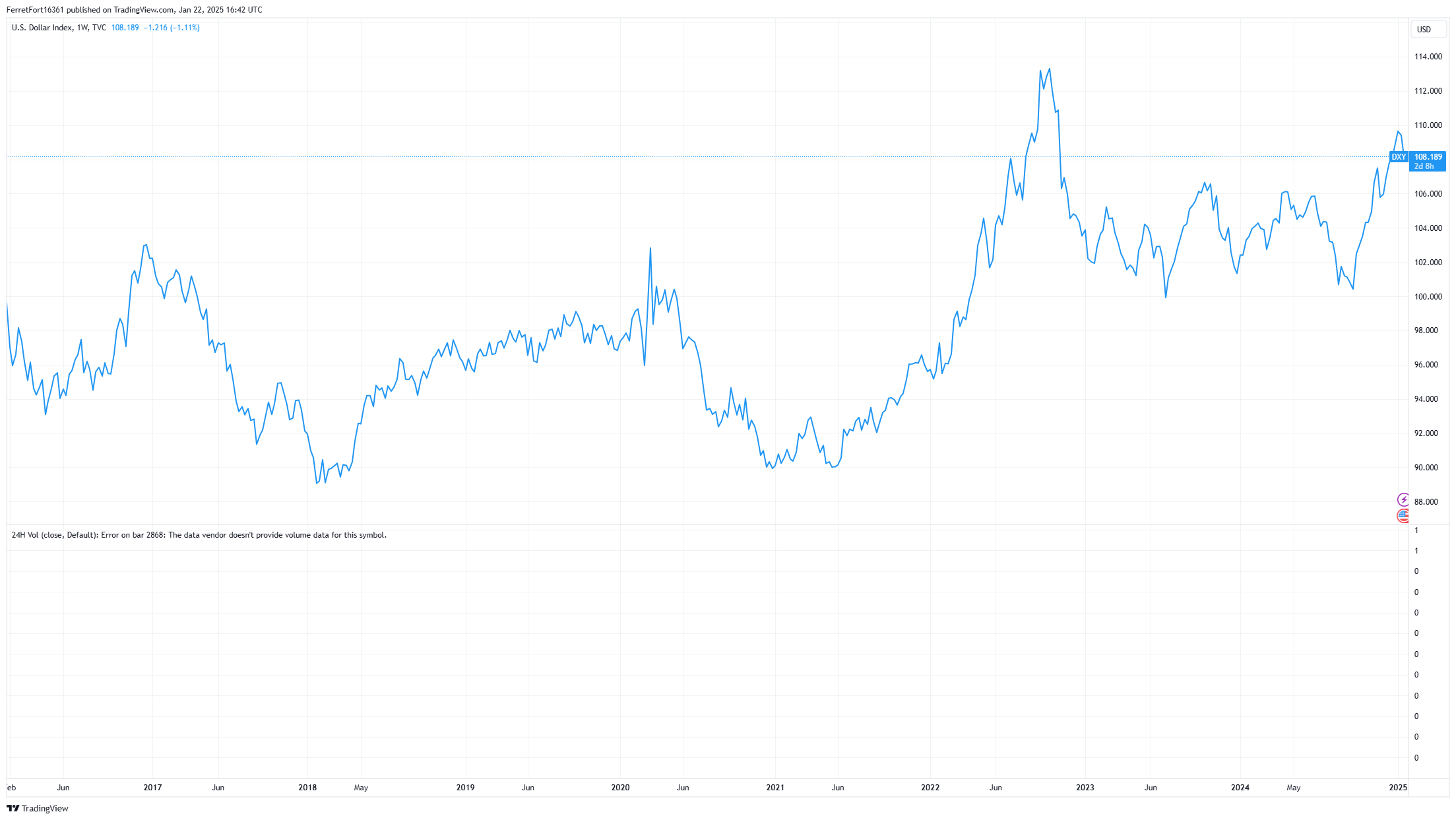
Currency markets, which price in more than simply equity growth expectations (everything from productivity to policy effectiveness to national debt and deficits and geo-political shifts), are delivering an even more decisive verdict. The US Dollar Index (DXY) has maintained remarkable strength, particularly against the yen (+55% from mid 2016), reflecting more than just interest rate differentials.
Source: Trading View
The DXY has moved + 8% from 99 to 108 over the past 10 years and a shocking +25-27% from the lows reached in Feb 2018, 8 years ago and June 2021. This suggests global markets are pricing in compounding some American advantages:
Technology leadership, particularly in AI
Energy independence and cost advantages
Regulatory efficiency
Strong institutional frameworks
This dollar strength creates its own policy tension. Despite his policies likely driving further dollar appreciation, former President Trump has repeatedly stated over the past year that the US dollar is too strong. This adds uncertainty to the currency outlook, as policies that enhance American competitiveness may conflict with stated currency preferences and highlights that a strong dollar can dampen US economic performance.
The Digital Dollar Dominance
Perhaps most telling is the "digital dollarization" of the global economy. The stablecoin market stands as a pure expression of market preference for future currency dominance. US dollar Stablecoins command ~99% market share, with non-USD alternatives failing to gain meaningful traction despite numerous attempts.
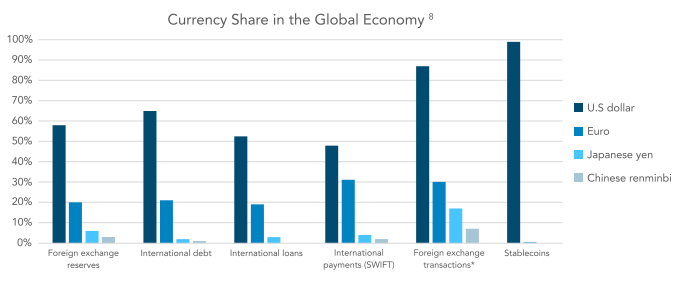
Source Nic Carter, Stablecoins: The Emerging Market Story Authored by: Sponsored by: September 2024. Chart adapted from “Top Dollar” by Eswar Prasad, in Foreign Affairs Magazine (July 2024)
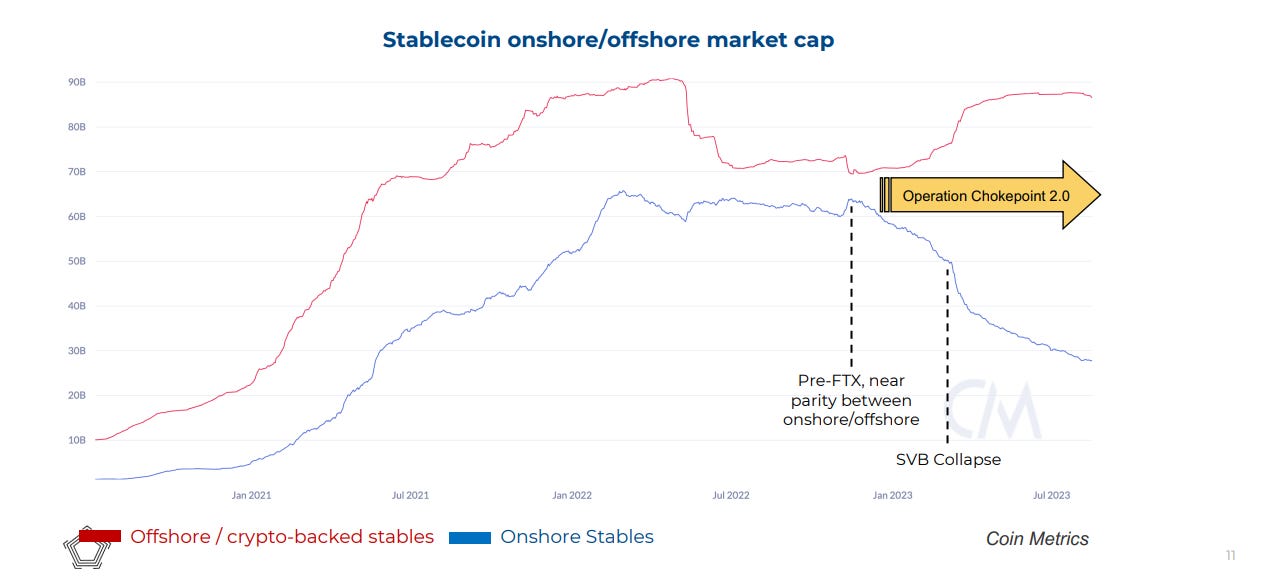
It is important to note that the US on-shore portion of the Stablecoin market declined from $60B to $30B due to regulatory pressures under the Biden Administration, shifting profit share to other countries. Those foreign competitors should be braced to lose significant share back to the US under the increased regulatory certainty of the Trump Administration and likely Congressional legislation.
This overwhelming preference for digital dollars creates a powerful feedback loop: stablecoin issuers must hold dollar-denominated assets (primarily T-Bills and Notes) as reserves, driving persistent demand for US government debt. This likely will make US government funding systematically cheaper and more reliable than other sovereign borrowers, further entrenching dollar hegemony. The digital revolution, rather than challenging dollar dominance, appears to be reinforcing it.
The Double-Edged Catalyst
The potential implementation of increased tariffs presents an exacerbating dynamic – simultaneously amplifying American advantages while increasing foreign disadvantages. Like a chess player gaining a tempo (making a move that improves one’s position while forcing the opponent to make a disadvantageous one), this policy approach could compound America's emerging productivity advantage.
Economic frictions like tariffs tend to disproportionately impact weaker economies. Whether these tariffs result in higher prices for US consumers or lower profits or market share for foreign exporters, their burden falls harder on less competitive economies. The same asymmetric impact applies to Trump's calls for increased NATO defense spending – while all members would face higher costs, this additional fiscal burden would strain already-challenged European economies far more than the US.
This combination – surging US productivity through AI adoption while raising costs for foreign competitors – appears to be forcing a global economic realignment. The evidence is already visible in massive capital flows. SoftBank CEO Masayoshi Son's commitment to invest $500 billion in US technology and AI - notably excluding his home market of Japan - and Saudi Arabia's reported $600 billion investment in the US economy exemplify this shift. That two major foreign investors are committing over $1.1 trillion to the US market signals a profound vote of confidence in American economic leadership.
The Productivity Inflection Point
As Stanley Druckenmiller noted at Davos, "animal spirits are running high" among US CEOs. This offensive posture, combined with emerging productivity gains and policy support, suggests we're approaching an inflection point in relative economic performance.
The implications are profound:
Dollar strength may persist
US market outperformance may continue
Global growth may increasingly depend on US dynamism
Other regions may be forced to accelerate their own productivity enhancement
While GDP figures might continue showing stability, the underlying reality is one of accelerating divergence. The US appears poised to enter an era of rising productivity and economic dominance, potentially reshaping global economic hierarchies in ways not seen since the post-war period.
My view is that this divergence, while potentially dramatic in the near term, will ultimately drive a broader global economic renaissance. Conventional wisdom would suggest that human nature - particularly the pride and protectionist instincts of current political leaders - will lead to retaliatory trade wars that harm everyone. Indeed, this may be the initial reaction. But I believe an even more fundamental human instinct - survival and the drive for prosperity - will ultimately prevail.
As other nations face the stark choice between reform and decline, they're likely to respond with productivity-enhancing policies that accelerate their own development. The pressures created by America's growing advantages could catalyze the very competition and innovation needed to raise living standards globally.
Why make this prediction when the last decades have shown the opposite? Because between abrupt technology advancements like AI and the radical shift in economic policies in the US, the competitive pressures on Europe, China, and Japan are about to shift from chronic to acute, demanding a response.
The key question isn't whether America will maintain its position, but whether the pressures created by its growing advantages will ultimately drive a broader global economic renaissance. Yet, like in chess, this long-term forecast looks many moves ahead, and the global economy's path could shift dramatically with any single move along the way. Still, understanding the direction of pressure - and the likely responses it may inspire - gives us our best framework for anticipating what comes next.