
The US Dollar has seen its purchasing power erode by 17.3% in only 4 years1.
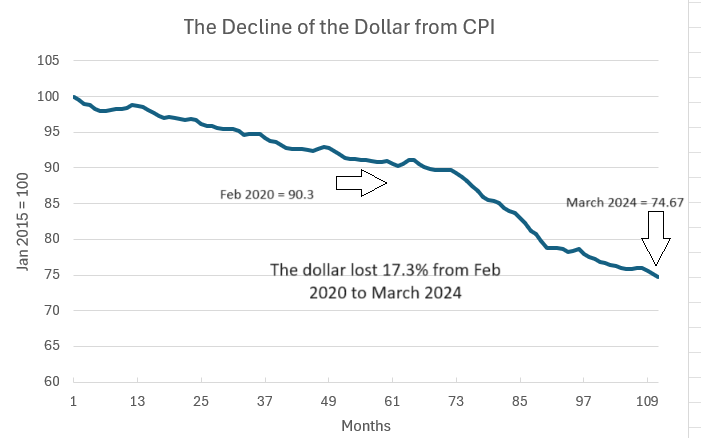
So why does the chart of the value of the $US show that it has been flat to rising vs DXY? (The DXY is a basket of other major currencies commonly used as a benchmark on Wall Street2.)

Which is more important watch? The former shows the value against living costs measured by the CPI. The latter shows what global flows of capital are pricing every day of the $US vs other currencies, which tend to fall a bit faster than the $US in purchasing power.
So for people, the former wins. For Wall Street traders and Central bankers, the DXY is more important.
The purchasing power of the dollar has actually declined by 98% since 1971 3when the US broke from the Bretton Woods agreement and disconnected officially from a gold standard.
What drives the “price” of the $US?
In the LONG RUN, the dollar’s value will appreciate vs other currencies when the health of the US economy is perceived to be improving vs the health of the currencies it is being measured against. Over time, the health of the US economy has improved more reliably than most other economies, putting upward pressure on the $US.
Over the SHORT RUN, changes in short term interest rates have a significant impact on the demand for $US because newly acquired dollars are typically invested immediately in short term yielding bonds or accounts; eg as short rates rise in the US, there is more incremental demand for dollars, and vice versa. (The term “Carry Trade” refers to investors locking in the rate difference between one currency with a high yield and another currency with a low yield.)
What are the effects of a “Strong” $US and why?
Gold: Theoretically, Gold should decline vs $US when rates are rising because:
1. The simple math above- it is priced in dollars.
2. Gold does not generate a yield so it is less desirable when rates rise because on the margin, a dollar of yield today is a “bird in the hand.”
3. Higher rates implies more monetary discipline- gold is a store of value whose supply grows at only about 2%/yr, much lower than fiat currencies grow; higher yields imply slower growth in the money supply, so less need for an investor to protect their money in a store of value.
Stocks: Theoretically US stocks should decline because:
1. The simple math above- they are priced in dollars.
2. Higher yields make bonds more attractive to stocks
3. Foreign corporate revenues and earnings are hurt as US goods become more expensive to foreign buyers, hurting overall US corporate earnings prospects
4. The US private sector’s ability to invest for growth gets hurt be higher rates which make borrowing more expensive
Bonds: US Bonds should decline because:
1. The higher interest rates of today make yesterday’s bonds of lower yield worth less.
What makes an economy “healthier”?
For investors considering the purchase of a currency, the health of the underlying economy is determined by the following:
1. GDP Growth
2. Unemployment rate
3. Population growth
4. Creditworthiness
5. Inflation Rate
6. Interest Rates
7. Education
8. Political Stability
The US has been the most reliably strong economy in the world for the last century and has been its own store of value for the rest of the world. This has been the core reason behind why the $US became established as the global reserve currency.
A currency’s value must also be adjusted for dilution- central banks can create more money which dilutes the value of outstanding currency.
What is a “Reserve Currency”?
A currency that is the dominant, global acceptable medium of exchange for commerce. Many write and speak about how the $US is at risk of losing its status as the Reserve Currency. They point to erosion in many of the characteristics above that determine the health of an economy- the most important being Creditworthiness as our total debt and structural deficits may lead to rising inflation, and deterioration in other categories as well. While these are potentially significant for the value of the dollar, losing reserve currency status is another issue altogether.
The likelihood of this should hinge most on what will replace it, rather than whether weaknesses in our US financial system undermines confidence.
Candidates do not seem eligible at this point:
1) The Euro- its economic statistics are inferior
2) Chinese Yuan- its closed economic and political system are inferior
3) Japanese Yen- its economic statistics are inferior
4) Gold- already dethroned and not a good “currency”
5) Bitcoin- at $1T, it is tiny and insignificant relative to the commerce needs of global trade, among other reasons.
Reserve currency status is often threatened when empires lose in war, but reserve currency status will hardly mean much if this were the downfall of the dollar. The geographic advantage of the US as a superpower is hard to overstate- two vast oceans on east and west coasts and two huge trade partners on north and south borders make it extremely unlikely that our military power could easily be overcome.
The probability that the US loses its reserve currency in any time frame to worry about is extremely unlikely.
Source CPI index from the Bureau of Labor Statistics
DXY. It is a weighted geometric mean of the dollar's value relative to following select currencies:
Euro (EUR), 57.6% weight
Japanese yen (JPY), 13.6% weight
Pound sterling (GBP), 11.9% weight
Canadian dollar (CAD), 9.1% weight
Swedish krona (SEK), 4.2% weight
Swiss franc (CHF), 3.6% weight
Visual Capitalist