
In previous essays, I have explored innovation, energy, and hard money as the fundamental elements driving the prosperity and rising living standards that have transformed humanity since 1750. Despite overwhelming pessimism about our economic future, I remain convinced these elements will continue to improve living standards—but only if we understand how they work together. Today, I want to augment my past analysis by examining the role of labor in unlocking resource constraints, building on insights from Saifedean Ammous's work on Austrian economics and sound money.
In The Bitcoin Standard, economist Saifedean Ammous presents a compelling argument rooted in Austrian economics: human labor and ingenuity are the ultimate scarce resources that drive economic growth by transcending apparent physical constraints. He challenges Malthusian fears of resource depletion, asserting that what limits any resource's availability is not its finite stock but the human effort directed toward extracting, innovating around, or substituting it. As Ammous writes, "What constitutes the practical and realistic limit to the quantity of any resource is always the amount of human time that is directed toward producing it."
This perspective echoes Julian Simon's view of humans as "the ultimate resource," where population growth and creativity turn scarcity into abundance through technological progress. Yet if human ingenuity has always existed, why did living standards stagnate for millennia before exploding after 1750? The answer lies in understanding that while labor fixes resource constraints, its effectiveness depends critically on two amplifying factors: energy density and sound money.
Energy: Labor's Force Multiplier
Energy availability has historically correlated tightly with economic growth, enabling machines to perform work equivalent to thousands of human laborers. A single barrel of oil equates to about 25,000 hours of human labor, fundamentally changing what human effort can accomplish.
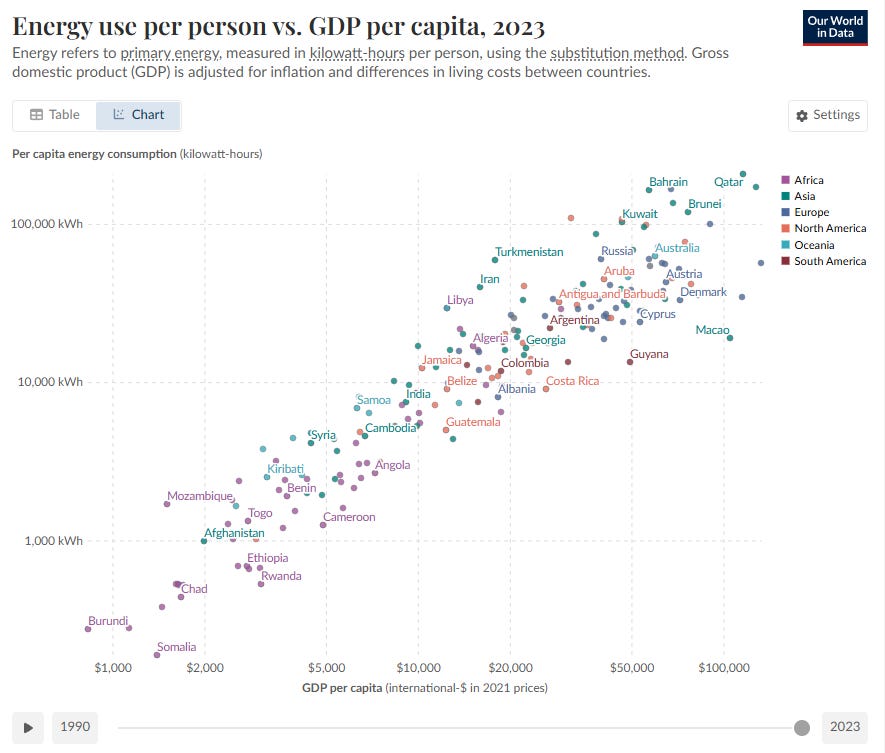
Source: https://ourworldindata.org/grapher/energy-use-per-person-vs-gdp-per-capita
Studies show that improvements in energy efficiency contribute significantly to total factor productivity, with thermodynamic efficiency accounting for up to 46% of growth in some periods. Before widespread fossil fuel adoption, even brilliant innovations faced energy constraints. Roman engineers understood hydraulics and mechanics, but without dense, transportable energy sources, their labor hit physical limits.
However, rising energy prices can temporarily hinder productivity, underscoring the need for continued innovation to maintain affordability. In Ammous's framework, sound money could steer labor toward efficient energy solutions, mitigating constraints like depletion by incentivizing long-term thinking over short-term extraction.
Sound Money: The Foundation for Productive Labor
At its core, Ammous's hypothesis posits that economic expansion stems from directing labor toward productive ends, but this requires proper incentive structures. Sound money—defined by its scarcity and resistance to debasement—preserves purchasing power over time, incentivizing productive labor over speculative or consumptive behaviors. As Ammous argues, under sound money, capital accumulation boosts labor efficiency: "Capital goods are built and acquired to increase the productivity of labor."
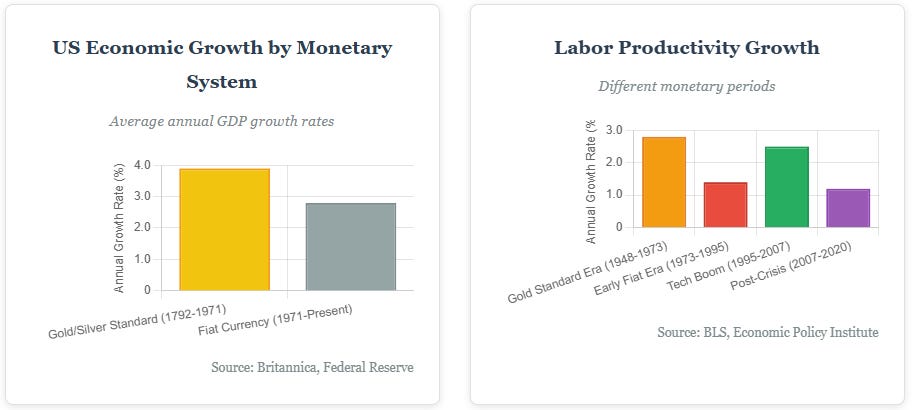
Under the gold standard, societies accumulated capital through what Ammous calls low time preference—prioritizing future rewards over immediate consumption. This encouraged savings and investment in labor-enhancing technologies, creating a virtuous cycle where deferred consumption funded tools and infrastructure that elevated societal wealth. Ammous illustrates this with historical examples: sound monetary systems fostered innovations that unlocked resources previously deemed inaccessible. Oil was once a nuisance until human ingenuity transformed it into a cornerstone of modern energy.
In contrast, fiat currencies, prone to inflation, erode savings and distort resource allocation, leading to malinvestments and reduced productivity. When money loses purchasing power unpredictably, labor gets channeled into financial speculation rather than productive innovation, breaking the feedback loop between savings, investment, and productivity growth.
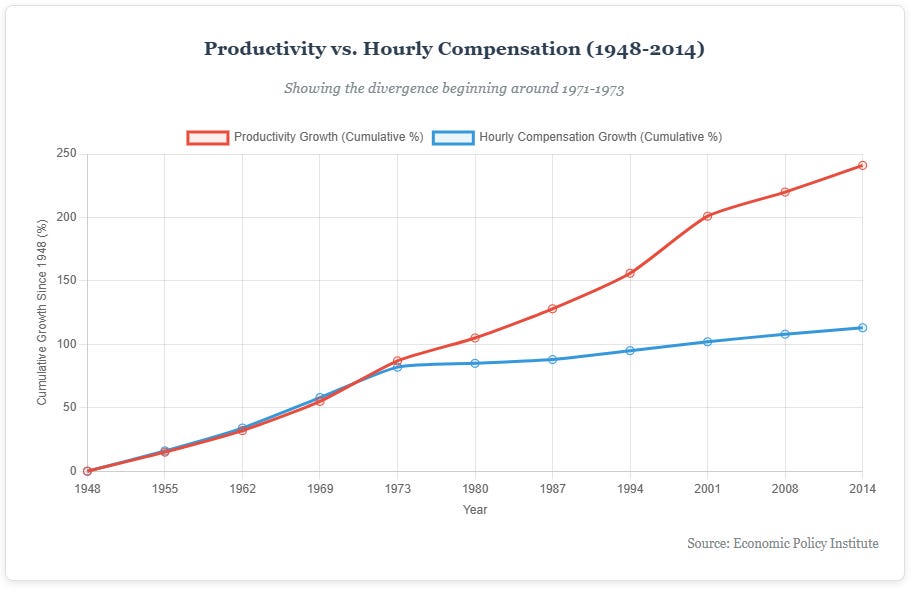
Notice that the dramatic divergence of productivity and wages after 1971 coincides precisely with the end of the Bretton Woods system and the transition to pure fiat currency. This supports the thesis that sound money is essential for ensuring workers benefit from their increased productivity.
The Multiplication Effect
The post-1750 prosperity explosion resulted not from superior human intelligence, but from creating conditions where labor could operate at maximum efficiency through the interaction of abundant energy and sound money. Labor identifies opportunities and solutions, energy provides the physical capacity to implement solutions at scale, and sound money coordinates this process across society efficiently.
This framework explains why resource-rich nations often remain poor while resource-poor nations prosper. Countries with monetary instability and poor energy infrastructure see their human capital constrained, regardless of natural resource endowments. Conversely, nations that maintain sound financial institutions and efficient energy systems allow their labor to command premium returns globally.
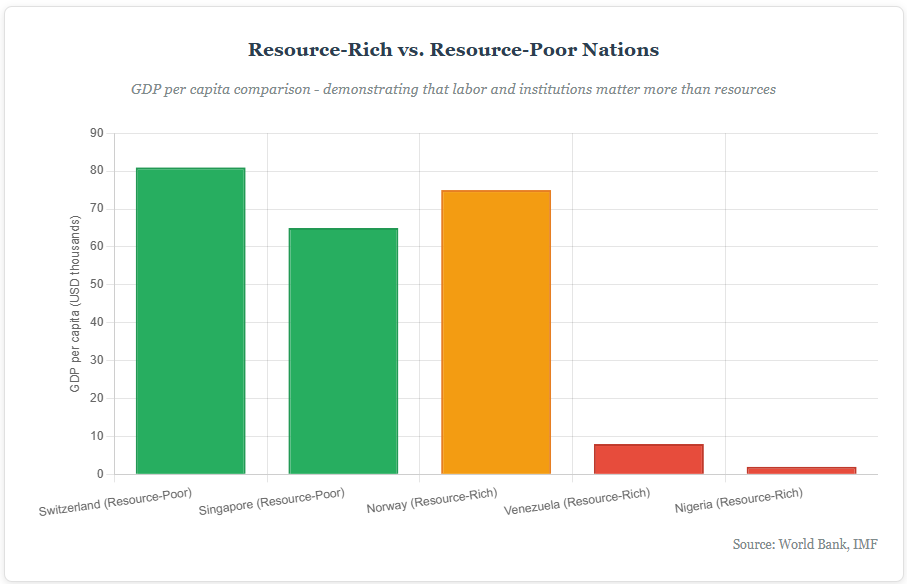
Ultimately, prosperity emerges from this interplay of human labor, sound money, and energy. As Ammous envisions with Bitcoin, a return to hard money could unlock unprecedented human potential in an energy-abundant future, channeling labor toward innovations that transcend today's resource constraints just as previous generations overcame theirs.
Thank you very much to our sponsors:
Truflation: Learn about what prices are actually doing by going to https://truflation.com/marketplace/us-inflation-rate
Foundation: Protect your Bitcoin using the latest off-line technology with easy-to-use Passport. Their next product, Passport Prime will protect all passwords off-line with even-better technology. https://foundation.xyz/
River Financial: If not cold storage for your Bitcoin, I’d highly recommend River for buying and holding- River is engineered to protect your Bitcoin over the long run. Use this link for discounts: https://river.com/signup?r=T7GGAF7G