
In the wake of the recent events at Columbia University, where pro-Palestinian student protests culminated in the arrest of nearly 300 individuals, the question of the American university system's role and its ability to navigate student activism once again finds itself at the forefront of public discourse. These protests, echoing similar movements across the nation, highlight the complex relationship between universities and their student bodies, raising concerns about the future of higher education and its capacity to effectively prepare students for a rapidly changing world.
See my interview with Sam Chauncey HERE.
As institutions traditionally viewed as bastions of intellectual exploration and social progress, universities now face a multitude of challenges. Concerns about rising costs, the effectiveness of a traditional degree in the face of alternative career paths, and the evolving nature of student activism necessitate a critical examination of the university landscape.
However, amidst this uncertainty, there remains a glimmer of hope. In his book "Principles for Dealing with a Changing World Order," investor Ray Dalio identifies the US higher education system, still the envy of the world, as a potential cornerstone for reversing the decline in American hegemony. This enduring strength suggests that universities, despite their challenges, may hold the key to fostering the next generation of leaders and innovators capable of navigating the complexities of the 21st century.
To gain a deeper understanding of these issues, a conversation with Sam Chauncey, a veteran administrator with over six decades of experience at Yale University, offers valuable insights into the internal dynamics and challenges facing universities today.
One key concern highlighted by Chauncey is the potential weakening of universities' core mission: nurturing individuals to use their minds for positive impact on society. He believes that the growing size and complexity of universities have led to a fragmentation of attention and a dilution of effectiveness. This raises questions about the true value proposition of a traditional university education, particularly in the face of rising costs.
Furthermore, Chauncey discussed the changing role of university leadership and the decline in public trust. The diminished stature of university presidents, coupled with a perceived lack of strong convictions about free speech, has impacted the handling of student protests and the overall perception of higher education. Additionally, the evolving student body presents its own set of challenges. Chauncey observed a shift in student interests and a fragmentation of attention due to the multitude of activities and organizations available. While this may impact the sense of community within universities, it also reflects a more diverse and engaged student body.
Measuring the true impact of a university education on graduates remains a significant challenge. Traditional measures of success, such as titles and positions, may not adequately capture the broader contributions individuals make to society. Chauncey also noted a shift in the concept of "justice," where outcomes are increasingly prioritized over process, potentially influencing student behavior and protest movements. This highlights the need for universities to foster critical thinking and ethical reasoning alongside academic knowledge.
The rise of alternative pathways for career training and education, particularly with the increasing costs of traditional higher education, presents another potential threat to the university system. As Chauncey observes, the questionable economic value of a degree, coupled with the availability of alternative options, may lead some to question the traditional university model.
While the future of American universities appears uncertain, Chauncey's insights underscore the need for a nuanced understanding of the evolving landscape. Universities must adapt to changing societal needs, student demographics, and technological advancements while remaining true to their core mission of intellectual development and social responsibility. This ongoing conversation requires careful consideration of the challenges and opportunities that lie ahead, ensuring that universities continue to play a vital role in shaping a better future for generations to come.
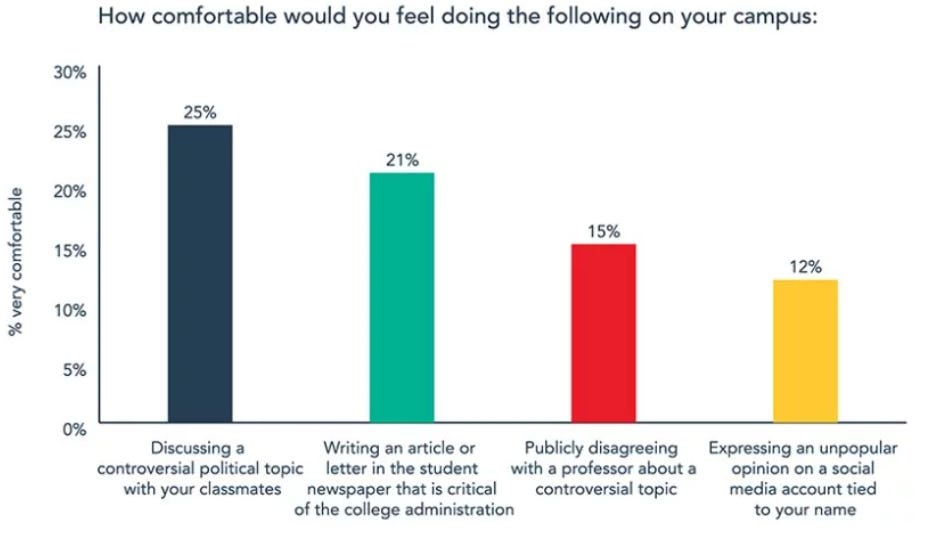
Source: FIRE (https://www.thefire.org/research-learn/2020-college-free-speech-rankings)