
For a growing number of Americans, pessimism about debt and deficits no longer feels ideological. It feels observational. Trillions are added to the national debt during periods of economic strength. Promises of fiscal restraint rarely survive contact with elections. Few people now believe this trajectory will be reversed by persuasion, process, or good intentions.
What remains unresolved is what follows from that recognition.
My recent conversation with investor and author Lawrence Lepard (The Big Print) offered a perspective that is both sobering and oddly stabilizing. Lepard does not believe politicians will suddenly regain control of spending. He does not expect deficits to be tamed through discipline alone. Yet he does not arrive at despair. He arrives at adaptation.
His core argument is simple. If the monetary system is structurally biased toward debasement, individuals do not need to wait for political reform to respond. They can protect themselves, to the extent they are able, by holding assets that cannot be created at will.
That idea deserves careful attention, particularly from those who sense that something fundamental is off but are unsure how to respond without becoming cynical or ideological.
Pessimism about government finances is now widespread, and for good reason. Disagreements remain over causes and remedies, but not over direction. The political incentives are clear. Spending delivers immediate benefits. Restraint imposes near-term pain in exchange for abstract future gains.
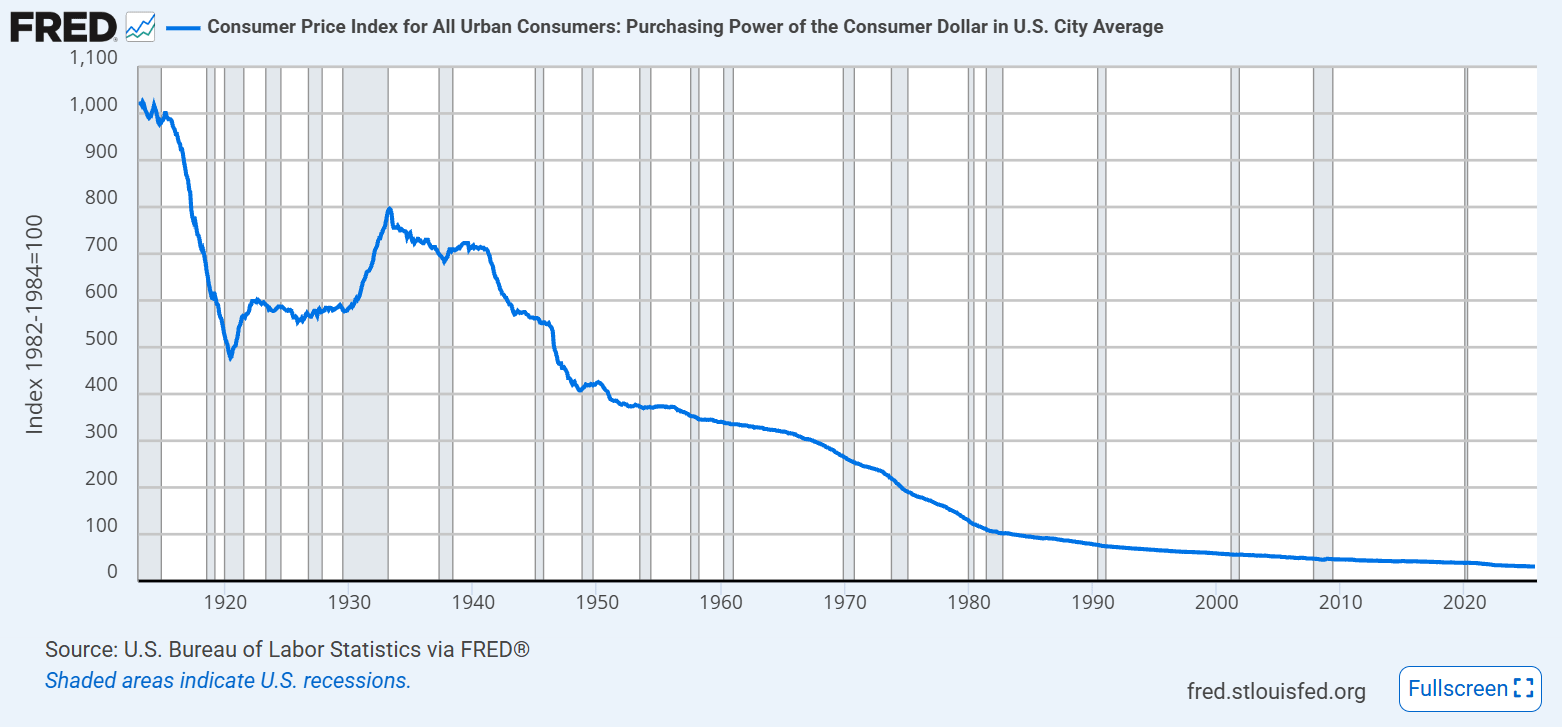
This chart shows the decline in the purchasing power of the dollar fell from $1,000 in 1913 to $30 as of November 1, 2025.
Lepard’s contribution is not to relitigate these realities. It is to ask a more practical question. If this is the system we inhabit, how should rational people behave within it? His answer is pragmatic. In a world where currency is steadily diluted, savings held entirely in financial claims denominated in that currency are exposed. Assets with hard constraints provide a form of protection regardless of whether one expects crisis or continuity. This framing matters because it restores agency. It shifts the discussion away from waiting for institutional reform and toward individual decision-making under uncertainty.
Money as a System of Incentives
Much of the public debate treats fiat money as a technical or economic arrangement. Lepard insists it is also a system of power. When money can be created without binding constraint, those closest to the source of credit benefit first. Asset prices respond before wages. Leverage is rewarded. Risk is often underwritten implicitly by the state. These outcomes are not the result of malice. They are the result of design.
Highlight clip from interview.
Over time, this design shapes social and economic outcomes that are then debated as failures of policy or character. Housing affordability deteriorates. Wealth concentrates. The distance between those who own assets and those who rely primarily on income widens.
Many of the problems dominating public discourse are downstream effects of monetary policy. They appear unrelated only because the cause is rarely examined.
Housing offers a particularly clear illustration. When credit expands, housing prices rise. Those who already own property see their balance sheets improve, while prospective buyers face steadily higher barriers to entry. Large financial firms increasingly treat houses as yield-bearing assets rather than places to live. The resulting frustration is often attributed to zoning, speculation, or generational conflict, even as the underlying monetary forces remain largely unexamined. Those factors matter. But they operate within a monetary environment that magnifies their impact.
Who Benefits First
The same logic applies to broader measures of inequality. Access to cheap capital allows some participants to accumulate appreciating assets. Others encounter higher prices for essentials and higher borrowing costs. Over time, these differences compound. This does not require a conspiracy. It requires only uneven access to credit and a monetary system that amplifies initial advantage.
Lepard uses the word “rigged” unapologetically, but his meaning is precise. The rules are not applied evenly, and the outcomes reflect that. Banks borrow at rates unavailable to households. Institutions that take excessive risk are often rescued when failure would be destabilizing. We saw this clearly in 2008, where he cited connected insiders secured massive non-recourse loans to buy distressed assets—a lifeline never extended to the homeowner facing foreclosure. Inflation spreads the cost quietly and continuously, without a visible line item.
The result is a system that feels unfair even to those who benefit from it. Trust erodes not because people misunderstand what is happening, but because they understand it all too well.
Clarity Without Alarm
One of the more hopeful observations from our conversation is that public understanding of money has improved markedly over the past decade. Twenty or thirty years ago, even experienced professionals could spend entire careers without interrogating how money is created or why it loses value.
Bitcoin forced a conversation that Wall Street preferred to keep quiet. It turned the mechanics of the Federal Reserve from a technical obscurity into a dinner-table debate. What is money? Who controls it? Why does its purchasing power decline over time?
Those questions now circulate far beyond academic circles. Whether one ultimately embraces Bitcoin or not, the broader awareness it has catalyzed represents a meaningful shift. Gold has long anchored similar thinking among investors attentive to monetary history, even if it never forced the conversation into the open in the same way.
Importantly, Lepard does not frame his views as prophecy. He acknowledges that productivity gains, technological change, or policy shifts could alter the trajectory. It is always wise to challenge predictions that feel inevitable.
But humility cuts both ways. History suggests that fiat systems regain discipline only when constraints are reintroduced, not when restraint is promised. Betting on self-control in the absence of limits has rarely worked.
This is not an argument for panic. It is an argument for preparation.
Lepard’s book resonates because it connects abstract monetary mechanics to lived experience. It does not demand ideological alignment. It invites readers to consider whether the problems they observe might share a common cause. That is a valuable service in a moment when public debate is saturated with symptoms and starved of diagnosis.
Fixing the money would not solve every social or political problem. It would, however, remove a powerful source of distortion. It would make many other problems easier to address by restoring limits that have quietly eroded.
More importantly, it offers individuals a way to respond without waiting for political consensus. Hard money allows people to opt out of the most corrosive aspects of the current system gradually and peacefully. That makes it worthy of serious consideration.
This conversation reinforced a conclusion I have reached repeatedly while hosting Exploring Prosperity. Many of the anxieties people feel about the future are rooted in systems that no longer behave as advertised. Understanding those systems requires clarity. Larry Lepard offers one such lens. It is not the only one. But it is increasingly difficult to dismiss.
For readers who want to hear the full conversation behind this essay, the complete interview with Larry Lepard is available below. It explores these themes in greater depth and provides additional context for the views summarized here.
Thank you very much to our sponsors:
Truflation: Truflation: BUY Truflation products/services and save 10% using code BOBDEW10. Learn about what prices are actually doing by going to https://truflation.com/marketplace/us-inflation-rate
Foundation: Protect your Bitcoin using the latest off-line technology with easy-to-use Passport. Their next product, Passport Prime will protect all passwords off-line with even-better technology. https://foundation.xyz/
River Financial: If not cold storage for your Bitcoin, I’d highly recommend River for buying and holding- River is engineered to protect your Bitcoin over the long run. Use this link for discounts: https://river.com/signup?r=T7GGAF7G
Anxiety about the future is good - it helps us avoid bad outcomes, at least some of the time. Interesting article with a clear sensible recommendation - thank you for sharing!