
Imagine a world where the 20th century’s wars, depressions, and inflations never happened—not because of luck or leadership, but because money, as a truth-preserving technology, couldn’t lie. That’s the premise of The Gold Standard, Saifedean Ammous’s new book—a sweeping reconstruction of modern history as it might have unfolded if the classical gold standard had never been abandoned.
Earlier this year, I hosted Lyn Alden, Bob Murphy, and Troy Cross on Exploring Prosperity to ask a narrower version of that same question: what would the post-1971 world have looked like if gold had remained our monetary anchor? That roundtable explored how sound money might have changed U.S. inflation, productivity, and debt since Nixon closed the gold window.
Ammous spent more than a year—closer to eighteen months—thinking through how a gold standard would have reshaped every corner of society. Where our roundtable examined a few decades of U.S. history, his book reconstructs more than a century of global economic and political development.
Rewriting the Century
Ammous begins in 1914, imagining a world where governments never hijack the gold standard—where the century that followed unfolds without fiat money’s distortions. Without the power to print, they can’t finance world wars or open-ended welfare states. Savings retain value, time preference falls, and progress compounds without distortion.
In this counterfactual world, banks fail fast and clean—depositors lose a few percent, owners lose everything, and speculation is punished early rather than socialized later. Governments become unattractive borrowers; those who lent to despots are ruined in what Ammous calls a kind of “financial eugenics.” Capital, purified by discipline, funds enterprise instead of empire.
The premise sounds simple but cuts deep: when money cannot be debased, civilization learns to live within its means. Inflation isn’t a policy variable—it’s a moral one.
A Method of Economic Imagination
What makes The Gold Standard remarkable isn’t only the counterfactual—it’s the method. Ammous fuses economic rigor with a plausible, imaginative narrative, tracing how monetary constraints would have cascaded through technology, energy, demographics, and politics.
He describes how earlier, cheaper energy might have emerged sooner; how the vast fortunes built on leverage, financial engineering, and political favoritism would never have existed; and how innovation, savings, and trust could have compounded instead of being siphoned away.
This is not nostalgia—it’s a thought experiment built on economic principles that can be examined and tested. By imagining a world that could have been, Ammous forces us to measure the one that actually emerged—and that framework deserves rigorous academic challenge, because only serious inquiry can begin to shift influential minds about the ills of fiat.
The Moral Core of Money
Beneath the historical sweep lies a moral argument: that sound money changes what humans value. “Human time is our scarcest asset,” Ammous writes, “the one good that is constantly running out.” As technology advances, we work less because we can afford to value our hours more.
In a hard-money world, that equation remains honest. Fiat currency, by contrast, erodes the link between effort and reward—taxing savers, rewarding debtors, and inviting politics into every corner of life.
That’s why The Gold Standard is ultimately a book about time preference, not metal. It asks whether a society that lives on borrowed time can truly progress. The answer is implicit: without monetary discipline, all other disciplines decay.
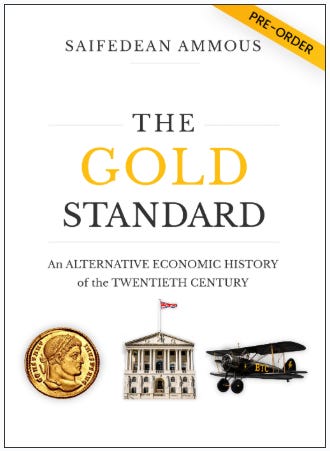
Order it, click HERE.
Why It Matters Now
For those of us exploring what sound money could still teach us, Ammous’s project marks an inflection point. Our earlier roundtable treated the gold standard as a lens for interpreting the past fifty years. The Gold Standard makes it a map for reimagining the next hundred.
It demonstrates that sound money is not a relic but a mirror—one that reflects how much of today’s dysfunction originates from removing constraints on value and time. When governments can print resources, politics becomes a competition for the spoils of printing. When money measures truth, incentives realign toward production and restraint.
I’ve come to see this line of inquiry as an ongoing project: understanding today under a gold standard—not as a policy proposal, but as a thought experiment that clarifies how prosperity works. These ideas deserve wider examination—because the more rigorously they’re tested, the more credible they become as fiat debasement accelerates and markets, through Bitcoin and gold, signal rising doubt that money should remain government-controlled. Until then, it remains one of the most illuminating intellectual exercises in economics.
The Takeaway
The Gold Standard isn’t a call to return to the past; it’s a reminder that the rules of civilization still matter. Hard money disciplines more than balance sheets—it disciplines behavior, politics, and imagination itself.
If history’s greatest errors began with easy money, perhaps its next leap forward will begin with sound money.
The full conversation with Saifedean Ammous is now live on Exploring Prosperity. In the coming weeks, I’ll examine the problems his book suggests might already have been solved—and may yet be—through sound money.
Highlight clip from the interview.
Full interview.
Thank you very much to our sponsors:
Truflation: Truflation: BUY Truflation products/services and save 10% using code BOBDEW10. Learn about what prices are actually doing by going to https://truflation.com/marketplace/us-inflation-rate
Foundation: Protect your Bitcoin using the latest off-line technology with easy-to-use Passport. Their next product, Passport Prime will protect all passwords off-line with even-better technology. https://foundation.xyz/
River Financial: If not cold storage for your Bitcoin, I’d highly recommend River for buying and holding- River is engineered to protect your Bitcoin over the long run. Use this link for discounts: https://river.com/signup?r=T7GGAF7G
Interactive Brokers: For Info Click HERE.
This content is provided by a paid Influencer of Interactive Brokers. Influencer is not employed by, partnered with, or otherwise affiliated with Interactive Brokers in any additional fashion. This content represents the opinions of Influencer, which are not necessarily shared by Interactive Brokers. The experiences of the Influencer may not be representative of other customers, and nothing within this content is a guarantee of future performance or success.
None of the information contained herein constitutes a recommendation, promotion, offer, or solicitation of an offer by Interactive Brokers to buy, sell or hold any security, financial product or instrument or to engage in any specific investment strategy. Investment involves risks. Investors should obtain their own independent financial advice and understand the risks associated with investment products and services before making investment decisions. Risk disclosure statements can be found on the Interactive Brokers website.
Interactive Brokers is a FINRA registered broker and SIPC member, as well as a National Futures Association registered Futures Commission Merchant. Interactive Brokers provides execution and clearing services to its customers. For more information regarding Interactive Brokers or any Interactive Brokers products or services referred to in this video, please visit www.interactivebrokers.com
Hey Bob…I get all the arguments for the gold standard but at the end of the day isn’t the issue that society isn’t willing to live with the human toll exacted by the consequences of strict austerity? For example the catastrophic unemployment during the Great Depression. I realize we might not have gotten into the GD if we had sound money in the first place.
How do we transition to sound money without going through a period of very restrictive austerity and a big dent to our prosperity with a lot of human suffering? Just asking…