
When credit begins to tighten, one of the least understood parts of the economy quietly becomes essential.
A New Credit Cycle?
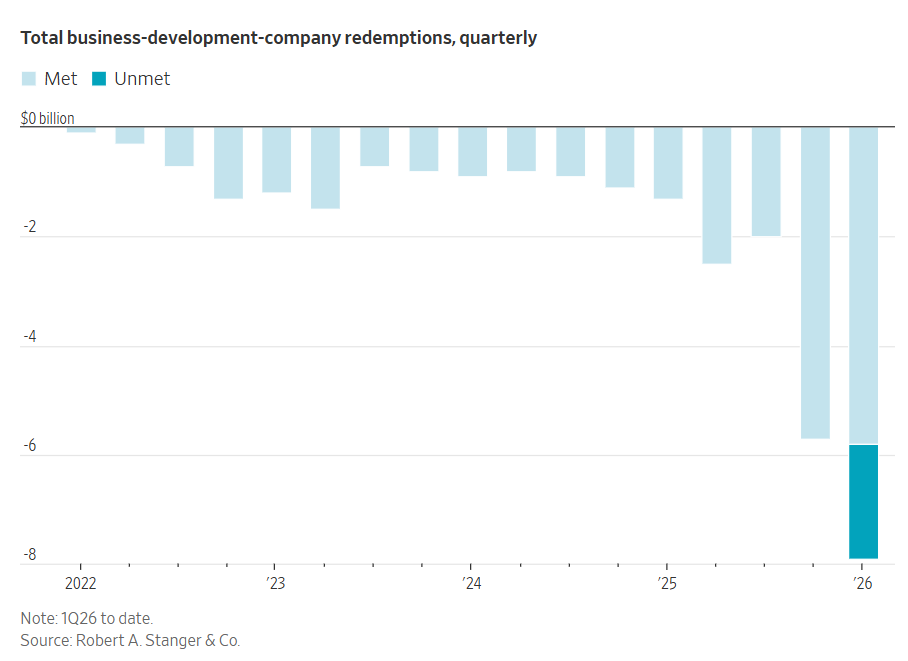
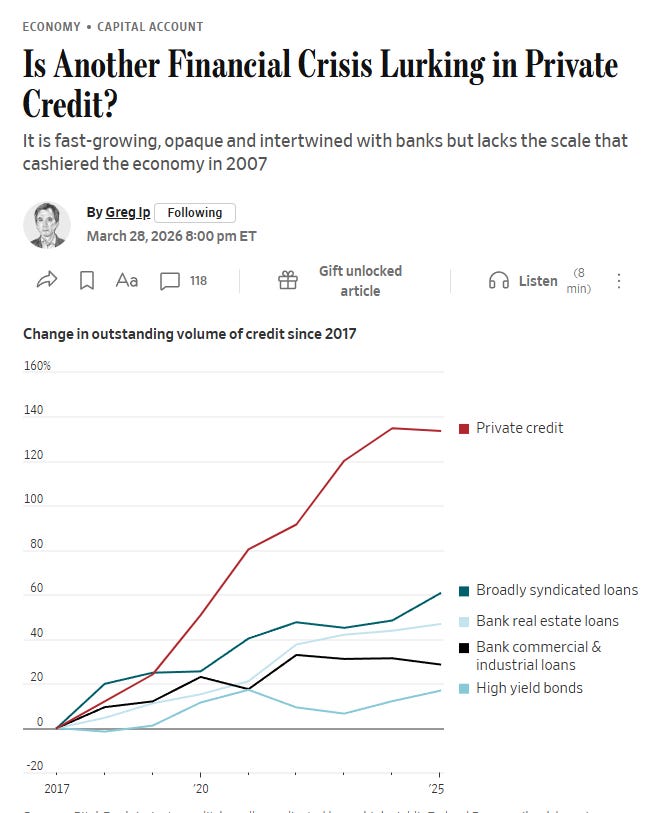
For much of the past two years, strong equity markets have encouraged investors to look past mounting strains in weaker corners of credit. That confidence may now be facing a more serious test. Several major private credit vehicles have recently limited redemptions as withdrawal requests exceeded quarterly caps. Stress that first appeared in lower quality lending has begun to move upward into larger institutional pools of capital.
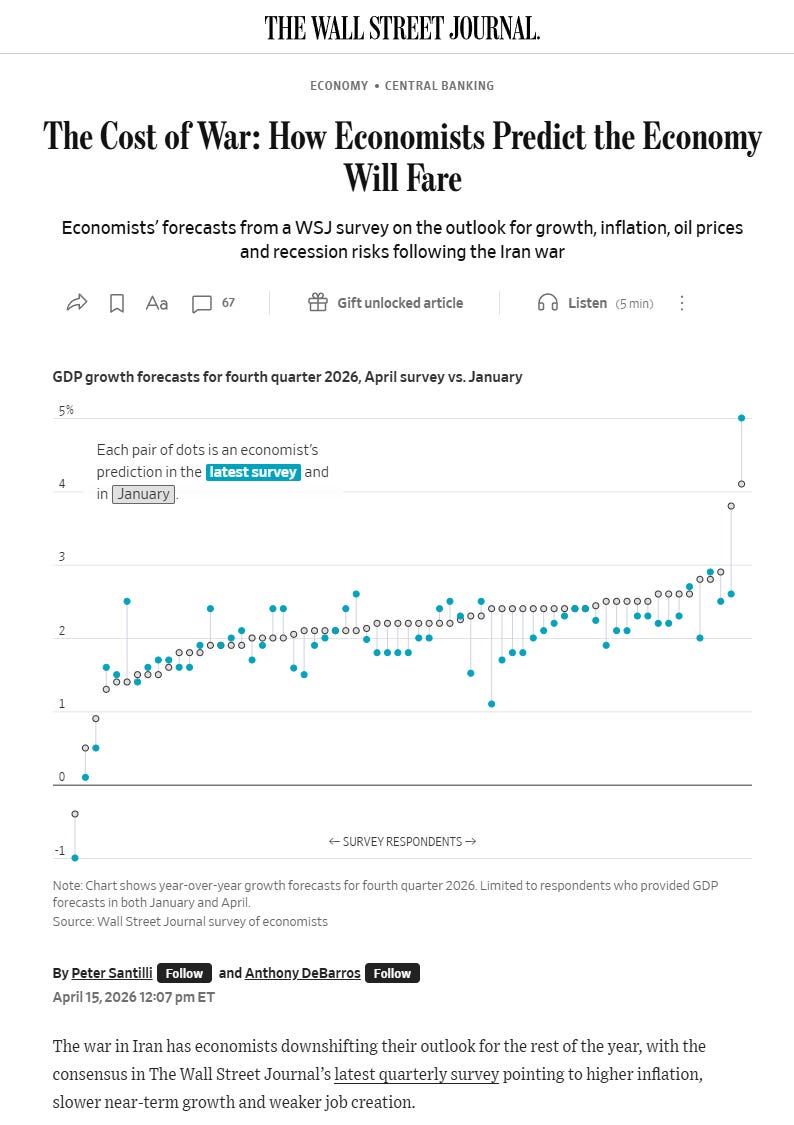
At the same time, geopolitical risk has returned to the foreground. Higher oil prices, if sustained, rarely remain isolated to the energy complex. They work their way through transportation, manufacturing, food, and consumer sentiment.
The United States enters this period in better condition than during past oil shocks because domestic production now provides an important cushion. That should not breed complacency. Many countries remain heavily dependent on global oil flows, and economic pressure abroad has a habit of returning through financial markets before it fully appears in domestic data. As capital begins to pull back and liquidity becomes more selective, the role of distressed investors becomes more important.
This is especially true in real estate.
What Distressed Investors Do
Distressed real estate investing is often misunderstood as the business of buying cheap properties from troubled owners. That description misses the actual economic function. The work begins when markets stop clearing smoothly. A lender may need liquidity. A borrower may have overlevered an asset whose original business plan no longer works. A bank may hold a loan it no longer wants on its balance sheet. In those moments, the challenge is not simply the absence of money. It is the absence of money paired with judgment. This process is what often corrects economic inefficiencies.
A skilled distressed investor does far more than provide capital. The capital is only the entry point. What follows is underwriting judgment, restructuring expertise, and operating discipline. It may involve buying a loan from a bank that needs immediate liquidity. It may require recapitalizing a project whose capital structure no longer fits the economics of the asset. It may involve replacing management, renovating units, renegotiating leases, or repositioning the property altogether.
This is why Bill Landis’s perspective is so valuable. Bill is the co-founder and Managing Partner for Raith Capital Partners, a leading distressed real estate investment firm. In my latest episode, he described what happens when liquidity stress spreads through markets: “the baby goes out with the bath water because people need liquidity.”
That sentence captures something broader than real estate. In moments of strain, investors must sell what they can rather than what they should. Good assets can become mispriced because the seller’s need for cash overwhelms the market’s ability to absorb supply. Capital flows begin to freeze.
Markets do not heal simply because prices fall. They heal when transactions resume.
When Markets Freeze
The most important historical example remains 2008. At the center of that crisis was not merely falling asset prices but the freezing of transactions themselves. Mortgage securities, commercial loans, and housing related credit instruments stopped functioning as markets. As Bill put it, “those securities literally were not trading.”
Price discovery disappears. Buyers step back. Sellers cannot exit. Lenders cannot reduce exposure. Banks cannot rebuild balance sheets. At that point, distressed capital performs a critical economic function. It restores liquidity to assets that no longer have a natural buyer. More importantly, it restores a pathway for assets to move into stronger hands.
This is one reason the role of institutional buyers after 2008 deserves more careful treatment than it often receives. Their participation accelerated the clearing of loans and housing related assets. Without that capital, the process of restoring lender balance sheets and restarting markets would almost certainly have taken longer, increasing capital losses and potentially prompting greater government involvement.
The Constraint Beneath The Capital
This is where the distinction between government intervention and distressed capital becomes important.
When markets seize, governments typically respond with broad liquidity measures. The objective is to stabilize confidence, stop runs, and prevent systemic contagion. In that sense, government action often resembles a shotgun. Large amounts of money are pushed into the system with broad reach and limited direction. Sometimes that is exactly what is needed.
Yet broad liquidity does not solve every problem. It stabilizes the system. It does not repair the asset.
A distressed investor works more like a rifle. The capital is directed at a specific problem. A single building. A broken loan. A misaligned capital structure. A lender that needs to sell. The intervention is targeted and the expertise is inseparable from the money itself.
There was one notable exception that Bill discussed. In the aftermath of 2008, some government programs were designed with much more precision. Certain public private investment structures were intended not just to flood the system with liquidity, but to restore actual price discovery and restart transactions in frozen securities. That kind of targeted intervention came closer to the function distressed investors perform in normal markets.
Clip from the interview- flexibility in building a business.
Even so, government liquidity and distressed expertise remain fundamentally different.
The government can stop a panic. It cannot rehabilitate a property. It cannot renegotiate leases, reposition an asset, or determine whether future cash flow assumptions are realistic. Those tasks require judgment at the asset level.
The past fifteen years have been defined by unusually long expansions, repeated policy backstops, and fewer full scale workout cycles. Capital pools have grown dramatically across private markets. Some specialized distressed funds closed during the long calm period. With them went teams whose primary experience was built in prior cycles. Money can be raised quickly. Judgment cannot.
Credit pressure is now moving into more institutional parts of the economy through strains in private credit. At the same time, rising uncertainty around the availability and pricing of oil is adding pressure globally. More assets and capital structures will require active repair. The bottleneck may not be the availability of capital. It may be the availability of investors who know how to turn capital into functioning assets again.
That is the deeper economic role of distressed investing. It is a repair mechanism within capitalism itself. When capital retreats from failure, recovery begins when informed capital moves back toward it.
In periods of calm, that function is easy to overlook.
In periods of stress, it becomes indispensable.
Full Interview.
Thank you very much to our sponsors:
Truflation: BUY Truflation products/services and save 10% using code BOBDEW10. Learn about what prices are actually doing by going to https://truflation.com/marketplace/us-inflation-rate
Foundation: Secure your entire digital life—from Bitcoin to passwords and files—with Passport Prime, an all-in-one personal security platform. Visit them at https://foundation.xyz/
River Financial: If not cold storage for your Bitcoin, I’d highly recommend River for buying and holding- River is engineered to protect your Bitcoin over the long run. Use this link for discounts: https://river.com/signup?r=T7GGAF7G