Just weeks after China’s surprise announcement of its thorium-fueled molten salt reactor's full-scale operation, the geopolitical implications are beginning to sink in. This isn't just a science story—it’s a global power story. And Erik Townsend (see link to his research below), longtime energy thinker and host of MacroVoices, is connecting the dots in a way few others have.
In our second conversation of this series, Erik laid out a startling scenario: if China succeeds in mass-producing thorium breeder reactors before the West does, they won’t just dominate the energy landscape—they’ll tilt the entire global power structure in their favor.
The Energy Cost Curve—And the Stakes
Let’s start with a sobering figure: in 2022, the global fuel bill—coal, oil, and natural gas—was over $6.25 trillion. Even with traditional solid-fueled nuclear, we could slash that to around $2.3 trillion. But if the world transitions to thorium-fueled molten salt breeder reactors? Erik estimates the fuel cost could plummet to just $312 million annually—a 99.996% reduction.
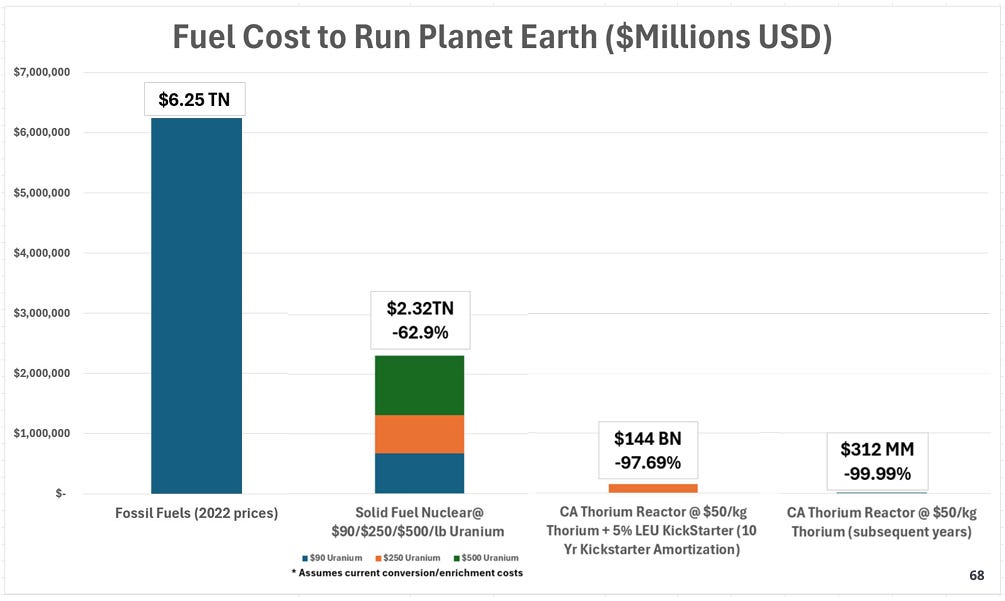
This isn’t science fiction. It’s a straightforward implication of switching to breeder reactors and using abundant, fertile fuels like thorium. More importantly, China is already doing it. They’ve built a functioning molten salt reactor in the Gobi Desert. They’re securing thorium supply. And they’re signaling their intentions—not just with rhetoric, but with blueprints for nuclear-powered container ships and aircraft carriers.
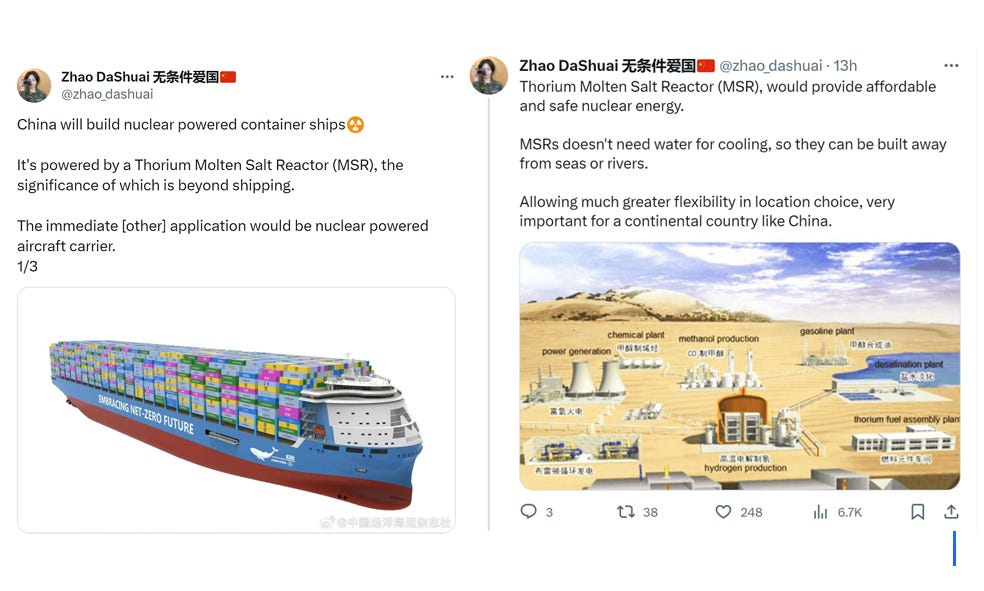
As Erik put it: “Energy dominance leads to economic dominance. Economic dominance leads to military dominance.” If China achieves cheap, modular, mass-produced nuclear before we do, they won’t just decarbonize faster—they’ll dominate geopolitically.
What China Gets—and the West Misses
What’s maddening is that the underlying technology isn’t new. The molten salt reactor was first demonstrated in the 1960s at Oak Ridge National Lab. The U.S. government abandoned it in the 1970s—just as it was poised for commercialization.
China, meanwhile, picked up where we left off.
Their strategy is coherent and national. The reactor they built in the Gobi wasn’t just to generate power—it was a demonstration project to show the world they could do it. And in the same week they announced the reactor’s success, they also revealed a massive thorium mine in Mongolia and plans for thorium-powered ships. That wasn’t coincidence. It was signal.
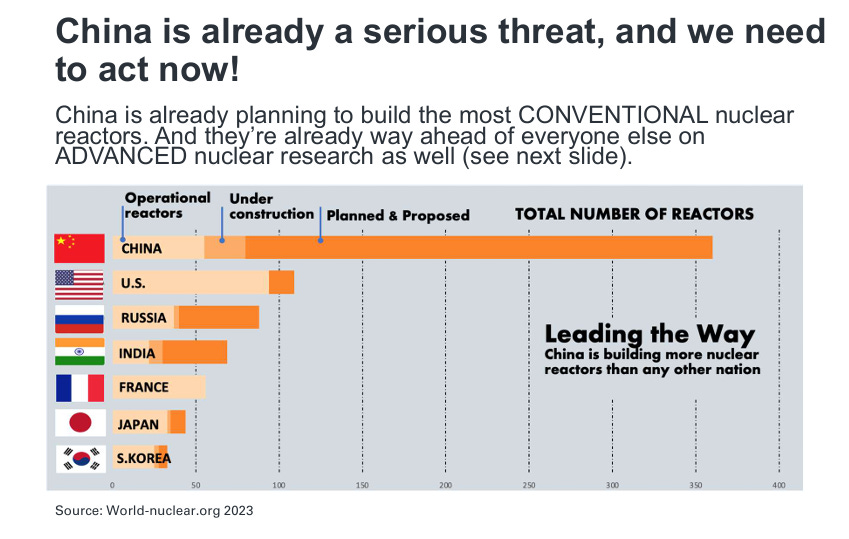
China’s lead isn’t theoretical—it’s visible in the numbers. As this chart shows, China is already building more conventional nuclear reactors than any other nation by a wide margin. What’s more alarming is that this doesn’t even account for their aggressive push into advanced reactor technologies. This scale of deployment gives China not only energy security but a strategic economic and geopolitical edge. If the West fails to respond with urgency, we risk ceding long-term energy and industrial leadership to Beijing.
They’re not playing the old game of incremental upgrades to light water reactors. They’re leapfrogging the legacy technology and heading straight for the prize: nuclear energy that costs less than coal.
A Call for American Leadership
Despite the inertia in the U.S., Erik voiced rare optimism—praising U.S. Secretary of Energy Chris Wright as the most competent and visionary leader the department has had in decades. In Erik’s words, Wright is the first energy secretary to seriously engage with the national laboratories that pioneered nuclear innovation and to recognize what’s at stake in this race.
But even with Wright’s leadership, Erik warned that we need a Sputnik moment—a galvanizing wake-up call that forces the West to recognize how far behind we are and how much is on the line. When the Soviets launched Sputnik in 1957, it shocked the United States into action, launching the space race and a generation of scientific advancement. We now need the nuclear equivalent—a moment that forces urgency, coordination, and investment on a national scale.
In my January essay, Progress Without Peril, I shared my belief that the incoming Trump administration might take bold action on nuclear energy—which was a primary motivation for writing about the nuclear future at the time. Yesterday, May 23, 2025, President Trump signed a sweeping executive order aimed at rebooting American leadership in nuclear energy. The order directs U.S. national laboratories to prioritize the development of proliferation-resistant advanced design reactors, and to produce a roadmap for production at scale. It also calls for regulatory reform to accelerate approvals and encourages public-private partnerships to compete with China’s growing nuclear footprint. While the long-term impact will depend on implementation, the move signals a significant policy shift that echoes the very urgency Erik Townsend calls for—a moment that could catalyze America's nuclear comeback.
From Mass Production to Global Impact
The heart of Erik’s vision is mass production. The analogy he loves to use is McDonald’s: they don’t build restaurants on-site—they truck in factory-made modules and bolt them together. Why not apply the same principle to nuclear?
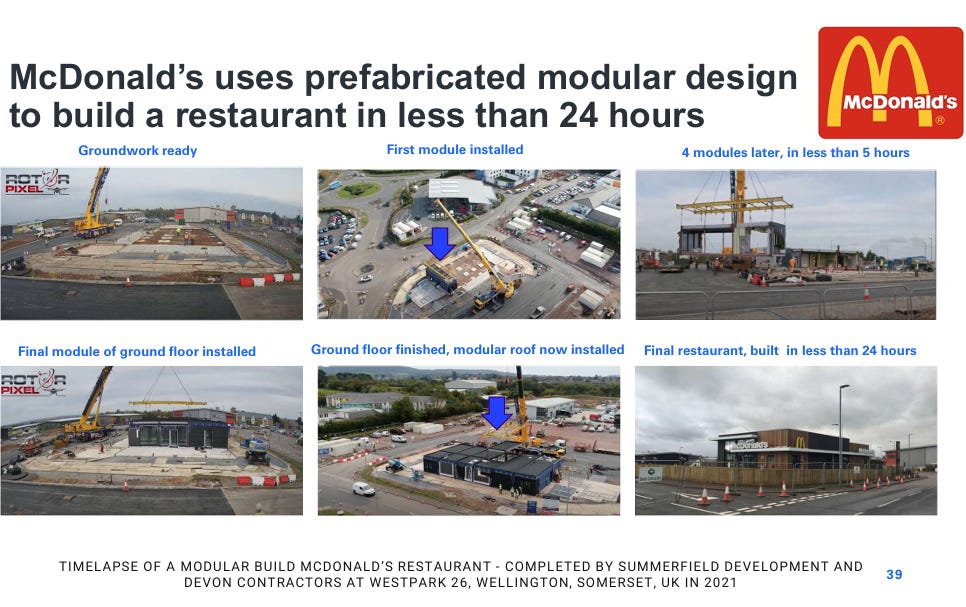
Copenhagen Atomics is already designing a 100-megawatt thermal reactor that fits inside a 40-foot shipping container. Their goal: build one reactor per day. Erik says we need to think bigger—one per hour. That’s what it would take to displace fossil fuels worldwide over the next few decades.
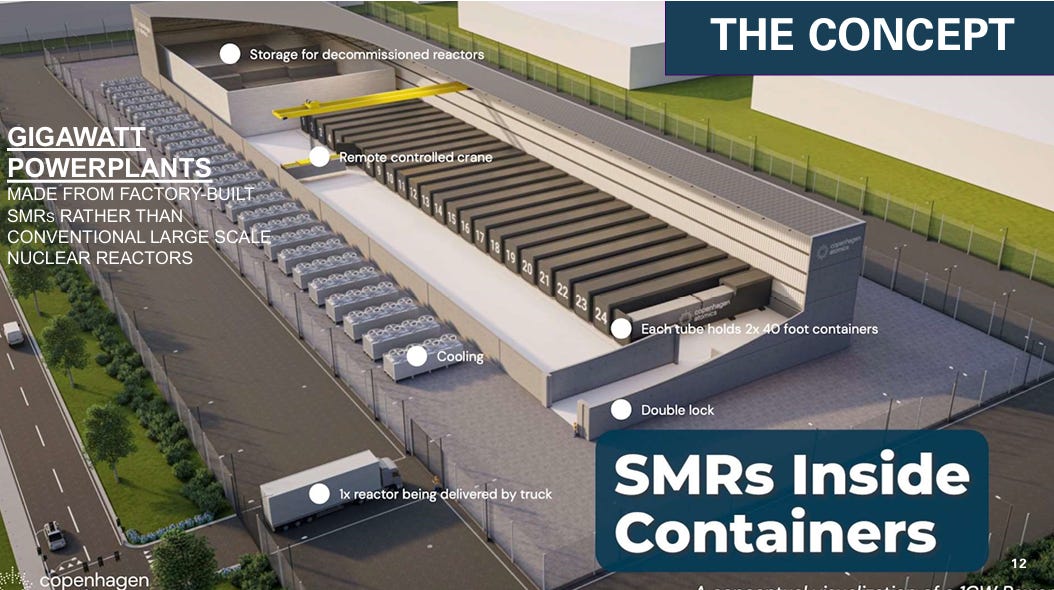
But this kind of manufacturing revolution also requires a new generation of power conversion systems. Conventional steam turbines are too large, inefficient, and costly. Enter supercritical CO₂ turbines—1/10th the size, more efficient, and modularization-friendly. They’re essential to keeping the capital cost of new power plants under the $1,000/kW threshold that will allow nuclear to outcompete gas.
The Clock Is Ticking
The implications go far beyond energy policy. If China develops energy independence through domestically fueled breeder reactors, their economy will no longer be vulnerable to maritime energy supply blockades—a key weakness today.
In a world where military dominance follows economic dominance, the race to make nuclear cheaper than coal and gas becomes a race for global leadership.
As Erik concluded in our interview, “Everything I’m describing here is going to happen. The only question is whether we do it—or China does it first.”
Let’s hope action from Washington is rapid—and that our Sputnik moment comes before it’s too late.
Thank you very much to our sponsors:
Truflation: Learn about what prices are actually doing by going to https://truflation.com/marketplace/us-inflation-rate
Foundation: Protect your Bitcoin using the latest off-line technology with easy-to-use Passport. Their next product, Passport Prime will protect all passwords off-line with even-better technology. https://foundation.xyz/
River Financial: If not cold storage for your Bitcoin, I’d highly recommend River for buying and holding- River is engineered to protect your Bitcoin over the long run. Use this link for discounts: https://river.com/signup?r=T7GGAF7G
Source: Erik Townsend research at: