
Guidance has become the lens through which talent is either focused or scattered. Today, it is badly out of alignment.
The college guidance process comes into play late. After twelve years of schooling, the moment of focus arrives in a single year. Inside that year, guidance is reduced to an hour. The narrowing is easy to miss. Its consequences are not.
American education is under visible strain. Confidence in universities has fallen sharply. K–12 schools feel less effective and less trusted than they once did. These pressures are often discussed on their own. Less attention is paid to the space between them, where students and parents make decisions that carry lasting financial and professional consequences. That transition has grown riskier, even as the system meant to guide it has changed very little.
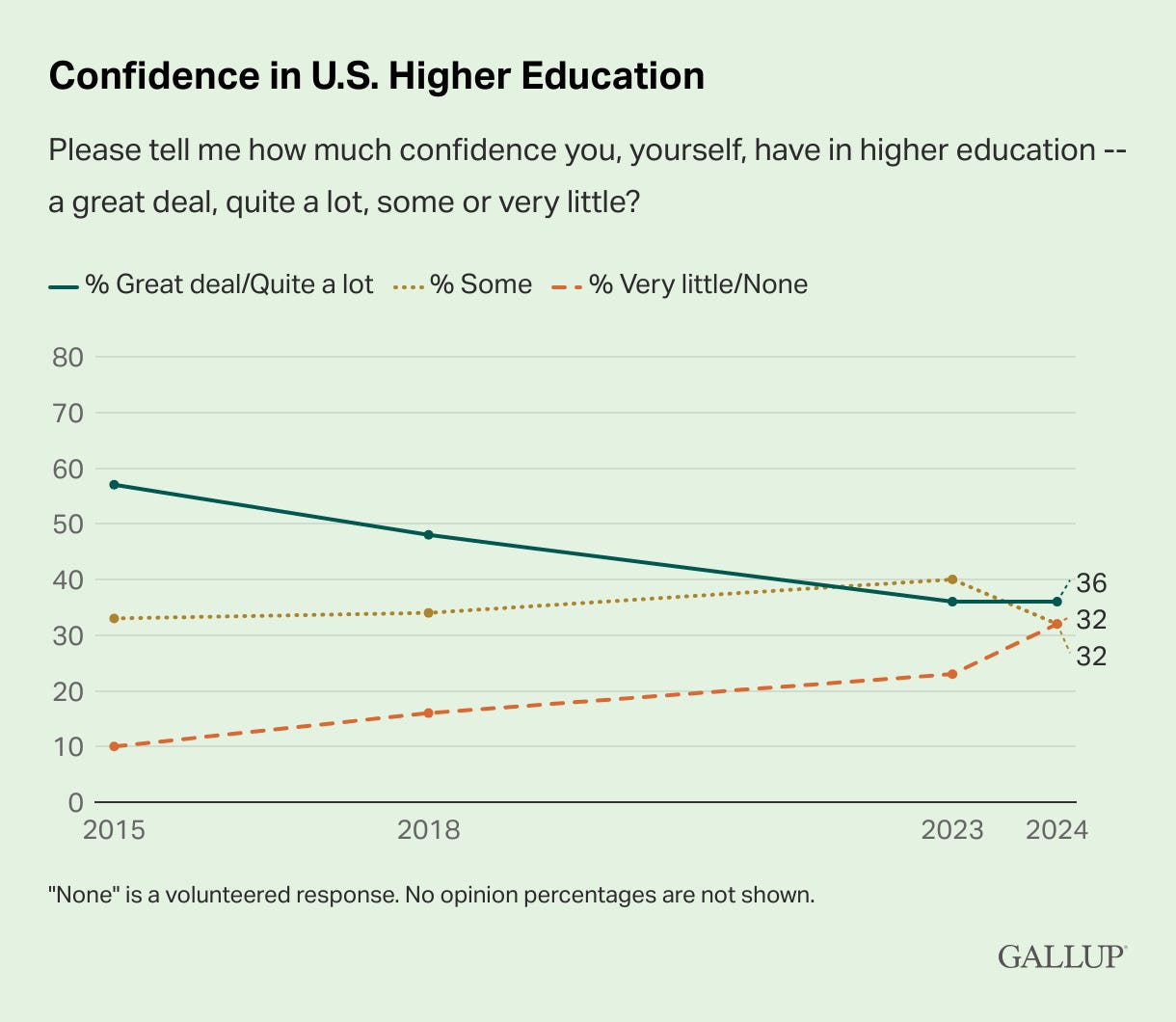
Public confidence in U.S. higher education has fallen steadily over the past decade.
Most families encounter the college selection process as a new problem. They experience it infrequently. Students face it with no prior reference. Parents often arrive with outdated assumptions. Across the table sit institutions and vendors that operate in this environment continuously. The incentives are strong. A single student can represent roughly a quarter million dollars in lifetime revenue. Colleges are expert at positioning themselves. Vendors know how to bend choice. When the stakes are that high, persuasion becomes sophisticated by necessity.
High school guidance was not built for this environment. As Jon Carson explains in our conversation, guidance is best understood as a system rather than a service. This system relies on counselors with large caseloads, limited time, and responsibilities that now extend beyond college advising. When the math is done, the result is familiar to many families. Roughly one hour per student per year is devoted to guidance.
That model once worked because outcomes were more predictable. College costs were lower. Mistakes were easier to recover from. Those conditions no longer hold. Real starting wages have stagnated. Tuition has risen even after financial aid. Housing absorbs a larger share of income. Student debt follows many graduates for decades. The risk profile has changed, while the guidance structure has not. The change shows up in student behavior. The share of high school students planning to attend a four year college has fallen from about sixty percent to roughly forty five percent.
My latest guest on Exploring Prosperity was education entrepreneur Jon Carson, co-founder of College Guidance Network. He put the evidence plainly:
“You know that’s not working because you have a very large amount of student debt that is in either arrears or default. Every dollar of that is a bad decision.”
There is no moral failing. Its a decision made with insufficient support. At scale, those decisions point back to the same problem. Too much risk is being carried by people with the least experience and the least help.
Families now face an abundance of tools that promise clarity. Rankings, portals, and free platforms present themselves as neutral sources of information. Many are not. Some monetize student data. Some serve colleges or lenders whose incentives remain invisible to users. Information has become abundant. Understanding has not kept pace. The lens is still out of focus.
This is why Carson keeps returning to a simple question.
“How do we make that one hour the richest one hour possible?”
The constraint is real. Schools are unlikely to add time. Counselors are unlikely to see lighter workloads. The response is to raise the quality of what happens within the time that exists. Preparation carries weight. Context shapes outcomes. Continuity matters. Technology plays a supporting role by reducing noise and preserving time for decisions that require judgment. When routine questions are handled elsewhere, the hour that remains can be spent on choices that warrant human attention.
For families on this path, this Exploring Prosperity YouTube episode offers a clearer view of how the system operates. It shows how incentives shape behavior across schools, colleges, and vendors. It explains where mistakes tend to originate and why they are costly. It makes visible a process most families encounter under pressure and with limited perspective.
The surrounding institutions may remain complex and expensive. That is unlikely to change quickly. Guidance still shapes outcomes. When it scatters talent, the costs are borne quietly and individually. When it focuses talent, those costs diminish. Better understanding does not guarantee success, but it does reduce the price of error.
Learn more about College Guidance Network HERE.
Full interview. (Also posted to my YouTube Channel.)
Thank you very much to our sponsors:
Truflation: BUY Truflation products/services and save 10% using code BOBDEW10. Learn about what prices are actually doing by going to https://truflation.com/marketplace/us-inflation-rate
Foundation: Protect your Bitcoin using the latest off-line technology with easy-to-use Passport. Their next product, Passport Prime will protect all passwords off-line with even-better technology. https://foundation.xyz/
River Financial: If not cold storage for your Bitcoin, I’d highly recommend River for buying and holding- River is engineered to protect your Bitcoin over the long run. Use this link for discounts: https://river.com/signup?r=T7GGAF7G