
This is the fourth in our series examining insights from our recent roundtable on the gold standard counterfactual. Previous essays explored how Nixon's 1971 decision potentially reduced economic growth, enabled government expansion, and worsened wealth inequality.
Nixon's exit from Bretton Woods fundamentally altered global financial markets, creating a fiat system with far-reaching consequences. By removing the natural constraint on monetary expansion, this decision reshaped how capital flows, how individuals save, and how wealth is created. Our roundtable revealed four key effects of this transformation that remain embedded in our economic landscape today:
Forced Financial Speculation for Ordinary Savers
Two-Tiered Wealth Creation System
Distorted Investment Incentives
Socialized Risks, Privatized Rewards
Effect 1: Forced Financial Speculation for Ordinary Savers
Under a gold standard, ordinary citizens could effectively save for the future simply by accumulating money. Without persistent inflation eroding purchasing power, basic savings represented a sound financial strategy. As Bob Murphy explained in our roundtable:
"I think that's actually a feature, not a bug, that in general, a household that just wants to defer consumption... wants to live below their means now, maybe because they're saving for their kid going to school or retirement... What's the most generic thing you can save in is the money that your community uses."
The post-1971 era has eliminated this option. Today, merely holding cash guarantees loss of purchasing power, forcing everyday citizens to become unwilling market participants. Murphy noted the mathematical reality: "If price inflation is like, suppose the real rate of interest is supposed to be 2%, and then yeah, if prices are falling 1% a year, that's fine. The nominal interest rate can be 1%. But if prices are falling 5% a year, well, then the nominal interest rate can't be negative 3% because everyone just holds cash and they earn zero, right?"
This environment makes financial speculation not a choice but a necessity, which Murphy observes "makes society's investments riskier" overall.
Effect 2: Two-Tiered Wealth Creation System
The fiat monetary system has created what amounts to a bifurcated path to wealth. Troy Cross shared a revealing anecdote from his teaching experience:
"I had a student many years ago, this was before I got into Bitcoin. It's one of the reasons I got into Bitcoin. Very successful student at a very fancy University said to me, well there's only two ways to get wealthy in the world. And one of them is to be Bill Gates and make a company that everybody uses... That's really hard. That takes a lot of work. The other is just go to Wall Street."
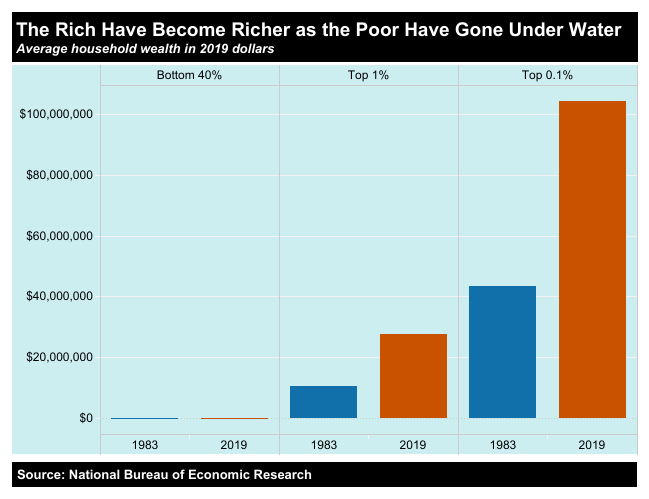
Cross's initial skepticism—"That doesn't sound right. That doesn't sound like the way the world should be, that those are your two options"—gave way to recognition after the 2008 crisis. He observed that "not only was she right and that easy money has kind of created this large sector of the economy that pays very handsomely, but also we are all on the hook for it in case it ever fails so that the risks are borne by everybody, but the upside is borne by the few who are in it."
The data confirm this transformation. Employment in financial services has grown dramatically since 1971, with both jobs and compensation increasingly concentrated in this sector. The financial industry now claims a disproportionate share of corporate profits and attracts a growing percentage of top graduates from elite universities. This shift represents a profound reallocation of human capital from value-creating industries to those primarily engaged in monetary management.
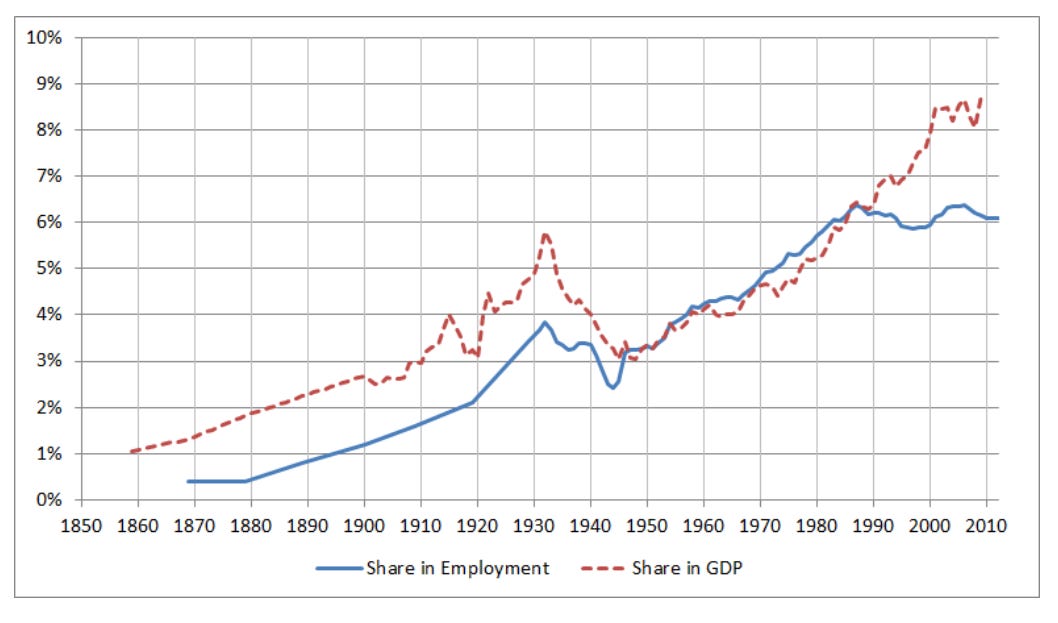
CHART: The concentration effect of fiat financialization. Source: https://cepr.org/voxeu/columns/wealth-inequality-entices-talent-finance
This reflection highlights a profound shift from an economy where wealth primarily flows from value creation to one where financial positioning itself generates extraordinary rewards.
Effect 3: Distorted Investment Incentives
The monetary environment created by abandoning gold has fundamentally altered investment incentives throughout the economy. Lyn Alden identified this distinction in our roundtable:
"There's like high ROI debt that's kind of out of necessity. And then there's like debt for arbitrage."
The former represents genuine value-adding investments, while the latter exploits monetary distortions. Alden explained that in our current system, money supply growth relative to resource growth creates the dividing line between these two approaches:
"I tend to draw the line not just at the deflation level itself, but at the actual line of money supply growth relative to typical resource growth. And that's kind of the cutoff point that I think is perhaps more relevant in that discussion."
When money supply grows faster than resources, debt-based arbitrage becomes rational. This explains behaviors that would seem irrational under a sound money system—like companies maintaining massive debt loads despite consistent profitability.
Effect 4: Socialized Risks, Privatized Rewards
Perhaps the most troubling aspect of our post-gold financial system is its fundamental asymmetry. When financial markets succeed, the benefits flow primarily to those positioned within the system. When they fail, the costs are distributed broadly across society.
Troy Cross articulated this dynamic with remarkable clarity, noting that after the 2008 collapse, he realized the financial sector had created a system where "the risks are borne by everybody, but the upside is borne by the few who are in it."
This represents a profound departure from market capitalism's traditional alignment of risk and reward. Under a gold standard, financial institutions wouldn't have the implicit backing of a central bank with unlimited money-creation ability. This would naturally limit leverage and speculation while ensuring that those taking financial risks would bear the consequences of failure. In the following chart, the fiat system allowed for this growth in the concentration of US corporate profits in the financial sector while the risks in the system compounded unchecked, and the losses and need for a government bailout would have been smaller without that compounding effect.
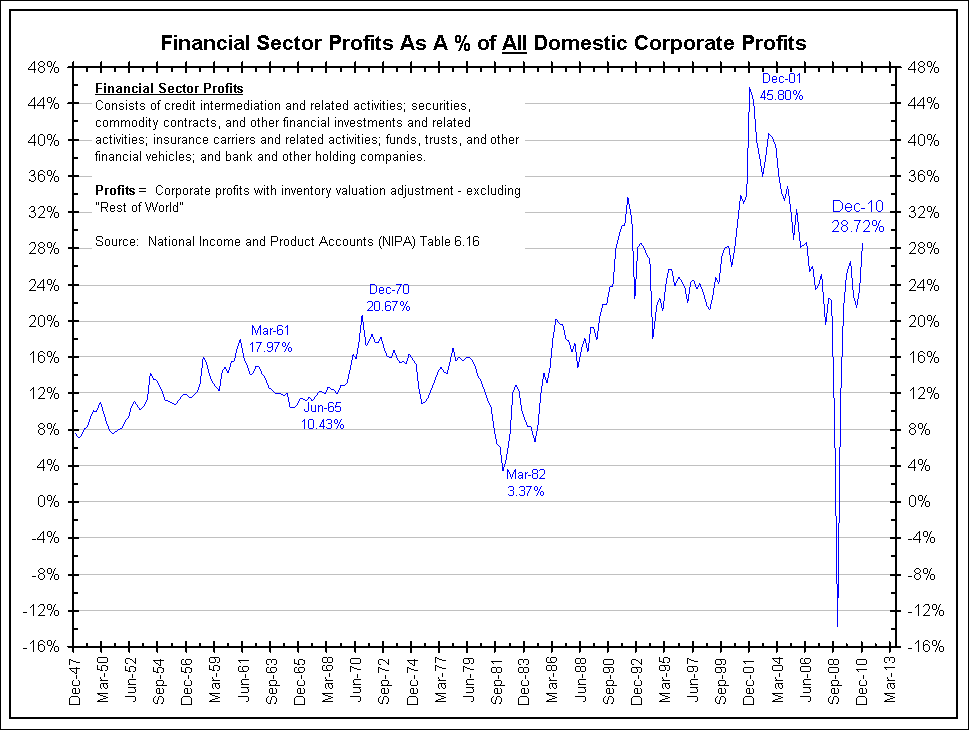
Source: nipa0328111_big.gif (969×730)

Under a gold standard, these four effects would be substantially mitigated. Ordinary citizens could save effectively without speculation. Wealth creation would more closely align with value creation. Investment would flow toward genuinely productive uses rather than monetary arbitrage. And financial risks would remain with those who choose to take them rather than being implicitly backed by society at large.
Troy Cross, while acknowledging these issues, offered an important counterpoint: "Sometimes malinvestment pays off. Suppose you have all this money floating around in the system... look at the internet bubble. Massive speculative frenzy. Some of those companies paid off, like Amazon." This suggests that while a gold standard might promote more disciplined investment, the occasional productive breakthroughs enabled by looser monetary conditions could be sacrificed.
As Alden noted when discussing developing economies, we can see the real-world impacts of our current system: "For the past 10 years or so in Egypt... their energy use per capita has gone flat to down from a fairly low level, which is generally not a very good sign of per capita economic growth." When monetary systems become disconnected from real resources, genuine prosperity suffers despite apparent financial gains.
In our next essay, we'll explore one of the most morally complex aspects of our monetary system choice: its relationship to warfare and crisis management. We'll examine the tension between the discipline imposed by hard money and the flexibility desired during emergencies.
Exploring the Gold Standard Counterfactual: The Complete Series
This six-part series explores different dimensions of how our world might differ if Nixon had reinforced the gold standard in 1971:
• Part 1: Economic Growth - Examining Murphy's provocative claim that global GDP could be 70% higher today
• Part 2: Government Size and Spending - How monetary systems influence government's role in the economy
• Part 3: Wealth Distribution - Why fiat currency systems distort the distribution of wealth
• Part 4: Financial Markets - How monetary uncertainty transformed investment into speculation
• Part 5: War and Crisis Management - The tension between discipline and necessary flexibility
• Part 6: The Technological Challenge - Can Bitcoin solve what gold couldn't?
Thank you to our sponsors:
Truflation: Learn about what prices are actually doing by going to https://truflation.com/marketplace/us-inflation-rate
Foundation: Protect your Bitcoin using the latest off-line technology with easy-to-use Passport. Their next product, Passport Prime will protect all passwords off-line with even-better technology. https://foundation.xyz/
River Financial: If not cold storage for your Bitcoin, I’d highly recommend River for buying and holding- River is engineered to protect your Bitcoin over the long run. Use this link for discounts: https://river.com/signup?r=T7GGAF7G