
Are there only two camps of thinkers about the $34T of US sovereign debt?
1) The first camp comprised of those who believe it is:
out of control,
cannot be repaid,
is bound to continue to rise further because the US now has structural deficits and politicians seem incapable of even tweaking annual deficits,
does not even include unfunded liabilities which are multiple larger than $34T
and someday, something will go wrong with it and the price to be paid will be hauntingly steep
and 2) the second is comprised of those who:
only speak of the need to cut taxes, raise government spending, or pack bills with pork
point to the past and accurately point out that running deficits and high taxes has not led to any crisis that could not be remedied with more, and more severe, deficit spending
avoid ever speaking about (or thinking about?) the real financial repercussions of borrowing each year to meet current obligations.
There is no camp of experts who are outspoken proponents of running high deficits on record amounts of debt in times of peace and economic growth. Even Keynesians argued that deficit spending was wise in times of recession or stress because economic growth would lead to periods of excess where the debt would shrink.
So it is somewhat of a mystery that this issue has no proponents of its real effects!
Is There an Exit Strategy?
Watching the value of the US Dollar in financial markets has the ironic characteristic of not being relevant as it is measured against all other “fiat” currencies.
And (nearly) all of these other fiat currencies are subject to the exact same fiscal affliction of high debt and recurring deficits.
If at some point there is an economic reconciliation, then the fiat currencies will be subject to the necessary “default” or “debasement.”
In this interview with Jason Trennert (HERE), we discuss these concepts in detail, as well as other topics including those below in the timeline.
Federal Government Interest Payments:
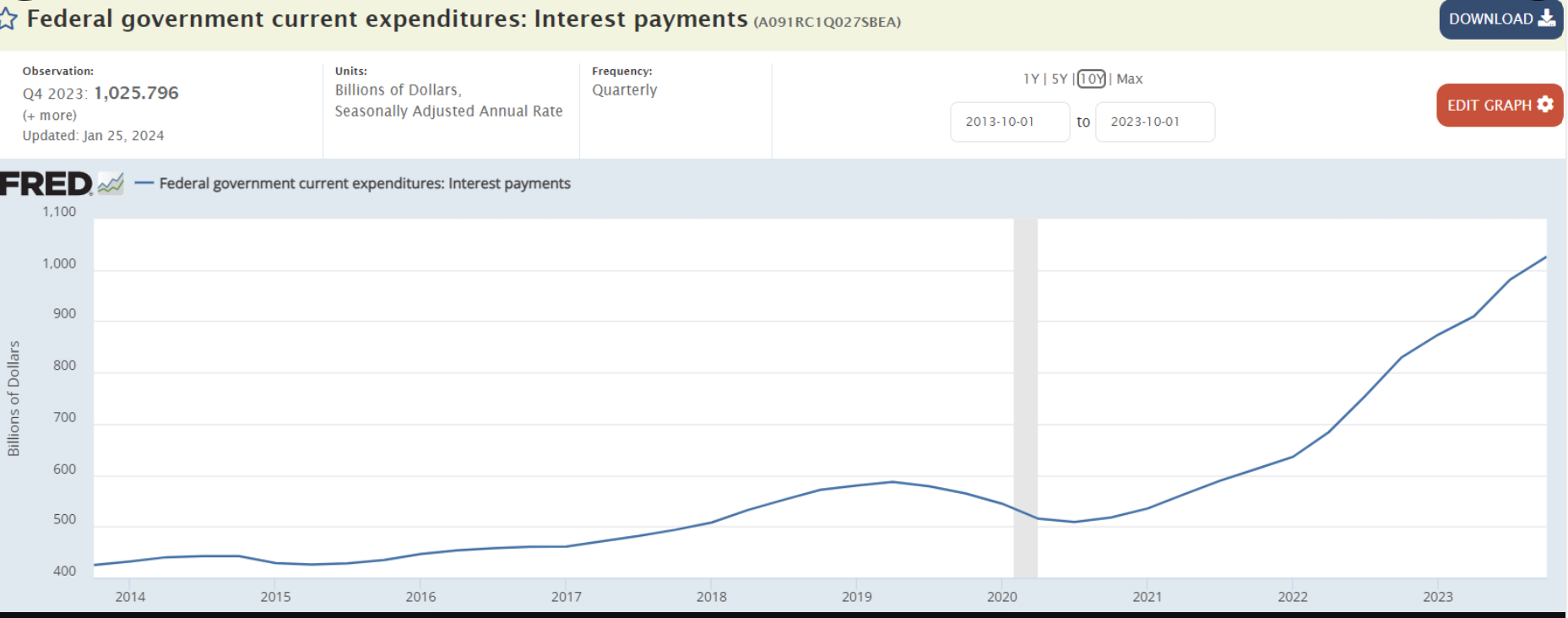
Conclusions: The heavy US debt burden and likely continued deficits will finally take a toll through rising interest rates and a crowd out effect on federal spending for worthy projects, and the best investments are likely in hard commodities and oil, and the equity of the producers. I believe Bitcoin provides an escape for citizens from this debt bomb, but Jason believes that gold is a better bet and that Bitcoin (and potentially other crypto) will be too threatening; governments will ultimately stop them. While governments will likely lose control of their fiat money because of rising debt service obligations (not from Bitcoin), and some/many in government (Executive Branch and the Fed) will insist on curbing or eliminating Bitcoin usage, i) the US political system’s (Congress) sensitivity to individual liberty will prevent this from happening, and ii) any efforts that may be undertaken despite that resistance will be unfeasible and/or ineffective.
I hope you enjoy our conversation with Jason Trennert as much as I did.
Timeline of the Jason Trennert Interview:
03:43 The Most Important Slide- Interest on the Federal Debt
07:01 World War II and solving the US sovereign debt problem vs today
08:55 SVB and S&P500 took off for 2 reasons
10:59 SVB Response may have saved a recession
12:28 Deep dive into inflation drivers- 2% target seems too ambitious
17:15 Can the Fed declare victory without 2% CPI? 21:12 Resolve in Congress to reverse fiscal excess?
26:41 Key problem with high interest rates
34:11 Structural inflation and good trades
37:41 Inflation- Kryptonite for Stocks
42:51 Private capital markets vulnerable to high rates
48:35 Anti-Trust and unlocking value?
54:32 Geopolitical risks and the financial markets
57:13 US economy and markets and their resiliency in wars
60:49 Watch out for the CPI echo