
This is the third in our series examining insights from our recent roundtable on the gold standard counterfactual. In previous essays, we explored how the US economy could be 70% larger had Nixon fortified the gold standard in 1971.
One of the most striking economic developments since 1971 has been the dramatic increase in wealth inequality in developed economies. Our roundtable participants concluded that this timing correlation with the abandonment of the gold standard represents a causal relationship, not merely coincidence.
In our roundtable discussion, financial analyst Lyn Alden offered a compelling framework for understanding this connection. "I think there are two different types of wealth concentration," she explained. "There's kind of the better kind and the worst kind."
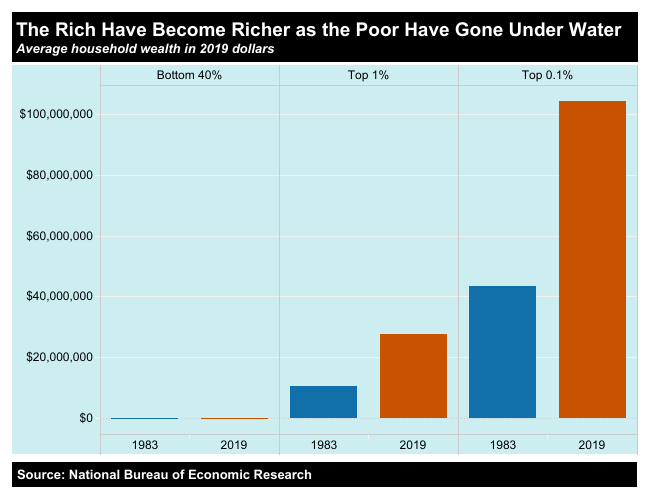
The first type—innovation-based wealth concentration—occurs when entrepreneurs create products, services, or efficiencies that genuinely improve living standards. When someone invents a life-saving medication, develops technology that makes workers more productive, or creates systems that reduce costs for consumers, their wealth represents a fraction of the value they've created for society. This form of wealth concentration is generally beneficial—it incentivizes innovation and reflects actual value creation.
The second type—financial arbitrage-based wealth concentration—occurs when individuals or institutions position themselves to benefit from monetary policy and financial engineering rather than other productive enterprise. This includes capturing the advantages of new money creation, leveraging debt in ways only available to large institutions, and engaging in financial speculation. While these activities do provide value by improving liquidity and capital flow throughout the economy, the outsized rewards can create imbalances.
Alden provided a striking example involving Procter & Gamble: "Why do they have $40 billion in debt if they've been profitable every year longer than I've been alive? Why do they have debt? It's because Procter & Gamble selling bonds is like the…” “...best thing they sell." Companies establish a "structural short" on fiat currency while running otherwise reasonable businesses. This strategy works because the Federal Reserve intentionally reduces the purchasing power of the dollar over time by expanding the money supply and targeting 2% inflation, effectively ensuring these companies repay their debts with less valuable dollars. Additionally, this borrowing makes financial sense because companies generate positive returns on their invested capital—not only do they benefit from the inflation tailwind, but they also use this artificially low-priced debt to invest in factories and processes that boost their normal returns on invested capital.
In the post-1971 era, wealth concentration has increasingly shifted toward this second type. Three primary mechanisms drive this shift:
First, the Cantillon Effect—named after 18th-century economist Richard Cantillon—describes how changes in the money supply don't affect all parts of the economy simultaneously or uniformly. Instead, the effects ripple out from the point where new money enters the system, benefiting some groups earlier and others later—or not at all. As Bob Murphy noted in our roundtable, corporations effectively receive a subsidy through this mechanism, while ordinary savers are penalized. This systematic transfer of purchasing power from wage earners to large entities positioned closely to the money-printing has compounded over five decades.
Second, asset inflation has outpaced consumer price inflation. When the Federal Reserve targets consumer prices while expanding the money supply, individuals and institutions are encouraged to move their depreciating dollars into assets for wealth preservation. Simultaneously, accommodative monetary policies hold interest rates artificially low, encouraging borrowed money to flow into these same assets, further driving up prices. Those with the most assets invested gain the most, especially those who add on debt leverage.
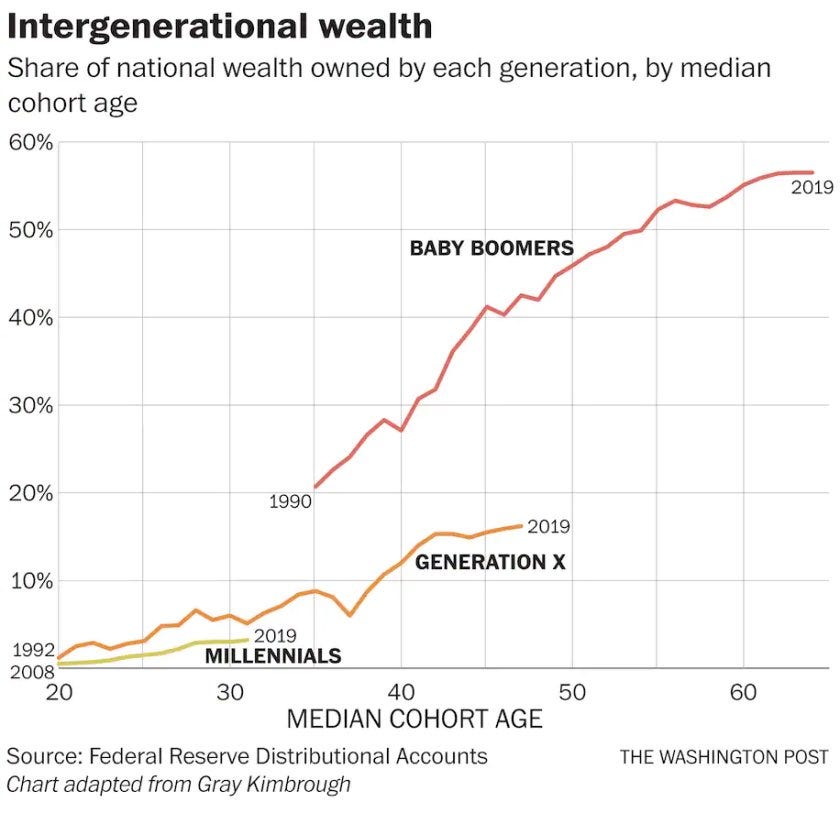
CHART: See how compounding over time has allowed Boomer wealth to pass 50% by age 54. Gen X and Millenials have lagged for many reasons, one has been the income gap (see below).
The housing market illustrates this effect clearly—home prices have risen so dramatically relative to incomes that many young adults cannot afford to purchase their first home until much later in life compared to previous generations. This has dual negative impacts: increasing wealth inequality and creating intergenerational tensions. It also pushes more people into increasingly risky investment behavior as they search for ways to build wealth in this distorted environment.
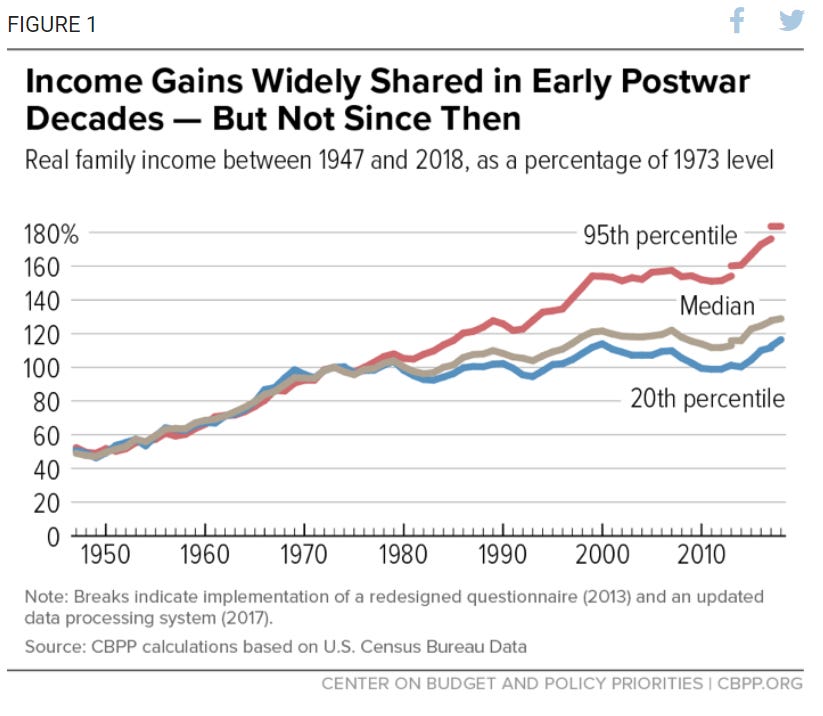
CHART: Income gains are widely shared in early postwar decades — But not since then
Third, currency debasement forces ordinary people to become investors simply to preserve their purchasing power. Previous generations could effectively save through bank deposits or cash, but inflation has eliminated this option. Today's households must navigate complex financial markets and assume investment risks they're often ill-equipped to manage. Successful investing requires specialized knowledge, significant time commitment, and emotional discipline—skills that most working people cannot be expected to develop. As households chase returns to offset inflation, they often take inappropriate risks or fall prey to high-fee investment products that further erode their savings.
Warren Buffett observed in a 2015 Wall Street Journal op-ed entitled “Better Than Raising the Minimum Wage”: "In 1982, the first year the Forbes 400 was compiled, those listed had a combined net worth of $93 billion. Today, the 400 possess $2.3 trillion, up 2,400% in slightly more than three decades, a period in which the median household income rose only about 180%." (Updated to 2023, the Forbes 400 now possess approximately $5.2 trillion—a staggering 5,400% increase since 1982, while median household income has grown just 255% over the same period.) This dramatic disparity—wealth inequality growing over 20 times faster than income inequality—reflects how asset ownership creates a compounding advantage under our current monetary system.
Buffett notes that this outcome isn't due to conspiracy or undeserving wealth concentration—most wealthy individuals have contributed valuable innovations or expertise. Rather, he suggests it's "an inevitable consequence of an advanced market-based economy" where specialized skills are increasingly rewarded over more common abilities. However, our monetary system amplifies these natural market outcomes by systematically favoring asset owners over wage earners.
Other data confirm these structural shifts. While wealth inequality metrics began turning around 1973 (shortly after Nixon's decision), other economic indicators show a growing disconnect between financial asset performance and broad-based prosperity:
Real wages for many workers have stagnated despite significant productivity growth
Home ownership has become increasingly unaffordable in many regions
Financial assets have dramatically outperformed productive assets
Under a gold standard, these dynamics would be significantly different. With a stable monetary unit, savers wouldn't be penalized for holding cash or simple savings accounts. Without the ability to create new money, financial arbitrage would yield fewer advantages, and wealth accumulation would be more tightly coupled to actual value creation.
This doesn't mean inequality would disappear—innovation-based wealth concentration would still occur—but it would more accurately reflect genuine contributions to societal welfare. The entire system would favor those who create real value rather than those who best position themselves relative to monetary flows.
Troy Cross observed in our roundtable that "price signals are a public epistemic good" that tell us what people genuinely need and want. When these signals are distorted by monetary manipulation, genuine value creation becomes harder to discern, insiders can gain advantage, and resource allocation suffers. Under a gold standard, the economic signals that guide capital and labor would more accurately reflect real societal preferences.
In our next essay, we'll examine how abandoning the gold standard has affected financial markets by altering investment incentives and expanding the financial sector. As Bob Murphy pointed out in our roundtable, just as rampant forest fires would draw talent to firefighting, monetary uncertainty has redirected significant talent toward financial management that might otherwise have focused on technological innovation and entrepreneurship.
Exploring the Gold Standard Counterfactual: The Complete Series
This six-part series explores different dimensions of how our world might differ if Nixon had reinforced the gold standard in 1971:
• Part 1: Economic Growth - Examining Murphy's provocative claim that global GDP could be 70% higher today under a gold standard
• Part 2: Government Size and Spending - How monetary systems influence government's role in the economy
• Part 3: Wealth Distribution - Why fiat currency systems distort the distribution of wealth compared to hard money economies
• Part 4: Financial Markets - How monetary uncertainty transformed investment into speculation
• Part 5: War and Crisis Management - The tension between discipline and necessary flexibility
• Part 6: The Technological Challenge - Can Bitcoin solve what gold couldn't?
Thank you to our sponsors:
Truflation: Learn about what prices are actually doing by going to https://truflation.com/marketplace/us-inflation-rate
Foundation: Protect your Bitcoin using the latest off-line technology with easy-to-use Passport. Their next product, Passport Prime will protect all passwords off-line with even-better technology. https://foundation.xyz/
River Financial: If not cold storage for your Bitcoin, I’d highly recommend River for buying and holding- River is engineered to protect your Bitcoin over the long run. Use this link for discounts: https://river.com/signup?r=T7GGAF7G