
My wife and I just welcomed a new granddaughter this week- born in a routine, uneventful delivery. That word may be the most miraculous description in human history. For thousands of years, childbirth was anything but. Each new life carried mortal risk for both mother and child. Today, we barely notice how extraordinary it is that something once so dangerous has become ordinary.

The Measure of Progress
Few statistics capture human progress more clearly than infant mortality—the share of babies who die before their first year. It’s one of the purest indicators of human flourishing because it reflects everything societies have learned about nutrition, sanitation, vaccination, antibiotics, clean water, hospitals, and prenatal care.
For most of human history, those losses were woven into the fabric of life — so common that whole communities were shaped by grief and lowered expectations of survival. Every drop in that rate is more than a medical success; it’s a restoration of something deeper: the chance for joy to replace sorrow, and for societies to build on hope instead of endurance. And as those numbers fell, civilization itself advanced.
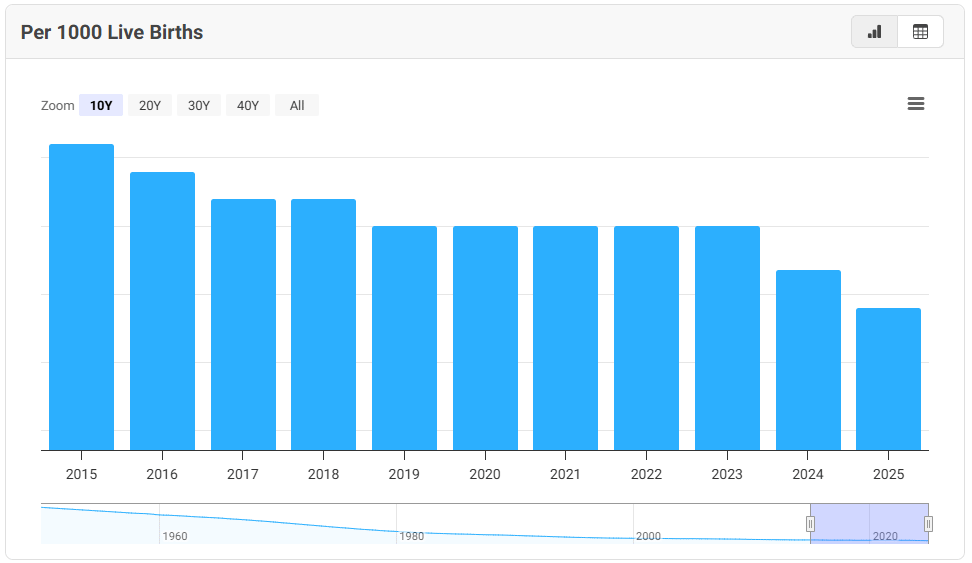
Source: US infant mortality reached a low of 5.2 per 1,000 live births in 2025, or 0.52%. (Macrotrends.net)
In 1800, nearly half of all children in the world died before the age of five. Even the wealthiest nations couldn’t reliably protect mothers from infection or infants from pneumonia and malnutrition.
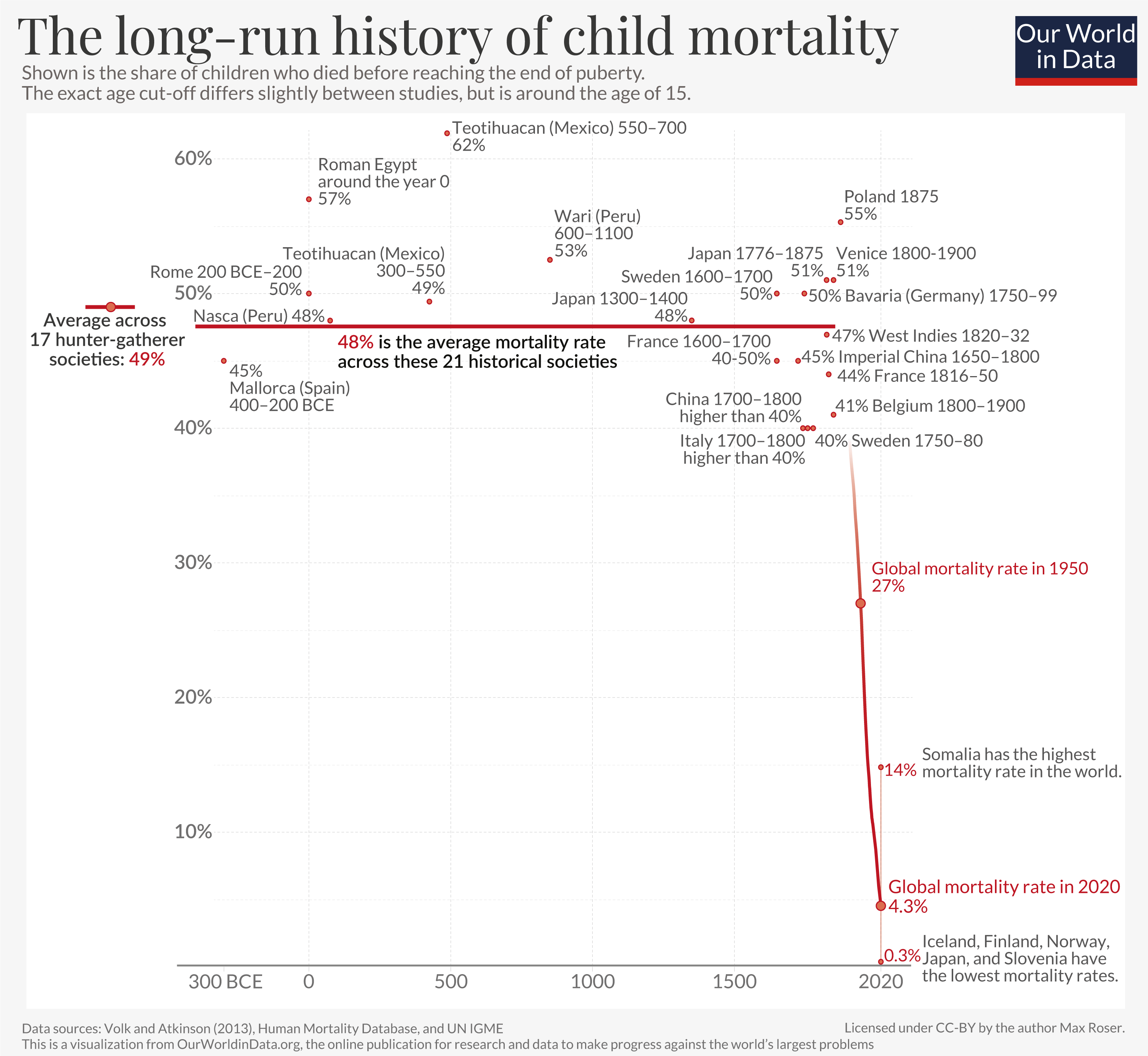
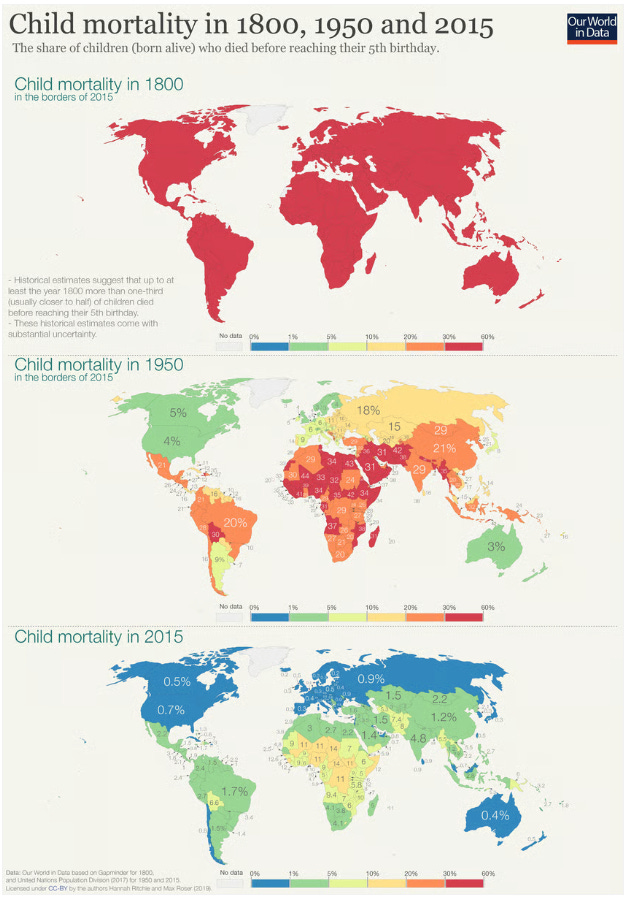
By 1900, those odds had barely improved. Then came the breakthroughs: germ theory, antisepsis, vaccines, antibiotics, and public-health systems. Within a century, infant mortality in the developed world dropped more than 90 percent. Globally, it now lies under 4 percent. In the United States, the rate just hit a record low of 0.52% in 2025.
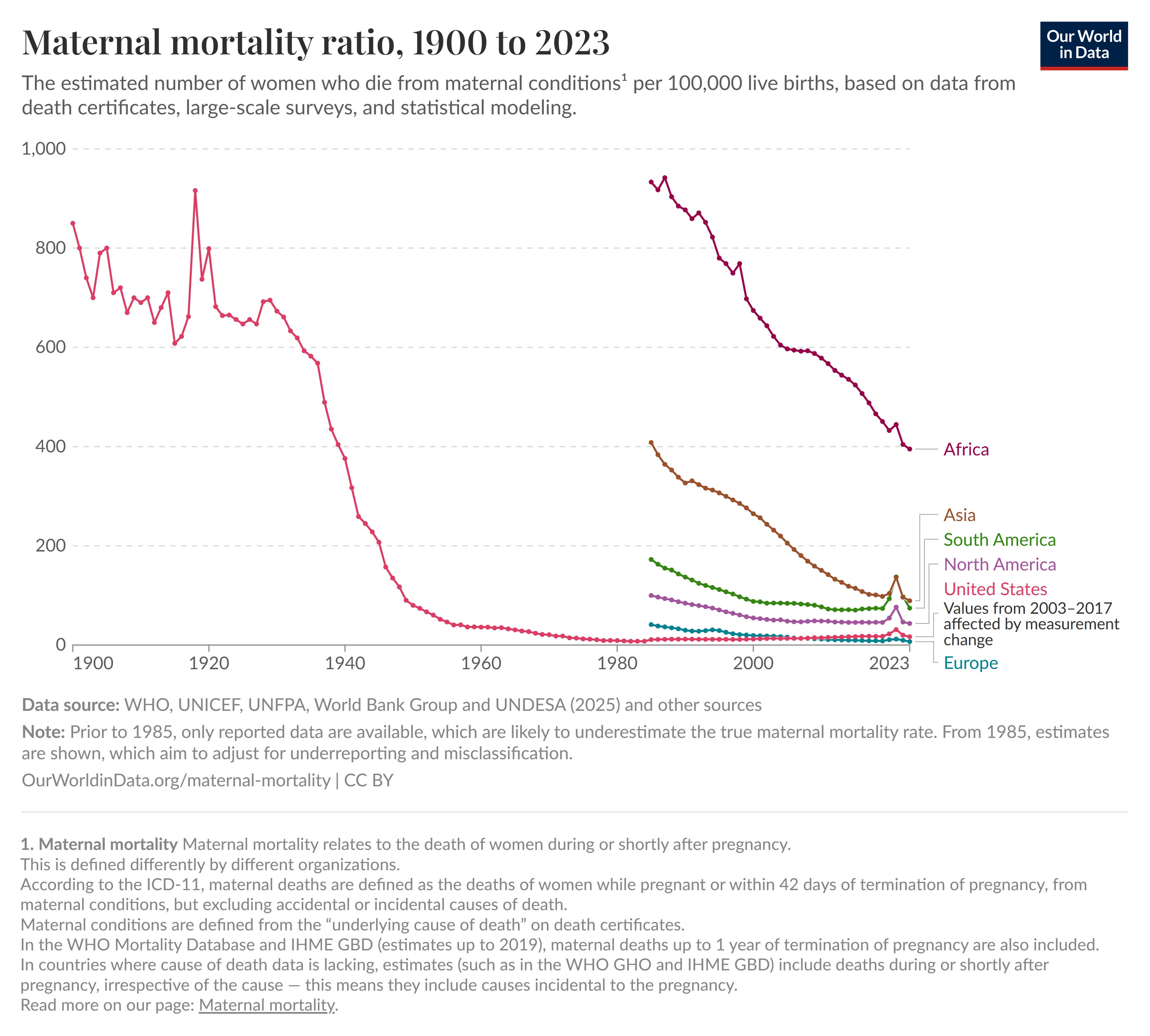
Maternal mortality followed a comparable arc: from nearly one in a hundred births to fewer than one in ten thousand in most advanced countries.
The progress is recent enough that our grandparents still lived in a world where childbirth carried real danger and loss was never far from any home. In 1900, nearly every American baby was born at home. By 1940, about half of U.S. births took place in hospitals; by 1969, 99 percent had. The hospital era brought antiseptics, blood transfusion, anesthesia, and neonatal intensive care—the moment when childbirth became dramatically safer.
In fact, that very safety has enabled a small but rising number of mothers to return to home or birthing-center deliveries—not out of distrust, but out of confidence. These are typically healthy, well-monitored pregnancies supported by strong prenatal care and rapid emergency-transfer options. For many mothers, the motivation is comfort, continuity of care, or the desire for a more personal experience. That such choices are possible at all is itself a testament to medical progress: birth has become safe enough that families can once again shape the experience according to their values.
The Modern Paradox
Yet the same system that achieved these miracles now stands as one of America’s greatest sources of pessimism. We live surrounded by medical brilliance, but few feel secure within it.
Costs are a main driver. Healthcare now consumes nearly one-fifth of U.S. GDP. Families face mounting premiums, deductibles, and co-pays; ninety-two percent of the twenty-four million Americans insured through the Affordable Care Act require federal subsidies to afford their coverage—a measure of how deeply the cost spiral has taken hold. We’ve all received invoices for routine lab tests or brief procedures priced in the thousands—charges that bear little relation to the actual cost of care. Medical debt remains a leading cause of bankruptcy. High prices for procedures and drugs force millions to postpone or forgo treatment altogether.
Access remains uneven. In 2023, roughly 26 million Americans still lacked any health insurance, while wait times for appointments can stretch into weeks. Outcomes vary widely across regions and hospital systems. Even among those with coverage, frustration is high: the more advanced the system becomes, the more inaccessible it feels.
A clip from my YouTube video, link to it below.
Underneath these issues lies a deeper dysfunction—the evolution of our third-party payor model. Originally, health insurance helped contain costs with modest premiums, low deductibles, and robust catastrophic coverage. Over time, it removed nearly all price discovery from the system, enabling unchecked inflation and institutional bloat. Premiums and deductibles have become unaffordable and must be subsidized by employers or the government—subsidies that themselves perpetuate the excesses. For most healthy contributors, the benefit is undetectable. The system, once a buffer, now leaves both patients and providers exhausted: one by cost, the other by constraint.
Meanwhile, doctors, nurses, and frontline health professionals find themselves underpaid, overworked, and buried in bureaucracy. Many say they no longer have the time or freedom to deliver the care they know their patients deserve. Access, compensation, and burnout have become inseparable.
This is the paradox of progress: the better we get at something, the higher our expectations rise. Two generations ago, families worried about surviving childbirth; today, we debate insurance co-pays. We resent delays and paperwork even as outcomes remain historically extraordinary.
The Ordinary Miracle
Holding my granddaughter for the first time, with calm professionals nearby and quiet monitors in the background, I wasn’t thinking about history or medical progress—I was thinking about how beautiful she was, and how lucky I am to have such love close at hand. That sense of quiet gratitude may be the truest sign of how miraculous the ordinary has become.
Thank you very much to our sponsors:
Truflation: Learn about what prices are actually doing by going to https://truflation.com/marketplace/us-inflation-rate
Foundation: Protect your Bitcoin using the latest off-line technology with easy-to-use Passport. Their next product, Passport Prime will protect all passwords off-line with even-better technology. https://foundation.xyz/
River Financial: If not cold storage for your Bitcoin, I’d highly recommend River for buying and holding- River is engineered to protect your Bitcoin over the long run. Use this link for discounts: https://river.com/signup?r=T7GGAF7G