
I have been revisiting some of my earlier work on the American university system, prompted by two recently published surveys and a small-group discussion on AI and education that Dartmouth professor of mathematics and computer science Daniel Rockmore and I led last week.
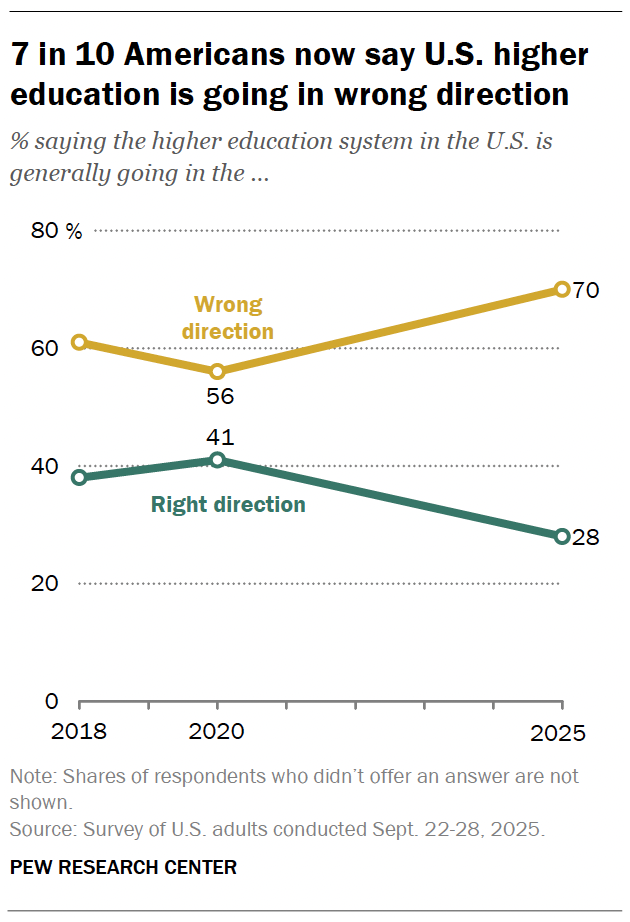
In a 2025 Pew survey, 70 percent of Americans said the higher education system was headed in the wrong direction, up from 56 percent in 2020.
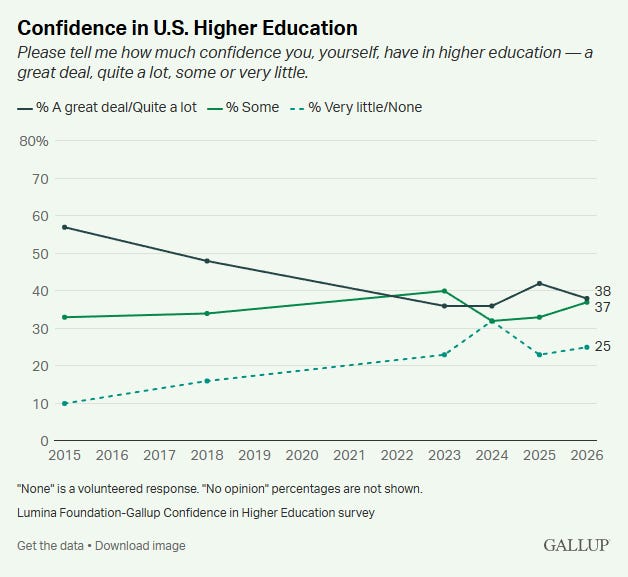
Then, in June 2026, Gallup found that only 38 percent expressed strong confidence in higher education, down from 57 percent in 2015 and 42 percent in 2025.
Yet Americans have not rejected education itself. 71% percent of graduates say their education was worth the cost, and 93 percent would choose to earn a degree again.
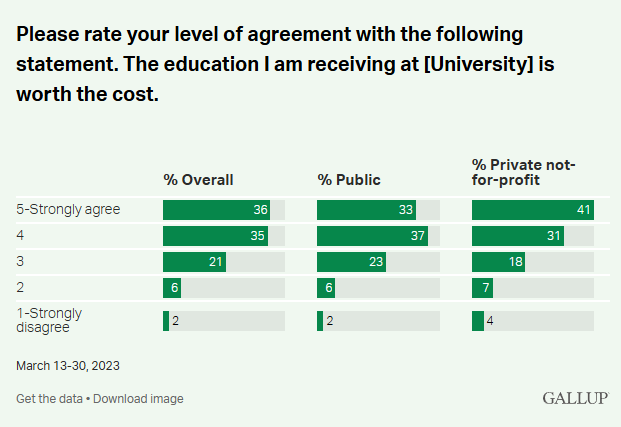
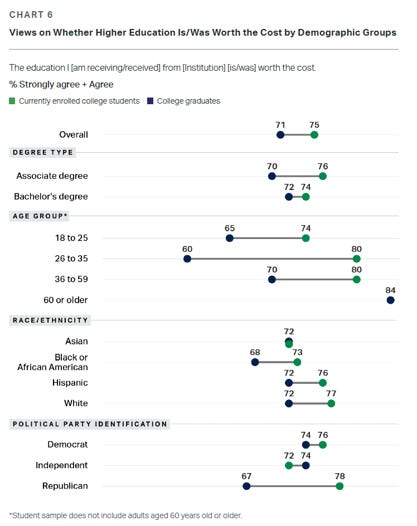
Taken together, the surveys suggest a widening divide between confidence in education and confidence in the institutions providing it. AI could widen that divide or force universities to demonstrate more clearly what an education is for.
Our recent discussion examined how artificial intelligence is challenging one of the university’s oldest functions: the delivery of knowledge. AI can explain difficult material, personalize instruction, and help people acquire skills at negligible cost. It may also enable new educational ventures to compete with parts of the university system. Listening again to my March 2025 conversation with Pano Kanelos, then president of the newly founded University of Austin, I was struck by how directly his diagnosis anticipated the pressures AI is now intensifying. AI appeared briefly in that interview, although its implications for teaching and learning were not central to our discussion. Beneath our conversation about cost, conformity, and curriculum was a question that has since become more urgent: What should a university produce that technology alone cannot?
Kanelos identified three crises in higher education. The first was a crisis of principles. Universities cannot pursue truth without open inquiry, civil discourse, and freedom of conscience, yet too many have allowed intellectual conformity to displace serious disagreement. The second was financial. Costs have risen while families have become less certain that a degree justifies the burden. The third was curricular. The structure of majors, departments, and academic specialization was designed more than a century ago for a world that no longer exists. AI sharpens each problem. Generated information increases the need for intellectual independence, inexpensive alternatives place additional pressure on the value of a costly degree, and accelerating changes in work expose the limits of curricula organized around fixed occupational skills. Kanelos and his colleagues eventually concluded that building a new university was easier than changing an established one. “That says everything you need to know about existing universities,” he told me, because starting one from the ground up is hardly easy.
Describing the conditions that led him to help found UATX, Kanelos said he had seen students and faculty increasingly “sleepwalking through this thing we call education.” In an intellectually homogeneous environment, students encounter fewer challenges to their assumptions and become more attentive to the answers expected of them. He compared the mind to a muscle, strengthened by tension, opposition, and stress. “A truly successful class is when you begin the class with a set of assumptions and end the class with a different set of assumptions,” he said. “That’s learning.” His conception of education centered on developing prudence, wisdom, judgment, and discernment, capacities that allow someone to continue learning as circumstances change. Rockmore and I returned repeatedly to curiosity as the quality that leads a student to question an answer, follow an unexpected connection, and continue beyond the first plausible explanation. AI gives students extraordinary tools for doing all three. It also makes avoiding the intellectual effort through which judgment develops far easier.
At the time of our conversation, UATX had organized its curriculum around these ideas. Students began with a common intellectual foundation, examining enduring questions across literature, philosophy, science, mathematics, politics, and history. A four-year Polaris Project gave each student a larger purpose toward which that learning could be directed. One student wanted to teach 100,000 people to read ancient Greek. Pursuing that goal required her to study teaching, technology, communication, organization, and ways of measuring whether she was succeeding. The educational value lay in building, failing, adjusting, and trying again. The project gave her education a direction that accumulating credits alone could not provide.
Rockmore described AI as a “gut-check moment” for higher education, a time for universities to ask, “What are we doing here?” As technology assumes more of the work involved in delivering information and producing answers, institutions will have to clarify which parts of education remain essential and how those purposes should be served. My prediction is that this reconsideration will lead to a proliferation of experimentation and entrepreneurship in education. AI lowers the cost of instruction, tutoring, assessment, and curriculum design, allowing new ventures to compete with individual university functions without recreating the enormous structure of a university.
New ventures will drive some of this change, and established universities can drive it as well. Entrepreneurship is as relevant to institutions as it is to startups. Universities that experiment with how they teach and undertake a disciplined examination of the value they provide may emerge stronger. They retain considerable advantages, including faculty expertise, research facilities, recognized credentials, alumni networks, and physical communities. AI can help them strengthen those advantages by freeing faculty to devote more attention to mentorship, intellectual challenge, and shared inquiry.
Universities that resist this examination may find the education system reconfiguring around them more quickly than they expect. Kanelos hoped UATX would inspire “a hundred new universities,” each approaching education differently. AI may now provide both the pressure and the means to create them.
Note: Pano Kanelos later left the presidency of UATX, which has since changed leadership. Its current direction lies beyond the scope of this essay.
Thank you very much to our sponsors:
Foundation.xyz: When it comes to protecting your Bitcoin, you shouldn’t have to simply trust the company that made your hardware wallet.
Foundation believes in verifiability over reputation. Its firmware and apps are open source, its builds are reproducible, and both Passport Core and Passport Prime have undergone independent hardware security audits. The point isn’t simply that Foundation says its products are secure. It’s that you can verify that for yourself.
Foundation is also expanding what users can control:
Passport Prime goes beyond Bitcoin. It can manage passwords and two-factor authentication codes, serve as a FIDO2 security key, and provide encrypted storage—all on a device you own and control. Foundation also plans to enable app sideloading, opening Prime to applications from independent developers.
Users can now add their own entropy. The latest Envoy and KeyOS releases allow users to introduce their own randomness when creating a seed, reducing reliance on the device itself to generate it.
Learn more about Foundation → https://foundation.xyz/
River Financial: If not cold storage for your Bitcoin, I’d highly recommend River for buying and holding- River is engineered to protect your Bitcoin over the long run. Use this link for discounts: https://river.com/signup?r=T7GGAF7G