
Most Americans have never heard of the Bank Secrecy Act, yet it quietly shapes how their money is treated every day. The law has been in place for more than fifty years. Its central threshold, a $10,000 cash reporting requirement, has never changed.
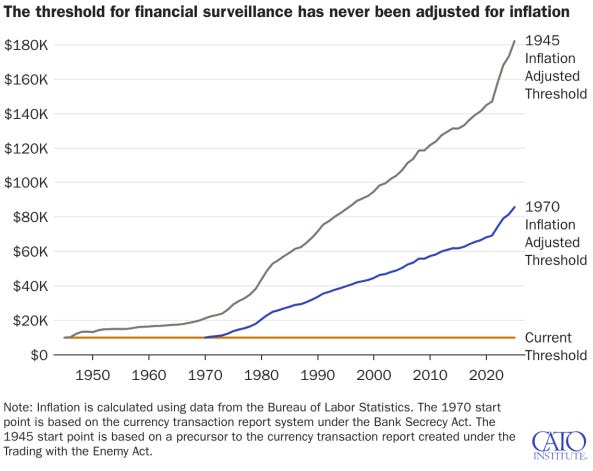
When the law was passed, $10,000 represented an unusually large transaction- the equivalent of $86,000 today. Today it captures activity much closer to the center of ordinary economic life. The statute did not expand, but inflation did the work for it. Over time, routine behavior fell inside a system designed for something else.
That shift shows up clearly in the data. In 2024, financial institutions filed roughly 27.5 million reports under the Bank Secrecy Act. These filings are often assumed to reflect serious criminal suspicion. In practice, most are triggered by transactions near the reporting threshold or by patterns that resemble an attempt to avoid it. Proximity to a number, rather than evidence of wrongdoing, drove approximately 22 million of those reports.
In my latest episode, Nick Anthony of the Cato Institute walked through what happens after those reports are filed. For years, the government could not say how often this information actually initiated investigations. Limited disclosures now offer a partial answer. In 2024, only 13 percent of IRS criminal investigations were tipped off by Bank Secrecy Act reports. In absolute terms, that comes to roughly 370 investigations tied to 27.5 million filings.
What the data does not show is just as revealing. There is no public accounting of how many arrests or convictions resulted from those investigations. Volume is tracked. Outcomes are not. What is clear is that most reports do not begin cases. Instead, law enforcement typically pursues an investigation through other means and consults the financial database after the fact.
Anthony described this sequence plainly during the interview. Financial data, he said, is useful “after an investigation starts,” not as a substitute for suspicion. “We already have a system for that,” he added. “It’s called the Fourth Amendment.” Under that framework, investigators make their case to a judge, obtain a warrant, and then examine bank records to confirm or reject their hypothesis.
The difference today is timing. The records already exist, collected in advance and stored indefinitely. Surveillance precedes suspicion. That inversion changes how the system functions, even before any enforcement action occurs.
Cost reinforces the shift. In 2024, U.S. financial institutions spent an estimated $59 billion complying with Bank Secrecy Act requirements. Those resources are devoted to monitoring, filing, and documenting activity that rarely initiates investigations. The burden does not fall evenly, and it does not disappear when reporting yields little.
Banks respond to those incentives predictably. Severe penalties attach to failures of compliance. Faced with that risk, institutions err toward caution. Accounts are closed. New customers are declined. Explanations are rarely provided, not by choice but by law. Confidentiality rules prevent banks from saying whether a report was filed or why a relationship ended.
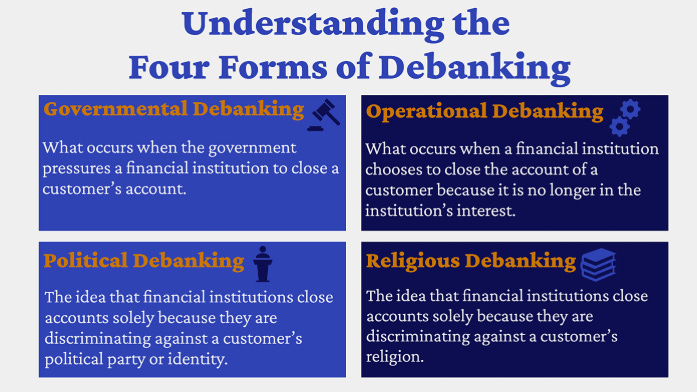
The result is a steady rise in debanking complaints, particularly among small businesses and lower balance customers. Compliance costs do not scale down with account size. Monitoring a $50 account is not meaningfully cheaper than monitoring a $50,000 one. Over time, access narrows.
This backdrop helps explain why debates around central bank digital currencies have grown more uneasy. Across jurisdictions, CBDCs have struggled to attract voluntary use. Where adoption occurs, it often follows incentives or mandates. Europe is pressing ahead with a digital euro that would be integrated directly into existing payment systems. Merchants and payment providers would be required to participate.
A clip from our interview.
Anthony’s concern was not technological. Digital payment rails already exist. The question is institutional. When new systems are built without clear consumer demand, pressure tends to replace choice. Limits are proposed to manage risk. Mandates follow to ensure usage. The pattern is familiar.
Anthony’s research quantifies how far the balance between national security and financial privacy has shifted. Tens of millions of reports now yield only a few hundred investigations. That gap is not widely understood. It should be. A system this far out of balance persists only when it remains obscure, and it will not correct itself without public pressure and a congressional response.
Read a Cato Institute full report by Nick Anthony HERE:
Full interview:
Thank you very much to our sponsors:
Truflation: BUY Truflation products/services and save 10% using code BOBDEW10. Learn about what prices are actually doing by going to https://truflation.com/marketplace/us-inflation-rate
Foundation: Protect your Bitcoin using the latest off-line technology with easy-to-use Passport. Their next product, Passport Prime will protect all passwords off-line with even-better technology. https://foundation.xyz/
River Financial: If not cold storage for your Bitcoin, I’d highly recommend River for buying and holding- River is engineered to protect your Bitcoin over the long run. Use this link for discounts: https://river.com/signup?r=T7GGAF7G
Thank you for having me on the show!