
As the Trump Administration pushes to reform and reduce the federal workforce, critics are missing a more fundamental question: What are the true economic costs of our sprawling government apparatus? The answer isn't just in budget ledgers but in how government spending—particularly when it acts as a customer—systematically distorts market incentives, redirecting America's talent from innovation to bureaucratic navigation.
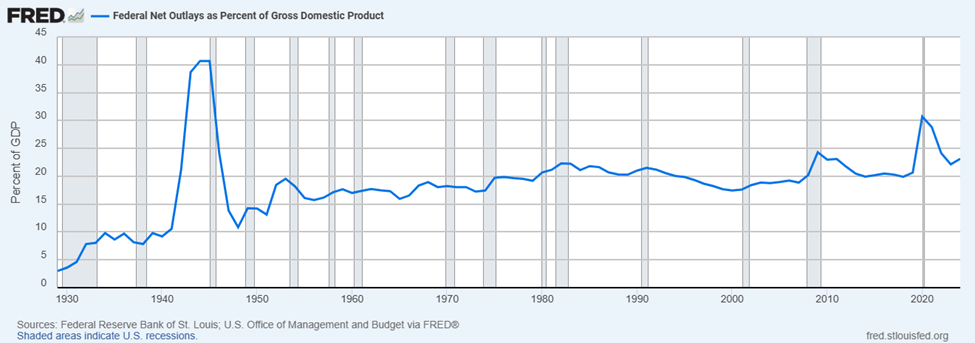
Since 1929, federal spending has ballooned from 3.0% to 23.1% of GDP, with total government spending—federal, state, and local—now consuming 34.5% of our economic output. But this headline figure masks a critical split.
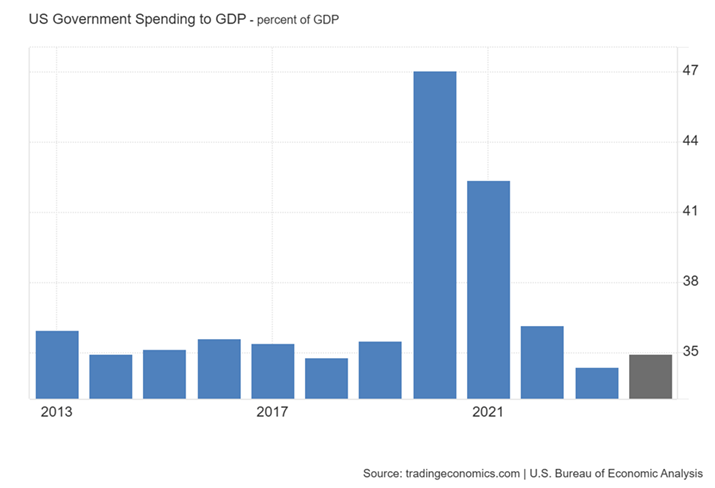
Chart: Total government spending including state and local as % of the US GDP.
In 2025, roughly $2.5 trillion of that total, or 11% of GDP, reflects direct government purchases of goods and services—defense contracts, highway construction, tech procurement. This is the government as customer, spending across federal ($1.9 trillion) and state/local ($600-$700 billion) levels. The remainder—over 20% of GDP—comprises transfers like Social Security or welfare payments.
It's the customer role that most directly warps business incentives, though transfers pose their own challenges to economic vitality.
The growth of government spending hasn't been linear but has surged at key turning points: the New Deal of the 1930s, the Great Society of the 1960s, and the post-2008 crisis interventions. Each wave began as crisis response but hardened into permanent expansions, pulling more industries into government's orbit. Each past expansion has created vested interests—firms hooked on government contracts—that resist meaningful reform.
When government buys directly, companies reorient from serving customers to pleasing bureaucrats. A typical business wins consumers with better products or prices; a government contractor thrives by mastering compliance, currying political favor, and meeting policy whims.
This shift is starkest in defense, where billions in annual federal spending shapes firms to prioritize procurement specs over cost efficiency. In healthcare, hospitals chase Medicare rules over patient needs; in education, universities balloon administrative staff to tap federal research grants and student loans. Even in technology, once a bastion of market ingenuity, companies now divert engineers to regulatory navigation and billion-dollar government cloud deals.
For firms juggling both markets and government contracts, the organizational tension is divisive. Winning government work demands documentation, compliance teams, and political networking—skills that sap resources from customer-focused breakthroughs. A company often splits into two cultures: one chasing market value, the other government favor, with the latter typically draining efficiency as resources tilt toward securing contracts over creating value.
The workforce feels this pull too. As government's $2.5 trillion customer footprint grows, talent flows toward mastering political systems over market value creation. This breeds a conflict: officials eyeing private-sector gigs may prioritize contractor-friendly decisions over taxpayer interests. The complexity of these bureaucratic systems might even hide opportunities for enrichment through fraud that are far more difficult in transparent, competitive markets.
While economists warn of short-term disruption and even recession from cuts in government spending, they ignore the long-term gain: a private sector renewed as talent shifts from bureaucratic navigation to market dynamism. The stakes transcend efficiency. Every generation lured into optimizing for government contracts—federal or local—over market innovation dims the productivity that built American prosperity.
The $2.5 trillion government spends as a customer isn't just a cost; it's a signal, bending our economy toward political favor over the relentless creativity of free markets. Future crises—economic, security, or environmental—are inevitable. The question is whether there will be limits to government expansion or if free market decision-making will continue to erode with each new crisis.
We must recognize that the true cost of government spending goes far beyond the budget. It's measured in the innovations never created, the businesses never started, and the prosperity never achieved when America's best minds focus on mastering bureaucracy instead of creating value in the marketplace.
Thank you to our sponsors:
Truflation: Learn about what prices are actually doing by going to https://truflation.com/marketplace/us-inflation-rate
Foundation: Protect your Bitcoin using the latest off-line technology with easy-to-use Passport. Their next product, Passport Prime will protect all passwords off-line with even-better technology. https://foundation.xyz/
River Financial: If not cold storage for your Bitcoin, I’d highly recommend River for buying and holding- River is engineered to protect your Bitcoin over the long run. Use this link for discounts: https://river.com/signup?r=T7GGAF7G