
“AI will solve math.” Dr. Alex Wissner-Gross, a computer scientist and frequent guest on Peter Diamandis’s (Metatrends) technology podcast Moonshots, has made that prediction repeatedly. Given the speed of recent advances, it no longer sounds far-fetched.
But what would it actually mean for AI to “solve math”?
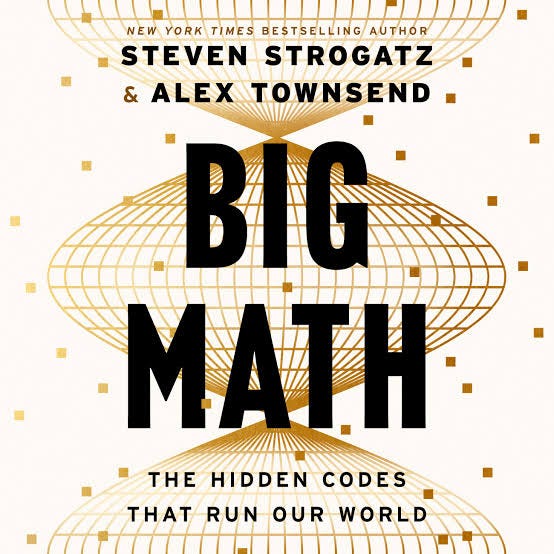
That was the question I wanted to put to Steve Strogatz, the Cornell mathematician, bestselling author and host of the popular mathematics podcast The Joy of Why. His new book, Big Math: The Hidden Codes That Run Our World, coauthored with Alex Townsend, makes sophisticated mathematics accessible to general readers, revealing how deeply it underpins modern life. AI is now extending the reach of mathematics while raising fundamental questions about how these increasingly capable machines work, whether they will ever think like humans, and whether they even need to.
AI can already solve mathematical problems that would challenge highly accomplished humans. But is it displaying mathematical ingenuity? Is it discovering new ways of thinking? And as machines become capable of solving more problems on their own, what will determine whether those problems are worth solving?
“Problem-solving is a narrow part of the whole endeavor of math,” Strogatz told me. To explain, he told a story about a mathematician and a very hard nut.
Solving Problems Versus Building Theories
Strogatz described two approaches to mathematics: solving problems and building theories. AI has made remarkable progress at the first. But developing new mathematical theories is a different challenge. A powerful theory can make a seemingly impossible problem relatively easy.
He illustrated the distinction with an analogy from Alexander Grothendieck, one of the greatest mathematicians of the twentieth century. Imagine trying to crack a very hard nut. One approach is to attack it with a hammer and chisel. Another is to place it in warm water until the shell softens enough to open. For Grothendieck, the hammer and chisel represented attacking a problem directly. The warm water represented developing a new theory that makes the problem easier to solve.
Of Wissner-Gross’s prediction, Strogatz said, “When he says that AI will solve math, maybe yes, in the chisel sense, but so far it has shown no aptitude for building theory.” He believes AI could eventually invent new mathematical concepts, but was careful about what we can conclude today. “If I were placing a bet, I would say yes, but we don’t know.”
Even the distinction between brute force computation and genuine ingenuity is difficult to establish. Strogatz questioned whether we understand human creativity well enough to make that judgment. Human mathematicians also combine existing ideas in novel ways. If a machine discovers an unexpected connection between two areas of mathematics, how different is that from what a creative mathematician does?
The Importance of Asking Good Questions
Solving a problem is one thing. Recognizing which problems are worth solving is another. “In addition to problem-solving, there’s inventing the questions,” Strogatz explained. “What’s a good thing to think about?” That requires “taste, judgment, curiosity.” He offered an example from his own teaching. AI can solve the problems on his Cornell mathematics exams and explain the answers clearly. But when he asks it to devise good questions for those same exams, he finds its performance “barely competent.”
Entrepreneurs routinely discover that an ingenious product can fail because customers never considered the underlying problem worth solving. On its own, AI could become remarkably good at identifying and solving problems that nobody cares about. Human guidance provides a purpose toward which the machine’s capabilities can be directed.
Of course, humans are not especially reliable judges of which discoveries will ultimately prove valuable. Much of pure mathematics was developed without any expectation of practical application. Number theory, long pursued for its intellectual beauty, eventually became essential to modern cryptography. Mathematicians were not necessarily looking for useful applications. They were pursuing questions they considered beautiful, deep or worth understanding. Their taste gave the work a purpose, even when its practical value was unknown.
Curiosity helps explain how progress builds upon itself. Strogatz pointed to young children, who begin asking why almost as soon as they can speak. Questions lead to discoveries, which create new questions and open paths of investigation that were previously unimaginable. As Strogatz put it, “Our curiosity led to math, math led to enormous power.” Mathematics helped make possible technologies ranging from wireless communications and lasers to medical imaging and space exploration. The pursuit of understanding has repeatedly given humanity capabilities that earlier generations could scarcely have imagined.
When Answers Come Without Understanding
For centuries, mathematics has provided a way to understand why things work, not merely to predict what will happen. AI is challenging that tradition. Increasingly, machines can produce valuable answers without revealing the reasoning behind them. Strogatz illustrated the implications with a story from Big Math about Regina Barzilay, an MIT computer scientist who was diagnosed with breast cancer at age 43 despite earlier mammograms that had not identified the danger.
Barzilay subsequently worked with radiologists to develop Mirai, an AI system that analyzes mammograms to predict a woman’s risk of developing breast cancer over the next five years. The system demonstrated an ability to identify risks that conventional methods could miss. But when Strogatz asked Barzilay what the machine was seeing in the images, she acknowledged that she didn’t know. It had discovered patterns that researchers could not yet explain. Strogatz pressed her on whether that lack of understanding was troubling. Her response was striking: “Why would we limit the model to what humans can understand?”
Strogatz found her response “haunting.” The question challenges an assumption that has guided scientific inquiry for centuries. We generally want explanations that reveal underlying principles, allowing us to apply what we learn to other problems. But if an AI system can identify a dangerous disease earlier than physicians can, should its inability to explain itself prevent us from using it? We may not need to understand how a machine arrives at an answer to benefit from it. We do, however, need evidence that the answer is reliable and a way to connect it to a useful outcome.
From Adding Machine to Oracle
Strogatz offered a useful way to understand how dramatically our relationship with computers has changed. They began as glorified adding machines, performing calculations that humans understood but could not carry out nearly as quickly. Later, computers became what he called “a kind of scout you could send out on missions,” exploring mathematical territory too vast or complicated for people to investigate themselves. The machines could return with discoveries that mathematicians would then examine and try to understand.
Now, Strogatz argues, computers are becoming something closer to an oracle, capable of telling us things that appear to be true without explaining why. An adding machine executes instructions. A scout explores territory we have chosen. An oracle offers answers that may exceed our ability to explain them. AI is expanding the range of questions we can investigate, sometimes beyond the limits of human understanding.
This creates opportunities for scientific discovery, but also raises questions about reliability and control. As Strogatz observed, the fact that these machines are not fundamentally understood is “part of what makes them wonderful, but part of what makes them scary.”
Their growing capabilities could produce an enormous amount of intellectual output without a corresponding increase in human prosperity. An AI system might identify thousands of previously unknown mathematical problems and solve them all, yet accomplish nothing that people find useful or intellectually worthwhile. The machine could be highly successful at mathematics while making no contribution to human welfare. The missing ingredient would not be computational power or ingenuity, but a reason to direct those capabilities toward purposes humans care about, whether practical or intellectual.
Will Machines Ever Think Like Us?
That raises a question about the future of AI. Humans currently supply much of the curiosity and judgment that direct these machines. But is that a permanent characteristic of human intelligence, or simply a limitation of today’s technology?
When I asked Strogatz whether machines could eventually develop curiosity, he resisted drawing a firm conclusion. “I don’t know. That’s really a deep one.” He described early research into whether AI systems might exhibit functional equivalents of certain human internal states. He was careful not to equate such findings with evidence of consciousness or subjective experience. But he was open to the possibility that machines could acquire capabilities resembling curiosity. “I wouldn’t be shocked if curiosity emerges,” he said, while acknowledging that this has not been demonstrated.
The distinction between behaving curiously and experiencing curiosity is important. A machine might independently identify gaps in scientific knowledge, formulate promising hypotheses and design experiments without experiencing anything resembling human wonder. It might also learn to assess which questions are likely to produce useful discoveries. If it can do those things successfully, does its internal experience matter? Barzilay’s question applies here as well. Why should humanlike thought be a prerequisite for valuable discovery?
Strogatz offered no prediction about whether current AI architectures will prove sufficient or whether fundamentally different technologies will be required. Machines have already demonstrated capabilities that once seemed beyond their reach. But there is a difference between recognizing what AI might eventually accomplish and assuming that it already possesses those capabilities.
The Human and Machine Partnership
Near the end of our conversation, I asked Strogatz whether human-directed AI was likely to produce more mathematical discoveries than AI operating independently. He thought so. “Because right now we’re an essential partner,” he said. “We’re the guide. We’re still holding the reins about where to point it.”
AI can explore possibilities, identify patterns and solve problems at a scale no individual could match. It can carry out much of that work autonomously once given an objective. But the ability to solve problems does not give a machine a reason to solve problems that benefit humanity. Today, humans provide that direction.
Perhaps Alex Wissner-Gross is right that AI will solve math. It may eventually develop the curiosity to identify important problems on its own, too. Strogatz would not rule that out. But AI need not think like humans to transform what humans can accomplish. Its greatest contribution may come from doing things we cannot do, and sometimes cannot even understand.
For now, we have access to a remarkable new source of intellectual power. Whether it translates into greater prosperity depends on where we choose to direct it.
Pre-order Big Math: The Hidden Codes That Run Our World HERE::
See the full interview here:
Thank you very much to our sponsors:
Foundation.xyz: When it comes to protecting your Bitcoin, you shouldn’t have to simply trust the company that made your hardware wallet.
Foundation believes in verifiability over reputation. Its firmware and apps are open source, its builds are reproducible, and both Passport Core and Passport Prime have undergone independent hardware security audits. The point isn’t simply that Foundation says its products are secure. It’s that you can verify that for yourself.
Foundation is also expanding what users can control:
Passport Prime goes beyond Bitcoin. It can manage passwords and two-factor authentication codes, serve as a FIDO2 security key, and provide encrypted storage—all on a device you own and control. Foundation also plans to enable app sideloading, opening Prime to applications from independent developers.
Users can now add their own entropy. The latest Envoy and KeyOS releases allow users to introduce their own randomness when creating a seed, reducing reliance on the device itself to generate it.
Order a new Passport Prime and receive a free bumper case using Code PROSPERITY at → foundation.xyz
River Financial: If not cold storage for your Bitcoin, I’d highly recommend River for buying and holding- River is engineered to protect your Bitcoin over the long run. Use this link for discounts: https://river.com/signup?r=T7GGAF7G
Bob, this is my favorite of your pieces so far. It was clear concise and as usual, you ask pertinent, probing questions.
Many things puzzle me that I don’t really care about doing a deep dive into.
AI is different. It puzzles me and I do care. Deep dive away!
Thx