
We often treat the future of technology and the future of finance as separate conversations. Silicon Valley speaks a language of exponential curves and abundance. Wall Street speaks a language of yield curves and scarcity. These two worlds rarely intersect in a meaningful way.
My recent interview with Jordi Visser bridges this divide. Visser serves as a rare translator who is fluent in the optimism of futurists like Elon Musk and Marc Andreesen as well as the harsh realities of the bond market. He views them as two trains hurtling toward a singular collision point.
Visser articulates a framework that very few macro thinkers accept. He argues that the artificial intelligence revolution is not just a productivity story, its a monetary event.
The Wall Street Blind Spot
Visser argues that Wall Street suffers from a fundamental “duration mismatch” with reality. Finance professionals are trained to model the world linearly, assuming that growth reverts to a mean. However, Visser aligns with many tech visionaries in viewing the current moment as the start of an exponential “elbow” in the curve.
He points out that Wall Street dismisses Musk’s forecasts regarding humanoids and abundance as promotional hype because they lack the framework to value them. Visser argues that by ignoring these signals, Wall Street is effectively “shorting the future.” They are betting that the world will look like 2019 for longer than it will, ignoring the evidence from both Musk and Andreesen last week who are “awestruck” by the weekly rate of change in AI outputs.
The Divorce of Labor from Capital
Visser points to a specific data point from last year that captures the break. The U.S. economy generated significant GDP growth of over 4% with zero labor growth. This anomaly points toward a permanent separation between capital and labor. AI competes directly with the one thing humans uniquely brought to the economy: cognition.
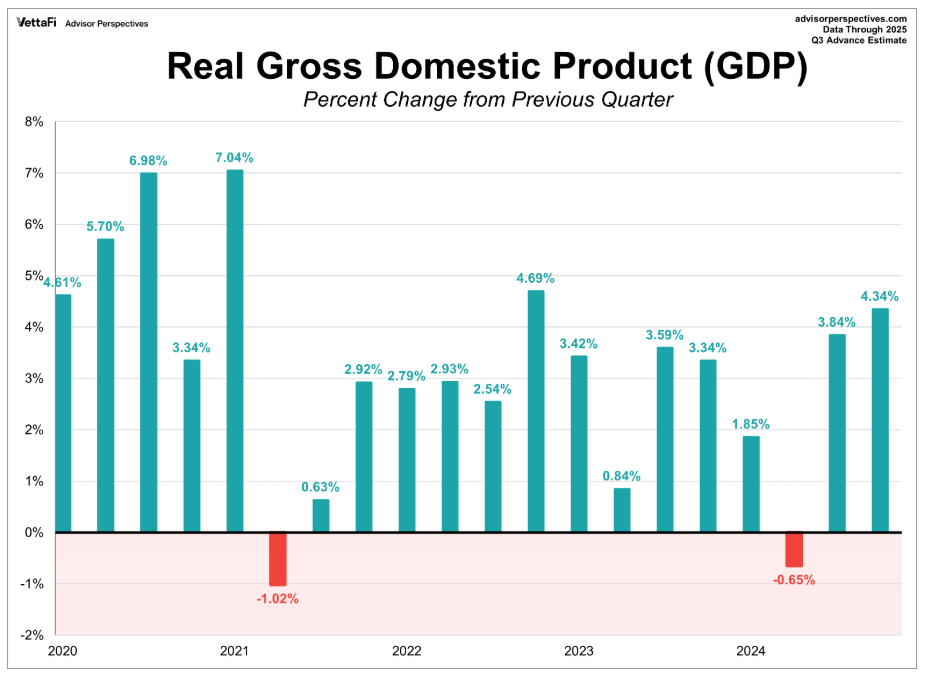
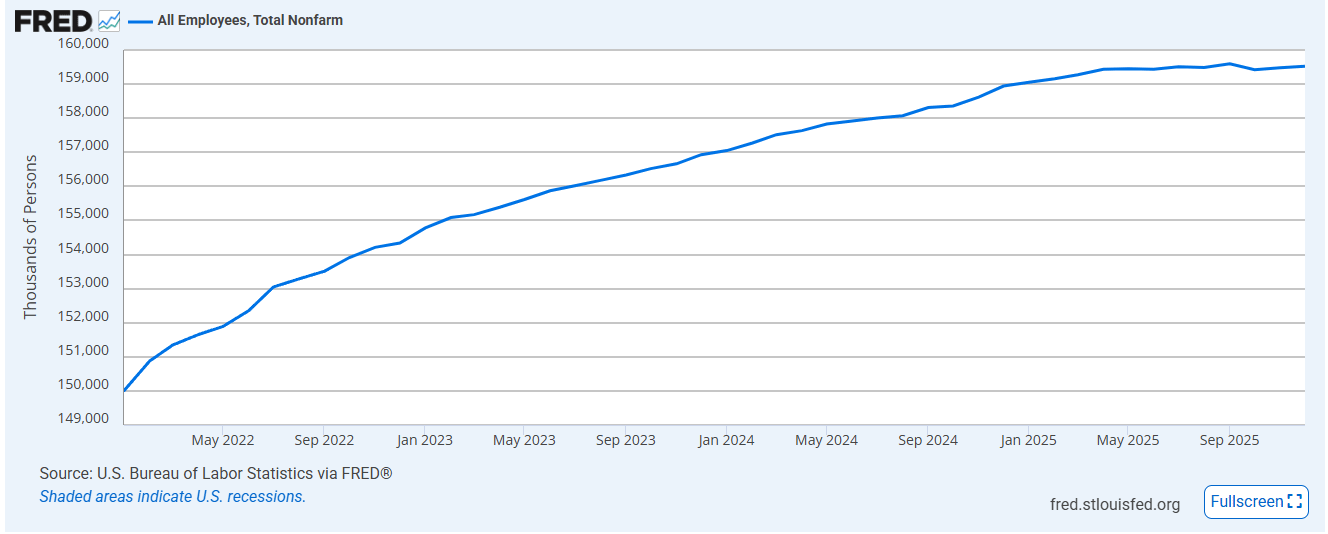
There was very little labor growth during 2025 while the economy acclerated.
In the past, business expansion required hiring. Visser argues we have entered an era where companies can scale revenue without increasing headcount. This dynamic creates a paradise for shareholders and a crisis for the workforce. The owners of capital capture the upside of efficiency while workers face a shrinking market for their time. This separation is what accelerates the collision Visser foresees. It drives corporate profits to record highs while simultaneously forcing the government to step in with liquidity to support the labor market.
AI Is the New Liquidity Mechanism
The most provocative insight from our discussion is the mechanism Visser describes regarding inflation and growth. He suggests that AI acts as a massive deflationary force that will collapse the cost of intelligence and production.
This deflation forces a reaction. The government must inject liquidity to bridge the gap between technological abundance and the survival needs of the displaced workforce. This dynamic functions effectively as a new form of Quantitative Easing. Visser explains that we could see high real GDP growth driven by efficiency alongside high nominal GDP growth driven by monetary expansion. The result is an environment where asset prices rise even as the structural integrity of the debt system weakens.
Solving the Healthcare Trap
We cannot discuss the debt super cycle without addressing its primary driver: healthcare costs. Visser argues that AI provides a key mathematical path to solvency.
The savings will not come merely from administrative efficiency. They will come from biological and diagnosis breakthroughs. Visser notes that machine learning has already accelerated drug discovery for a decade and led to the GLP-1 revolution. He predicts that AI will soon allow us to detect cancer on day one and effectively eliminate chronic conditions like obesity. Since the vast majority of government healthcare spending occurs during the final months of life, Visser implies that if AI allows citizens to "die healthy," the structural pressure on the state evaporates.
The Education Reset
The education system faces a different kind of reckoning. Visser argues that the value of a traditional degree has effectively fallen to zero because universities actively discourage the use of the most powerful tool available.
He contends that the barrier to reform is not technological. It is the ego of the "sage on the stage" who fears becoming obsolete. Schools continue to prioritize memorization in an era where knowledge is free. Visser envisions a future where AI acts as an individualized tutor that shifts the curriculum from finding answers to asking better questions. He believes the current model is preparing students for a world that no longer exists.
The Death of the Competitive Moat
The defining change is speed. Artificial intelligence compresses the time between idea, execution, and competition. Businesses still innovate, but rivals arrive sooner, often before advantages can harden into durable defenses. Visser also attacks a sacred concept in value investing. He argues that the idea of a “competitive moat” is obsolete in an AI world.
Traditional capitalism rewards incumbents who build defenses around their business models. Visser asserts that when knowledge becomes free and coding becomes immediate, these defenses evaporate. A competitor can replicate a business model instantly in this new world. This creates a paradox where corporate profits may explode due to efficiency, yet the durability of those profits becomes fragile. He believes US stocks may underperform global markets simply because their valuations rely on moats that will no longer exist.
Bitcoin as the Purest AI Trade
This framework leads to a stark conclusion regarding capital allocation. Visser views Bitcoin as the asset that sits at the intersection of the Debt Super Cycle and the AI Deflationary Boom.
He describes Bitcoin as “the most mispriced trade” he has ever seen. If AI drives the marginal cost of production to zero and the government debases the currency to manage the transition, Bitcoin becomes the logical offset. It is the only asset that mathematically resists the liquidity flood required to sustain the AI transition. Visser positions it not as a speculative token but as the necessary hedge against the collision he foresees.
The Unanswered Question
I pressed Visser on the specific timing of this climax. His answers revealed the tension inherent in his thesis. He is certain about the destination but the path remains opaque. We are entering a period where the rules of capitalism are being rewritten in real time.
Visser offers a map for this new territory. He accepts that the debt spiral and the abundance curve are now the same chart. Understanding that relationship is the only way to navigate what comes next.
Full interview above.
Thank you very much to our sponsors:
Truflation: BUY Truflation products/services and save 10% using code BOBDEW10. Learn about what prices are actually doing by going to https://truflation.com/marketplace/us-inflation-rate
Foundation: Protect your Bitcoin using the latest off-line technology with easy-to-use Passport. Their next product, Passport Prime will protect all passwords off-line with even-better technology. https://foundation.xyz/
River Financial: If not cold storage for your Bitcoin, I’d highly recommend River for buying and holding- River is engineered to protect your Bitcoin over the long run. Use this link for discounts: https://river.com/signup?r=T7GGAF7G