
This week, two seemingly unrelated things intersected.
A friend mentioned that his son decided he never wants to have children because he doesn’t want to bring them into a world like ours.
Derek Thompson’s Substack arrived with the subject line, “A Philosopher’s One-Word Theory to Explain Why the World Feels So Weird.” It linked to his podcast conversation with University of Chicago philosopher Agnes Callard, who is developing an idea she calls the “Unicontext.”
Thompson introduced the discussion by describing it as “a theory of everything that explains why people feel like everything sucks these days.”
That’s an ambitious description. The conversation lived up to it.
Callard’s central idea is the Unicontext. For most of human history, people lived in many different contexts. Home had its own norms. School had its own. Church, work, the neighborhood, and countless other communities all carried different expectations about how people should behave. Today, technology has increasingly merged those separate worlds into one enormous shared context. Much of modern life now takes place in a single global room where millions of people, ideas, tragedies, successes, arguments, and opinions compete for attention simultaneously.
The power of the idea lies in the range of questions it attempts to explain.
Why Bad News Travels Better Than Good News
Callard argues that goodness is often local while suffering is universal. One culture’s idea of a wonderful meal, a meaningful tradition, or a successful life may not translate easily to another. Violence, illness, grief, injustice, and death require no translation. In a global conversation, suffering becomes the language everyone understands. That helps explain why negative stories spread so easily and why they so often dominate public attention.
Why Identity Crowds Out Character
Character can only be revealed over time. Honesty, courage, generosity, and integrity become visible only after interacting with or knowing someone across many situations. Identity is immediately visible. In a world increasingly filled with strangers interacting across a single shared context, identity naturally becomes easier to discuss than character.
Why Comparison Never Ends
The Unicontext also helps explain why comparison has become so pervasive. When separate contexts merge, comparison becomes almost unavoidable. Callard illustrates this with the example of two school districts. As long as families attended their local schools, there was little reason to compare them. Once both schools become realistic options, everything starts to be measured: graduation rates, AP courses, college admissions, teacher quality, test scores. Rankings become increasingly important. Institutions begin optimizing for the same metrics, and over time they become more alike. The same dynamic extends well beyond education, encouraging businesses, careers, communities, and even people to converge toward whatever the world has decided to measure.
A Question Worth Exploring
One question remained after the conversation ended. If the Unicontext helps explain why humanity’s problems have become universally visible, does it also make humanity’s progress more difficult to recognize?
Progress usually arrives gradually. Tragedy is concentrated. It demands attention.
Perhaps the same framework also helps explain why genuine heroes seem harder to find. Progress is hard to see, and so, it seems, are the people driving it. There is no shortage of remarkable people accomplishing extraordinary things today, yet admiration often struggles to compete with comparison.
Back to My Friend’s Son
He isn’t wrong about what he sees. The suffering that reaches him is real. But the world he is judging isn’t the whole world. It is the Unicontext’s version of it, one that naturally amplifies the experiences every human being immediately understands: violence, injustice, illness, and death.
Progress spreads differently. It arrives quietly through millions of small advances and billions of everyday problems being solved: diseases eradicated, children surviving illnesses that once claimed countless lives, technologies that quietly improve everyday life, and acts of kindness that rarely extend beyond a family or neighborhood. Those stories simply don’t compete very well inside a global conversation where comparison and tragedy command our attention. That doesn’t mean the good isn’t there. It may simply mean it has become much harder to see.
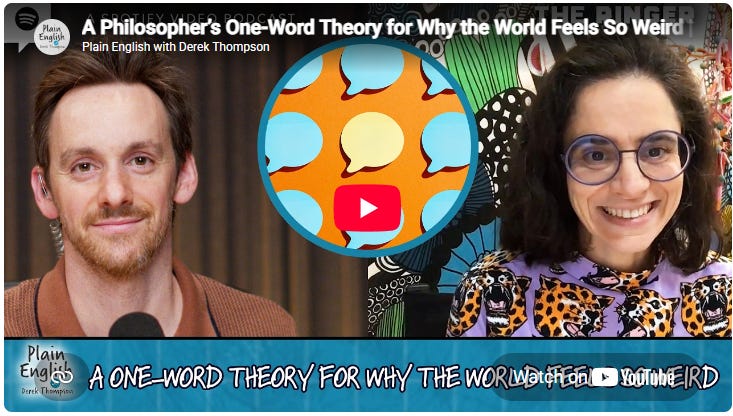
Professor Callard’s theory offers a fascinating way to think about the modern world, and it raises questions that extend well beyond the conversation itself. For anyone interested in why modern life often feels so different from the world our parents experienced, Derek Thompson’s conversation with Agnes Callard is well worth an hour of your time.
Thank you very much to our sponsors:
Foundation: Secure your digital life—from passwords, 2FA, files and Bitcoin with Passport Prime, an all-in-one personal security platform. Visit them at https://foundation.xyz/
River Financial: If not cold storage for your Bitcoin, I’d highly recommend River for buying and holding- River is engineered to protect your Bitcoin over the long run. Use this link for discounts: https://river.com/signup?r=T7GGAF7G
According to the Happy Lives Institute, happiness is highly correlated with GDP, with everyone's favorite outliers being the Nordic countries. Maybe happiness is inversely correlated with temperature? On a global population-weighted basis, happiness has been recovering sharply in the last according to self-reported data, especially in Europe and Latin America, although the trend has been down in N. America, especially among youth (consistent with your friend's son). Possibly this is Haidt's theory about the deleterious effects of social media on young people. Not surprisingly, low levels of happiness are associated with countries experiencing civil war. Is professor Callard's theory based on this or other data, or does it reflect her own take on the world?