
Inflation today is not behaving the way headlines suggest. Rather than re-accelerating or slipping out of control, price pressures have eased at the margin, volatility has declined, and many of the forces that were expected to push inflation higher simply failed to materialize. That assessment comes from Truflation CEO Stefan Rust, whose company has the most granular view of actual price changes in the world.
A weaker dollar should have complicated that picture. The dollar index DXY fell 10 percent last year, a move that would normally raise import costs and feed inflation. Exports strengthened as U.S. goods became more competitive, while tariff policy was applied selectively rather than broadly. Critical inputs were largely spared until domestic capacity could adjust. What looked disorderly in headlines functioned, in practice, as a managed adjustment.
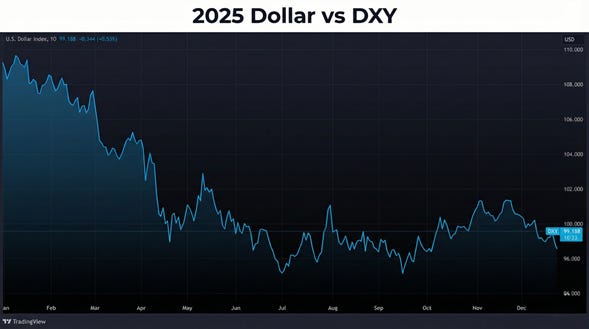
The U.S. Dollar Index (DXY) measures the dollar’s value against a basket of major foreign currencies.
That context matters for understanding tariffs. They dominated inflation commentary last year, with a prevailing assumption that higher tariffs would flow directly into consumer prices. What occurred was “the opposite,” Rust said. Much of the tariff burden was absorbed upstream, pushed back onto foreign suppliers rather than passed through to U.S. consumers. At the same time, energy prices fell sharply and food prices stabilized. The decline in oil alone offset what little inflationary pressure tariffs might have created, leaving little trace at the consumer level.
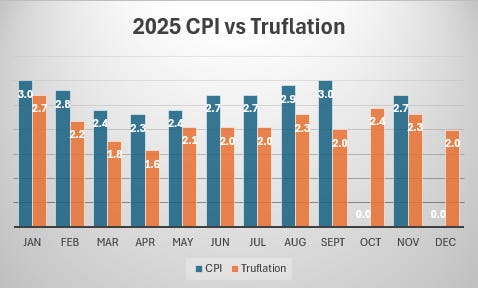
The Truflation US CPI Index is a real-time, independent alternative to the official U.S. Consumer Price Index, calculated daily using millions of data points from diverse sources to provide a more timely and comprehensive measure of inflation across 12 household spending categories.
This is where Truflation becomes especially useful. Traditional CPI methodologies smooth price changes over time, rely on surveys and modeled consumption baskets, and are frequently revised. Truflation instead tracks tens of millions of real-time price points, most updated daily, based on how people actually spend. Its index moves faster because prices move faster, even when that speed clashes with the public’s expectations of what inflation is supposed to look like. Short-term volatility is not noise; it is information arriving without delay.
Importantly, this approach is not confined to the United States. Truflation’s international coverage shows how inflation shapes societies differently depending on duration and institutional response. In Argentina, where inflation once spiraled uncontrollably, Rust describes an unprecedented turnaround, with Truflation working directly with local data to reflect domestic spending patterns during reform. Measurement there is not commentary; it is part of the economic infrastructure.
The same methodology now extends to labor markets. After the Bureau of Labor Statistics (BLS) revised prior employment figures by nearly a million jobs, Truflation launched its own employment index. Using a blend of official inputs, payroll providers, and alternative datasets, the index shows fewer jobs than headline BLS reports but more than ADP. The divergence stems from areas legacy surveys struggle to capture like self-employment, nonprofit work, and the modern gig economy.
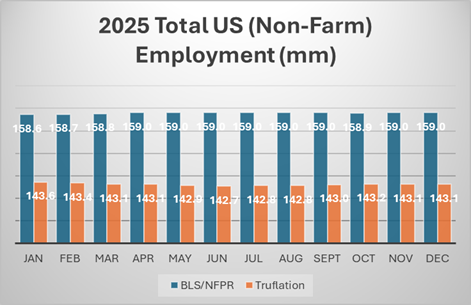
Note: The BLS released combined/delayed data for October and November in mid-December 2025, but the standard monthly release for October was skipped; also, the November/December data is “preliminary.”
Taken together, Truflation’s pricing and labor data point to the same conclusion: the core challenge is not a lack of statistics, but a growing mismatch between how economic conditions are measured and how they are experienced. By applying a consistent, real-time methodology across prices and employment, Truflation narrows that gap—not by simplifying reality, but by exposing it more clearly. That same innovation in data collection is now being matched by innovation in product development, as Truflation builds tools that allow users not just to observe more accurate inflation data, but to respond to it.
That clarity can feel uncomfortable. Making inflation more visible can initially make public understanding feel messier rather than cleaner, as discrepancies between official narratives and lived experience become harder to ignore. But that tension is not a failure of measurement. It is the cost of precision. Inflation has long served as a proxy for currency integrity, and smoothing it made systems appear stable even as trust quietly eroded. Truflation’s contribution is not reassurance. It is honesty—and the tools to act on it.
Thank you very much to our sponsors:
Truflation: Truflation: BUY Truflation products/services and save 10% using code BOBDEW10. Learn about what prices are actually doing by going to https://truflation.com/marketplace/us-inflation-rate
Foundation: Protect your Bitcoin using the latest off-line technology with easy-to-use Passport. Their next product, Passport Prime will protect all passwords off-line with even-better technology. https://foundation.xyz/
River Financial: If not cold storage for your Bitcoin, I’d highly recommend River for buying and holding- River is engineered to protect your Bitcoin over the long run. Use this link for discounts: https://river.com/signup?r=T7GGAF7G