Exploring Prosperity examines how technology, markets, money, and human ingenuity shape our future. Evidence, not cheerleading.
Research reference | Updated November 10, 2026
On September 15, 2026, I launched an AI research agent to identify and organize evidence about artificial intelligence’s effects on productivity and the economy.
The objective is to understand what AI is actually accomplishing, where it is succeeding or failing, and what those results might mean for economic prosperity.
The investigation covers the speed and quality of work, employment, entrepreneurship, business formation, firm size, product innovation, and the economic value created by better decisions.
I am particularly interested in whether AI enables individuals and small businesses to accomplish work previously requiring much larger organizations, and whether its benefits are captured by workers, businesses, technology providers, or consumers.
This page is intended to be an evolving reference for readers who want to examine the underlying evidence. (See full inventory of studies in Appendix below.)
The Research Collection
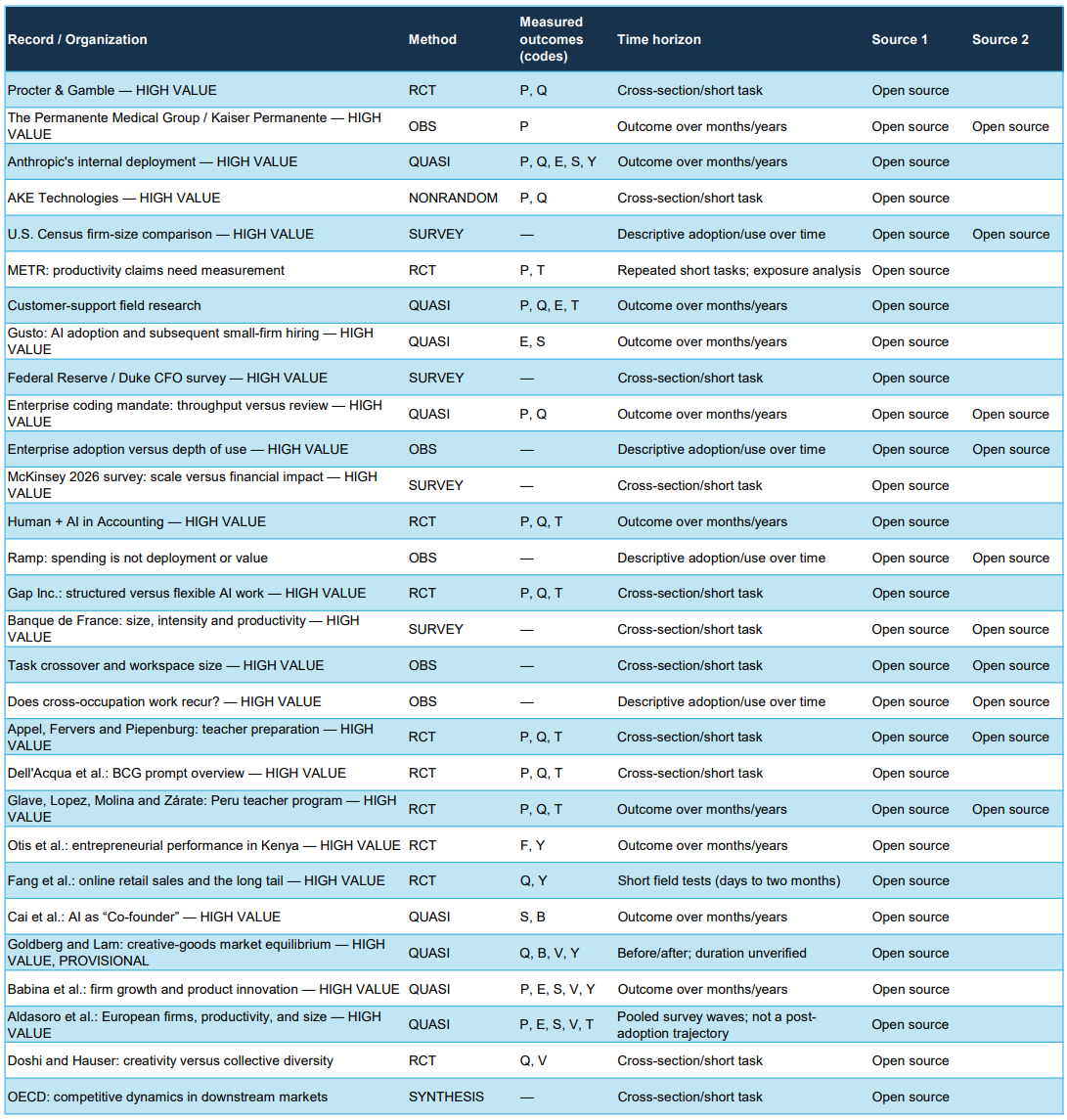
As of November 10, the inventory contains 82 records, divided into two groups:

The 29 analytical records include randomized experiments, quasi-experimental research, observational studies, surveys, and one research synthesis. Ten are journal articles, nine are working papers or preprints, six are corporate research reports, three are public-institution reports, and one has author-reported journal acceptance.
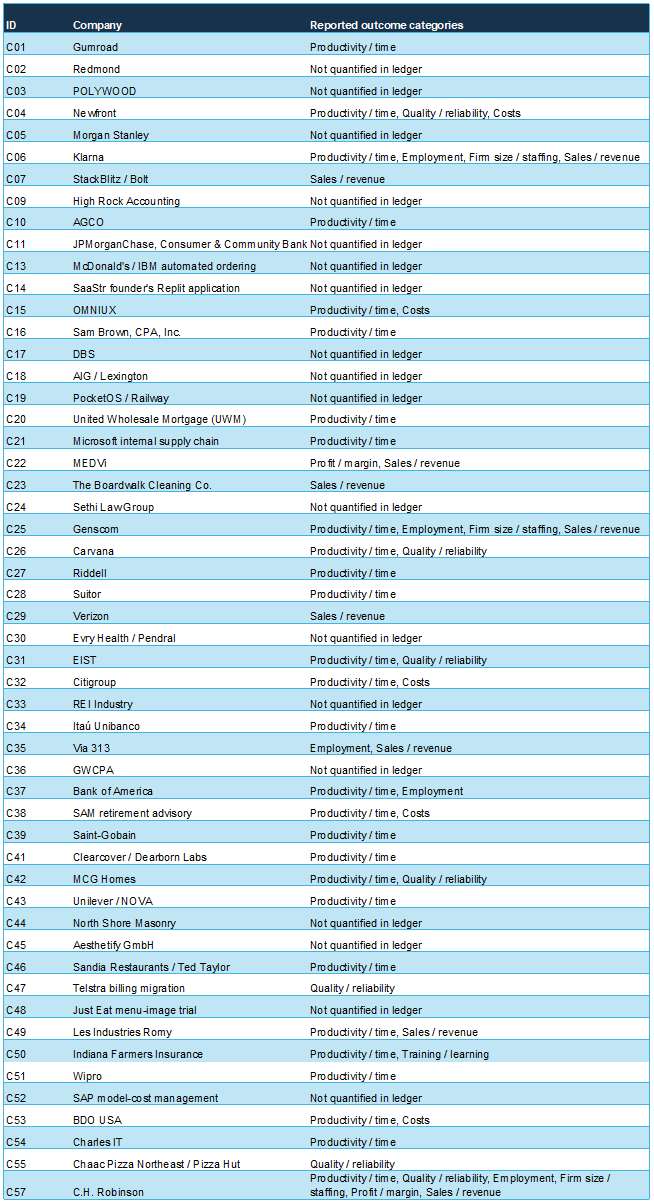
The 53 company accounts document reported implementations and outcomes, including changes in productivity, staffing, costs, revenues, and organizational practices.
These categories should not be treated as equivalent evidence. Randomized experiments can establish causal effects within their settings. Observational research may identify important relationships without establishing causation. Company accounts can illustrate how businesses are using AI, but often lack comparable control groups and complete cost information.
This is a curated research inventory, not a systematic review or a statistical meta-analysis. It includes studies published before the agent began monitoring the literature, as well as newer research.
Selected Research Findings
The following studies illustrate the range of findings and questions emerging from the collection. They are selected for their economic relevance, research design, and implications for understanding AI productivity.
1. Experienced software developers became slower with AI
METR (2025)
Researchers examined 16 experienced developers working on 246 real software issues in repositories they knew well. Access to AI increased completion time by 19%, even though developers believed it had made them approximately 20% faster. The experiment used early-2025 AI tools, and its results should not be assumed to apply to all developers or current systems.
Why it is important: People may misjudge AI’s effects on their own productivity.
2. Customer service productivity improved, especially for novices
Brynjolfsson, Li, and Raymond (2025), Quarterly Journal of Economics
A study of 5,172 customer service agents found that AI assistance increased resolutions per hour by approximately 15%. Less experienced and lower-skilled workers experienced substantially larger gains, around 30%. The study examined deployment at one employer, rather than a randomized rollout across the economy.
Why it is important: AI may help workers acquire or apply knowledge previously concentrated among more experienced colleagues.
3. AI access did not improve average business performance among Kenyan entrepreneurs
Otis et al. (2026), Management Science
Researchers randomly provided access to GPT-4 through WhatsApp to participants in a study involving 640 Kenyan entrepreneurs. There was no statistically significant improvement in average revenue or profit outcomes. Initially weaker businesses experienced worse outcomes, while initially stronger businesses showed suggestive improvements. The difference between these groups was statistically significant.
Why it is important: Access to powerful AI tools does not automatically translate into better business performance. Existing business capabilities may influence the results.
4. Accountants produced more accurate work without significantly reducing total time
Choi and Xie (2026), Journal of Accounting Research
In a randomized experiment involving 99 accountants classifying financial transactions, AI improved accuracy by 17.5 percentage points. Total completion time did not change significantly. The broader paper also includes observational evidence of faster accounting processes. These are distinct findings from different parts of the research.
Why it is important: Productivity improvements may appear in work quality rather than hours saved.
5. Consultants benefited from AI on some tasks and suffered on others
Dell’Acqua et al. (2026), Organization Science
In research involving Boston Consulting Group consultants, AI improved performance on tasks within its capabilities. On a task outside those capabilities, AI-assisted consultants completed work faster but were less likely to produce correct answers. The deterioration varied according to the experimental treatment.
Why it is important: The suitability of AI for a particular task can be more consequential than its general capabilities.
6. AI enabled individuals to perform work comparable to teams
Procter & Gamble research (2026), Organization Science
A randomized experiment involving hundreds of participants examined how AI affected product innovation work. Individuals using AI achieved proposal-quality results comparable to those of two-person teams working without AI. This was a bounded experiment within an established company, not evidence that an entire business could operate with fewer employees.
Why it is important: AI may change the amount of collaboration and organizational infrastructure required for some kinds of work.
7. AI helped less popular products find customers
Fang et al. (2026), working paper
A large randomized experiment involving approximately 1.85 million consumers examined AI-assisted product search. Sales of lower-volume products increased by 4.92%, while sales of higher-volume products showed a small decline. The experiment demonstrates improved matching within an existing platform, not the creation of new profitable businesses.
Why it is important: AI may make it easier to serve specialized demand, potentially expanding the economic opportunities available to niche products.
8. Some evidence suggests larger firms benefit more
Aldasoro et al. (2026), European Investment Bank/BIS working paper
Using European firm data, researchers estimated AI-related productivity effects across different business sizes. The strongest positive estimates appeared among larger firms. The results depend on the study’s identification assumptions and do not establish that large firms always benefit more.
Why it is important: AI may reduce the labor required for some activities while reinforcing advantages associated with scale, data, distribution, and organizational resources.
9. AI improved individual creativity while making outputs more similar
Doshi and Hauser (2024), Science Advances
In a randomized creative-writing experiment, access to AI-generated ideas improved some evaluations of creativity. However, AI-assisted stories also became more similar to one another.
Why it is important: Better individual outputs do not necessarily produce greater diversity across a market.
10. Business growth and productivity gains are not the same
Babina et al. (2024), Journal of Financial Economics
Research examining AI investment among U.S. public companies found associations with firm growth and product innovation, particularly among larger firms. Some reported estimates of labor productivity and total factor productivity were not statistically significant. The study primarily concerns AI investment before the recent generative AI boom.
Why it is important: Growing faster, producing more products, and operating more efficiently are different economic outcomes.
What the Evidence Is Beginning to Suggest
Several themes recur across the research.
Speed and quality must be measured separately. Faster completion can accompany more errors. Better results can also require the same amount of time.
The benefits of AI depend on the task and the user. Less experienced workers sometimes benefit most, while in other settings stronger businesses appear better positioned to use AI effectively.
AI may change how businesses are organized. Some work can be accomplished with smaller teams, but that does not necessarily mean smaller companies will enjoy a competitive advantage.
Better information may create economic value that conventional productivity measures struggle to capture. Improvements in accuracy, communication, judgment, and decision-making may not immediately appear as reductions in labor hours.
Company success stories require careful interpretation. Reported savings, revenue increases, and staffing changes may be genuine, but determining how much AI caused them requires additional evidence.
Questions the Research Has Not Yet Answered
The collection also exposes substantial gaps.
How much of AI’s economic value comes from faster work, and how much comes from better decisions?
Does AI reduce the minimum efficient size of a business, enabling more entrepreneurs to profitably serve specialized markets?
Will small businesses gain competitive ground, or will established companies benefit more from their data, distribution, capital, and existing customers?
How much training and experience do people need to use AI effectively, and can AI itself accelerate that learning?
Who ultimately captures the economic benefits: employees, entrepreneurs, established businesses, AI providers, or consumers?
And how long will it take for these changes to become visible in economic statistics?
These questions will guide future additions to the inventory.
How This Resource Will Be Maintained
I intend to update the collection as new research becomes available, with particular attention to studies that measure actual economic outcomes, distinguish correlation from causation, and examine effects over time.
The research agent helps identify, organize, and compare evidence. Its findings still require scrutiny. Sources, methodologies, definitions, and statistical claims can be misunderstood or misclassified, even when an AI-generated summary appears convincing.
Readers should consult the original papers, linked above, when evaluating specific findings.
Last research cutoff: November 10, 2026.
Exploring Prosperity examines the forces changing how wealth is created, measured, and shared.
Thank you very much to our sponsors:
Foundation: When it comes to protecting your Bitcoin, you shouldn’t have to simply trust the company that made your hardware wallet.
Foundation believes in verifiability over reputation. Its firmware and apps are open source, its builds are reproducible, and both Passport Core and Passport Prime have undergone independent hardware security audits. The point isn’t simply that Foundation says its products are secure. It’s that you can verify that for yourself.
Foundation is also expanding what users can control:
Passport Prime goes beyond Bitcoin. It can manage passwords and two-factor authentication codes, serve as a FIDO2 security key, and provide encrypted storage—all on a device you own and control. Foundation also plans to enable app sideloading, opening Prime to applications from independent developers.
Users can now add their own entropy. The latest Envoy and KeyOS releases allow users to introduce their own randomness when creating a seed, reducing reliance on the device itself to generate it.
Order a new Passport Prime and receive a free bumper case using Code PROSPERITY at → foundation.xyz
River Financial: If not cold storage for your Bitcoin, I’d highly recommend River for buying and holding- River is engineered to protect your Bitcoin over the long run. Use this link for discounts: https://river.com/signup?r=T7GGAF7G
Appendix: Complete AI Productivity Research Inventory
The complete research inventory contains 82 records collected through November 10, 2026: 29 analytical research entries and 53 company accounts. The inventory will be updated as new evidence becomes available.
The accompanying Excel workbook includes research classifications, measured outcomes, methodological notes, and links to original sources.
The 29 Analytical Research Entries:
The 53 Company Accounts: